The world’s race to secure critical minerals is changing the geography of civil wars. Deposits of rare earths, coltan, gold and uranium are no longer merely sources of wartime revenue; they are becoming strategic assets whose control affects military supply chains, industrial policy and competition between major powers. As governments seek secure access to these materials, local battlefields are becoming increasingly entangled with global geopolitics.
Civil wars have always been influenced by natural resources. Oil, diamonds, timber and narcotics have financed armed groups, rewarded territorial conquest and attracted foreign patrons. What distinguishes today’s conflicts is the strategic value of the resources themselves.
Minerals once regarded primarily as commercial commodities are now indispensable to batteries, semiconductors, aerospace systems, precision weapons and energy infrastructure. Rare earths, coltan, cobalt, copper, lithium, uranium and gold have become matters of national security. Political exclusion, ethnic tensions and state collapse remain the principal causes of most civil wars, but control of these deposits increasingly shapes where offensives are concentrated, how armed groups finance themselves and why outside powers become involved.
Myanmar’s rare-earth front
Northern Myanmar offers the clearest example of extraction becoming a battlefield objective in its own right. In Kachin State, the military has intensified operations around rare-earth mining zones and border routes connected to China, and the region produces roughly half of the world’s heavy rare earths, making control of the area important far beyond Myanmar’s civil war. The Kachin Independence Army seized the main mining belt around the towns of Panwa and Chipwi in 2024, disrupting exports and giving an ethnic armed organization leverage over one of the most concentrated strategic supply chains in the world.
Control of the trade has since become a mechanism of governance as much as combat. China responded to the KIA’s takeover by closing border crossings along the Yunnan frontier, halting shipments until a new arrangement was negotiated; the KIA, for its part, has imposed export levies on ore moving into Yunnan, effectively taxing a supply chain it does not own but does control militarily. Heavy rare earths extracted in Kachin are processed almost entirely in southern China, meaning Beijing’s downstream processing dominance and the KIA’s upstream territorial control now function as counterweights within the same conflict economy.
That interdependence has given Beijing a direct interest in the conflict’s territorial balance. China has pressured armed actors, supported efforts to stabilize trade routes and encouraged arrangements that protect mineral flows. At the same time, India has pursued closer rare-earth cooperation with Myanmar as New Delhi seeks alternatives to Chinese-controlled supply chains, adding a second external power to a contest still fundamentally rooted in military rule and ethnic autonomy.
Myanmar illustrates how critical minerals can reshape military objectives around a strategically important supply chain. The next cases demonstrate different mechanisms. In eastern Congo, minerals have become bargaining chips in great-power competition; in Sudan, they sustain the war economy; and across the Sahel, governments are using resource control to redefine their relationships with external powers.
Congo’s minerals become bargaining chips
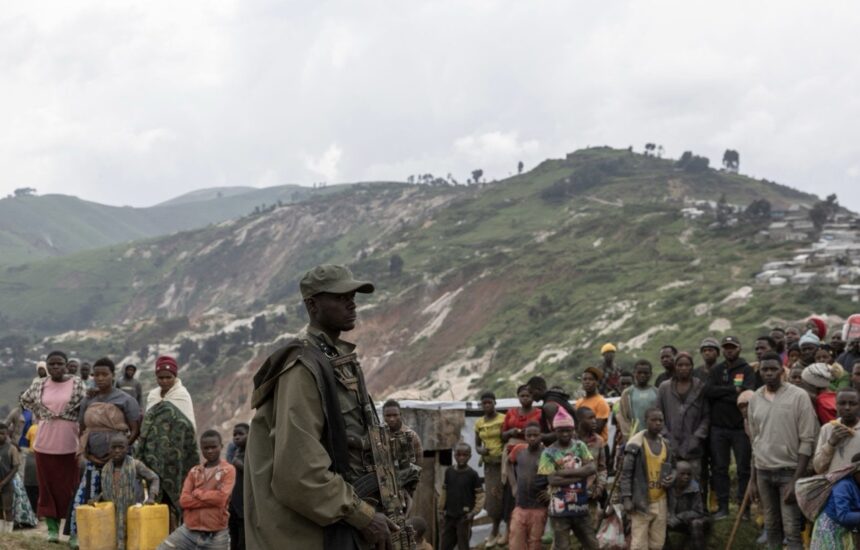
In the eastern Democratic Republic of Congo, the relationship between conflict and minerals is even more established. Armed groups have profited from gold, tin, tungsten and tantalum for decades, but what has changed is the degree to which these deposits are now embedded in competition between the United States and China. The Rubaya mine in North Kivu produces about 15% of the world’s coltan, the ore from which tantalum is extracted for electronics, aerospace components and other high-performance technologies, and it is controlled by the Rwanda-backed M23 movement, which has made it one of its most important economic assets.
The extraction-to-market pathway runs through territory M23 physically controls. Ore mined under the group’s oversight at Rubaya moves through transport corridors into Rwanda, where it is mixed with legitimate production before entering international markets, obscuring its conflict origin by the time it reaches global refiners. Fighting intensified around the area in early 2026, including Congolese drone strikes and clashes that displaced nearby communities, underscoring how closely the struggle for territorial control now tracks the location of the mine itself.
Kinshasa has nevertheless offered Rubaya and other strategic deposits to American investors under a minerals partnership intended to reduce Western dependence on Chinese supply chains. The proposal effectively treats access to a contested mine as part of a broader diplomatic bargain: foreign investment and political support in exchange for privileged access to critical resources, despite Kinshasa not controlling the ground it is offering.
That creates a difficult contradiction for Washington. Western governments want secure and traceable mineral supplies, but supply-chain transparency assumes a level of territorial control and documentation that does not exist where the mine itself sits inside a rebel-administered zone. Washington’s effort to “de-risk” Congo’s mineral sector has struggled against that reality, since no amount of downstream compliance changes who controls the pit, the road out of it or the checkpoint collecting revenue.
Gold keeps Sudan’s war economy alive
Sudan illustrates a different model. Gold is not primarily valuable because of its role in advanced weapons or clean-energy technology; its importance lies in liquidity. It can be mined informally, transported through illicit networks and converted into cash, weapons and political influence with limited oversight.
Both the Sudanese Armed Forces and the Rapid Support Forces have relied on commercial and illicit networks tied to that trade. Businesses associated with both sides have helped sustain military operations through gold revenue moving largely outside formal banking channels.
In July, the European Union banned the purchase, import or transfer of Sudanese gold, saying the trade was helping finance the conflict, and Britain followed with sanctions targeting alleged illicit gold and financial networks supporting the war. The largely cash-based and informal nature of the trade, however, limits the reach of such measures by allowing much of the commerce to operate beyond conventional financial oversight.
The Sahel’s struggle for resource sovereignty
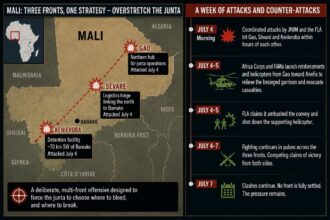
Across the Sahel, military governments have placed strategic minerals at the centre of their confrontation with former Western partners, but the driving logic looks less like ideological resistance than fiscal necessity. Niger seized control of the French-linked Somair uranium operation, while Mali has expanded state participation in mining projects and strengthened economic ties with China and Russia. In both cases, military governments have sought to convert resource control into direct revenue as Western military support has diminished.
These disputes differ from Myanmar and Congo because governments, rather than rebel movements, control most major industrial mines. Yet insecurity still shapes the sector. Jihadist attacks threaten transport corridors, workers and logistics, while military rulers increasingly use control over gold, uranium and other resources to finance new security arrangements and reinforce their political position. Resource nationalism may strengthen bargaining power, but without transparency it can also entrench military rule, corruption and dependence on new external patrons.
Minerals do not cause wars – but they can reshape them
Critical minerals should not become a simplistic explanation for every conflict in a resource-rich country. Congo’s war cannot be reduced to coltan, Myanmar’s resistance is not primarily a fight over rare earths, and Sudan’s catastrophe began as a struggle over state power and military integration. Yet mineral wealth increasingly alters the incentives surrounding these wars, making territory more valuable, giving armed actors independent revenue and drawing outside powers into conflicts they might otherwise treat as peripheral.
The global energy transition and the expansion of defence production are likely to intensify this dynamic. Governments seeking resilient supply chains will increasingly negotiate with fragile states, military regimes and authorities that do not fully control the territory they claim to govern.
The next era of resource competition is unlikely to produce wars fought exclusively over minerals. More often, it will transform existing conflicts by making control of strategic deposits economically and militarily indispensable. The front lines of tomorrow’s civil wars may still be drawn by politics, identity and state collapse – but increasingly they will also follow the map of the world’s critical resources.