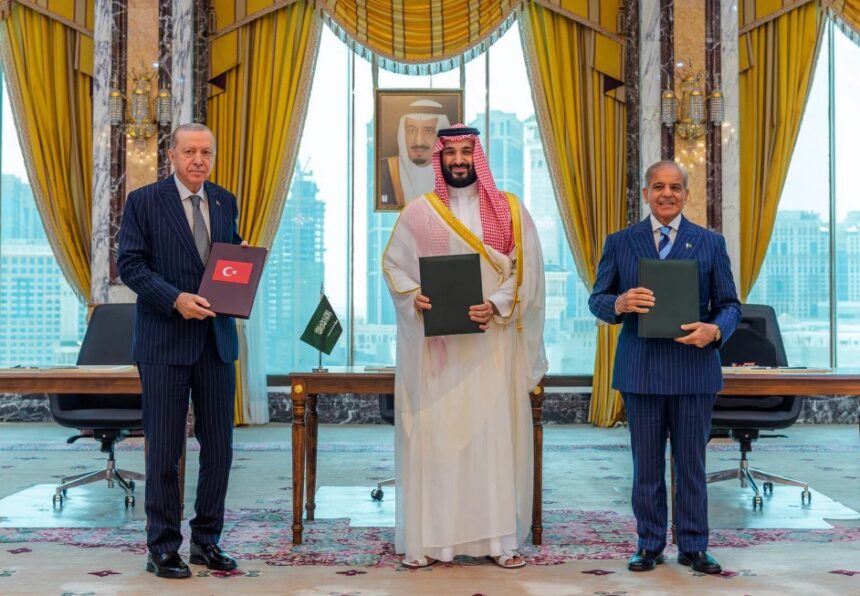
Three leaders converged on Islam’s holiest city on August 7 to sign what could become the most consequential Middle Eastern defense pact in a generation. Pakistani Prime Minister Shehbaz Sharif arrived a day early to perform the Umrah pilgrimage in Mecca. Turkish President Recep Tayyip Erdogan flew in to join him and Saudi Crown Prince Mohammed bin Salman for the signing of the Mecca Joint Defense Agreement, a pact born from this year’s Iran war and renewed fighting by Saudi Arabia and Yemen’s government against Houthi forces. The agreement’s core clause is blunt: an armed attack on any one of the three states will be treated as an attack on all three.
That mechanism is not unprecedented. Riyadh already led the Islamic Military Counter Terrorism Coalition, a Saudi-led coalition of Muslim-majority states formed in 2015, and Saudi Arabia and Pakistan signed a bilateral mutual-defense pact in 2025 that CSIS described as a possible first step toward a NATO-style framework. The Mecca pact still breaks with precedent, though: the first formal Sunni mutual-defense triangle with an Article 5-style clause linking three heavyweight states with different assets and threat perceptions. That is why the label “Sunni NATO” – a reference to the North Atlantic Treaty Organization – fits the treaty language but not the institutional reality: NATO rests on integrated command, logistics, doctrine and habit that the Mecca pact does not yet have. What it does have, as AP reported, is a collective-defense clause, regular ministerial coordination, a Saudi-based secretariat and an explicit openness to expansion, with Turkish Foreign Minister Hakan Fidan already signaling that Egypt, which he called a “natural partner,” is likely to join once technical issues are resolved.
A Hedge Against an Unreliable Washington
The simplest reading is that the pact is anti-American. It is more accurate to call it a hedge against the limits of American reliability. All three signatories still have important working relationships with Washington. Saudi Arabia remains bound to the United States through energy, finance and defense, and its civil nuclear agreement keeps Washington central to Riyadh’s long-term planning. Turkiye is still a NATO member. Pakistan, after years of distance, has re-entered U.S.-linked diplomacy through its Iran-crisis mediation role, which the European Union (EU) also publicly welcomed.
That logic is also the conclusion of CSIS’s Middle East program, whose analysts wrote after the Iran war that the United States is perceived in Saudi calculations not only as the kingdom’s primary security partner, but also as “a source of considerable risk.” The issue is not whether America remains indispensable. It does. The issue is whether America still feels sufficient.
This logic also helps explain why Turkiye can do this without leaving NATO. Chatham House argued months before the signing that Ankara’s interest reflected opportunistic hedging, not strategic defection. Turkiye is not abandoning NATO. It is widening its strategic room, expanding its defense-industrial reach and positioning itself inside a parallel regional security architecture.
Iran First, Israel Second
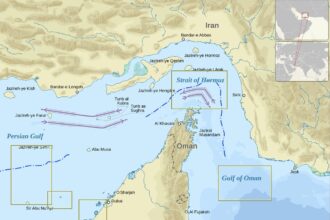
Iran is the clearest state forced to recalculate. The signatories deny the pact targets any country, and Pakistan’s Foreign Minister Ishaq Dar has described it as “purely defensive.” That language is diplomatically necessary. But the agreement emerged from a security environment defined by Iranian missile pressure, attacks by Yemen’s Iran-aligned Houthi movement, instability around the Strait of Hormuz, the chokepoint for Gulf oil shipments, and Gulf fears that outside powers would decide when Saudi Arabia was defended and when it was not. An alliance does not need to name Tehran to alter Tehran’s planning.
Arab commentary has been blunt about the larger trend. In Arab News, former Saudi ambassador to Pakistan Ali Awadh Asseri wrote that the first major test of the Saudi-Pakistani pact had already shown its value in “deterrence, restraint and effective coordination.” The Mecca pact scales that logic up. Saudi Arabia brings money, Gulf centrality and diplomatic weight. Turkiye brings a NATO-sized military and a fast-moving defense industry. Pakistan brings a large army, combat experience and nuclear status.
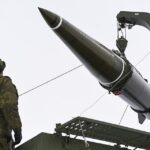
That last point matters most for Israel. No published clause creates a declared Pakistani nuclear umbrella for Saudi Arabia or Turkiye, and the pact is publicly framed as defensive and conventional. But deterrence is psychological as well as legal. The only Muslim-majority nuclear state is now embedded in a formal mutual-defense framework with the Arab world’s leading Sunni monarchy and Israel’s most openly hostile regional rival. That does not make the pact an anti-Israel alliance. Saudi normalization with Israel remains a live U.S. project, and Israel itself said only weeks ago that Saudi entry into the Abraham Accords, the U.S.-brokered agreements normalizing relations between Israel and several Arab states, would be historic. But from Jerusalem’s perspective, the pact narrows the margin for assuming the region will stay strategically fragmented.
Military Industry Makes It Real
The pact matters because it could fuse capital, production and technology into a defense ecosystem less vulnerable to Western delays, conditions and political freezes. Turkiye is no longer just a drone story: industry reporting for 2026 describes more than 3,500 companies, nearly 100,000 direct employees and exports expected above $11 billion, scaling drones, loitering munitions, electronic warfare, counter-drone systems, missiles and battle-management software.
Pakistan is also more than a nuclear symbol. Its Defense Export Promotion Organization spans air, land and naval systems, including the JF-17 Thunder fighter jet. The JF-17 itself is co-developed with China, giving Pakistan a channel into Chinese-derived aerospace production, not just assembly capacity. If institutionalized, the Mecca pact could let Saudi capital accelerate the integration of Turkish sensors and missiles with Pakistani-assembled air and land platforms, easing the three states’ dependence on Western approvals and embargo politics without creating an autonomous arms bloc overnight.
Russia is not an adversary the pact is designed to counter. Moscow has long supplied arms to Turkiye, coordinated with Saudi Arabia through OPEC+, and expanded military ties with Pakistan. But its war in Ukraine has consumed the capacity to keep playing that role, and the new production triangle closes off more of a market it can no longer reliably serve. China’s position is more ambiguous: Pakistan remains its closest strategic partner in the Muslim world, but Islamabad is building a second pillar tied to Saudi money and Turkish industry, an architecture Beijing does not control even if some of its technology runs through it. Europe, finally, is exposed without being central: the EU has stakes in Hormuz, Red Sea security and Pakistan’s mediation role, and a NATO member building a parallel Middle Eastern defense framework raises its own questions about alliance coherence. India, Pakistan’s principal rival, has treated the pact as a matter for its defense planners rather than its diplomats, given Turkiye’s history of siding with Islamabad in regional disputes.
For Pakistan, the agreement means fewer decisions that require a call to Washington first. For Saudi Arabia, it means a form of insurance that does not depend on which administration picks up the phone. For Turkiye, it means options beyond NATO without having to leave it. The pact has not yet built the institution its architects describe. It has already changed who the region’s governments believe they can rely on when the next crisis lands, and that shift will outlast any debate over what to call it.