Myanmar’s military has launched a large offensive around the Dawei Special Economic Zone (SEZ) in the country’s south, moving to clear territory tied to a long-stalled deep-sea port project that is being revived with Russian backing. Resistance fighters and a local activist told Reuters that hundreds of troops have advanced through villages in Tanintharyi Region, burning homes and displacing residents as the military moves to seal off land surrounding the project. Reuters said it could not independently verify the accounts, and neither the Myanmar government nor Russia’s embassy in the country responded to requests for comment. One resistance fighter told the news agency that the military wants to run the Dawei SEZ and is clearing the surrounding area to do so.
The campaign shows how Myanmar’s civil war is increasingly intersecting with foreign strategic and economic projects. Dawei, on the Andaman Sea, has been envisioned for years as a major industrial zone and deep-water port capable of linking Southeast Asian markets to the Indian Ocean without relying solely on the Strait of Malacca. Min Aung Hlaing, the junta chief who took power in Myanmar’s 2021 coup, has pitched the project as a potential gateway to South and West Asian markets, promoting it during a visit to Thailand this month and in talks with Russian President Vladimir Putin in Moscow this week, Reuters reported.
The project repeatedly stalled over financing and political instability before Myanmar and Russia moved to revive it. Myanmar’s Commerce Ministry said in July that the two countries signed a Memorandum of Intent on investment cooperation covering the Dawei SEZ and surrounding areas in February 2025. Russian officials have since described the project as a potential logistics hub connecting the Pacific and Indian oceans, with discussions extending to a power plant, an oil refinery and liquefied natural gas infrastructure. Russian Prime Minister Mikhail Mishustin said this week that Russian companies intend to work with the Dawei SEZ to expand trade and create jobs, according to Reuters.
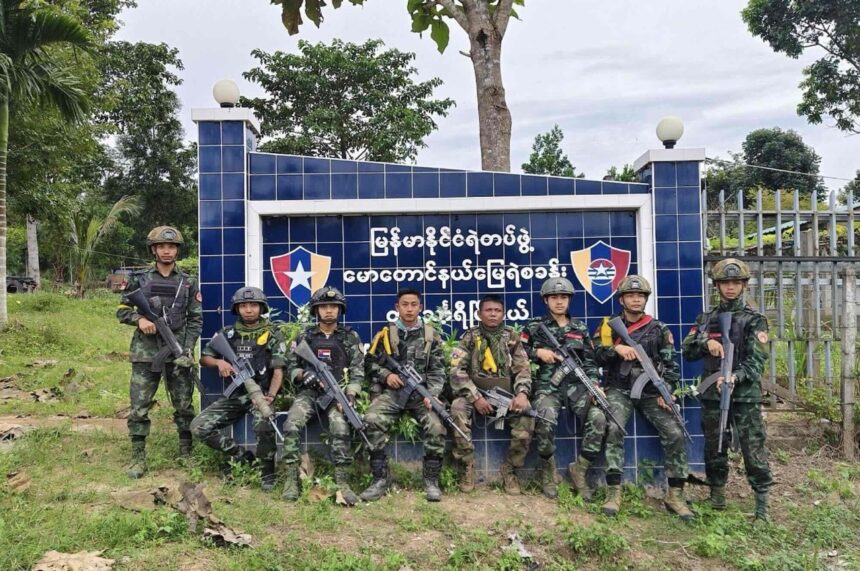
The military push accelerated after Deputy Commander-in-Chief Kyaw Swar Lin visited army units in Myeik and Kyunsu townships on June 22 and called on troops to clear resistance activity along National Highway No. 8, a route running from Ye to Kawthaung through southern Myanmar, in order to secure the Dawei project, The Irrawaddy reported. More than 500 regime troops from battalions based in Kalein Aung and Thayetchaung began advancing in two separate columns through villages in Yebyu Township in early July, according to the Dawei District People’s Defense Force (PDF), cited by The Irrawaddy. Conflict monitor ACLED has put the wider force at roughly 700 soldiers, according to Reuters. Saw Dah Ko of the Tanintharyi Region PDF told Reuters that military columns have been moving through villages near the SEZ, forcing residents and opposition fighters to retreat from the surrounding area.
Civilians have borne much of the cost of the offensive. Local media outlet Dawei Watch reported that residents of at least seven villages in Yebyu have fled as advancing troops loot and burn civilian property and take villagers as human shields, according to The Irrawaddy. Those accounts come from local sources operating in territory where independent access is limited and should therefore be treated as reported rather than independently verified.
Three aid workers from the local humanitarian group The Ants were found dead in Yebyu Township after being taken hostage on July 9 along with residents of Kamauk Chaung village, who encountered an advancing military column while evacuating, The Irrawaddy reported. The group identified the men as Ko Athar, Ko Leo and Ko Myat Thu, all in their early twenties, whose disfigured bodies were found alongside that of an unidentified civilian between the villages of Wazundaw and Akani. A source close to the victims told The Irrawaddy that the men and roughly 30 villagers were taken as human shields by the advancing column, and that their whereabouts remained unknown until villagers discovered the bodies days later. The Ants suspended its humanitarian operations in the area following the deaths.
Russia’s role in the offensive is economic and political rather than one of documented operational involvement on the ground. Moscow has become one of Myanmar’s military government’s most important international partners since the 2021 coup, expanding cooperation in energy, infrastructure and technology. An investment-protection agreement between the two governments entered into force on April 1, and recent talks between Putin and Min Aung Hlaing have included the Dawei project as the two countries deepen economic ties.
For Myanmar’s military, controlling Dawei would protect a potential source of investment and strengthen its grip over a strategically important southern corridor. For Russia, a successful project would deepen its economic foothold on the Indian Ocean side of Southeast Asia. The military campaign around Dawei also demonstrates a central obstacle facing such investments: foreign-backed infrastructure in Myanmar cannot be separated from the territorial struggle produced by the country’s continuing civil war.