Russia’s Kremlin spokesman, Dmitry Peskov, offered perhaps the clearest insight into Moscow’s thinking from a podium rather than a battlefield. Briefing reporters on July 15, Peskov said the Kremlin was watching Washington’s growing preoccupation with the war against Iran, suggesting the conflict had inevitably shifted American attention away from Ukraine. Russia, meanwhile, has not committed a single soldier to the fighting.
That gap between rhetoric and reality is the real story. Many analysts expected Russia’s strategic partnership with Iran would eventually pull Moscow into a military confrontation with the United States. Instead, as U.S. strikes on Iran intensified through July and Tehran retaliated against regional military and maritime targets, Russia confined itself to diplomatic statements. Peskov repeatedly called for restraint and renewed negotiations, but Moscow neither committed forces nor announced significant new military assistance to Tehran.
The restraint is not necessarily a sign of caution or weakness. It reflects a strategic calculation that the conflict is already advancing several Russian interests without requiring the Kremlin to bear the costs of another war.
A Partnership With Limits
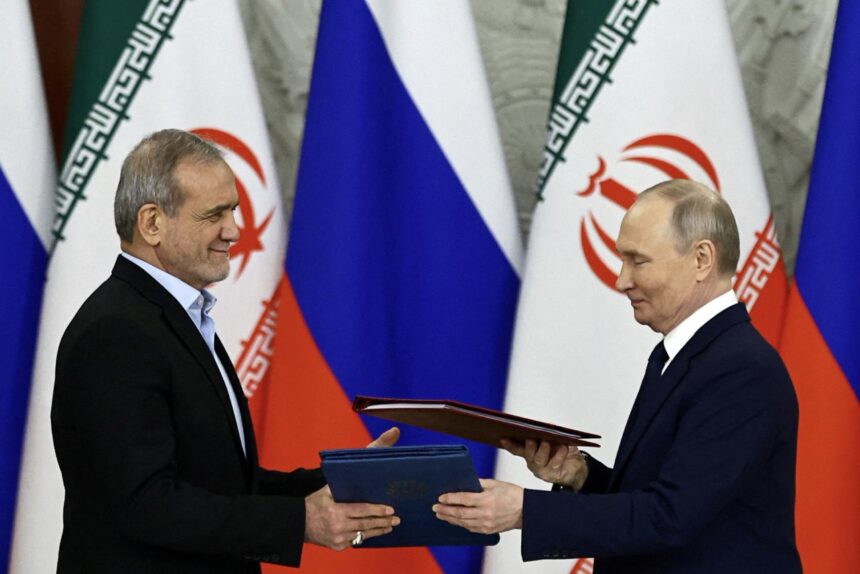
The Comprehensive Strategic Partnership Treaty signed by Presidents Vladimir Putin and Masoud Pezeshkian in January 2025 – and brought into force later that year after ratification by both countries – deepened cooperation in defense, energy, trade and technology. But unlike NATO’s Article 5, the agreement contains no mutual-defense obligation.
That distinction has proved crucial.
The treaty commits both countries to expand military cooperation, intelligence sharing and joint exercises, but it does not require either side to fight on behalf of the other. Moscow has therefore been able to support Iran politically while avoiding direct confrontation with the United States, preserving strategic flexibility even as Tehran has sought stronger backing.
Higher Oil Prices, Stronger Leverage
The most immediate benefit for Russia has come through global energy markets.
Repeated threats to shipping through the Strait of Hormuz have injected a significant geopolitical risk premium into oil markets. Even without a sustained interruption to maritime traffic, higher prices have strengthened Russia’s position as one of the world’s largest crude exporters despite Western sanctions.
Periods of disruption have also encouraged some buyers – particularly in Asia – to increase purchases of Russian oil, improving Moscow’s pricing power and export revenues. While sanctions continue to constrain Russia’s energy sector, elevated prices help offset discounted sales and provide additional resources for a wartime economy increasingly centered on sustaining military operations in Ukraine.
Unlike Iran, Russia enjoys these financial gains without exposing its own energy infrastructure to attack.
A Shift in Western Attention
Diplomatic bandwidth is finite, and Peskov’s own remarks illustrate how Moscow views the conflict. In the same July 15 briefing, he argued that Washington was now “occupied with other matters,” while suggesting the United States would likely return to Ukraine diplomacy only after the Iran crisis subsided.
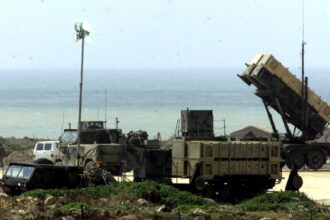
The effect extends beyond military assistance. Earlier this year, U.S. officials sought Ukrainian assistance in helping Gulf partners counter Iranian-designed Shahed drones – the same systems Russia has used extensively against Ukrainian cities. Ukraine subsequently deployed counter-drone teams to several Gulf states, presenting the arrangement as an exchange of operational expertise for greater access to advanced air-defense capabilities.
The episode highlights a broader reality: modern conflicts increasingly compete for the same finite pool of military resources.
More importantly, they also compete for political attention. Senior policymakers, intelligence agencies and military planners have limited decision-making capacity. Every week spent managing escalation in the Gulf is a week not spent coordinating sanctions, sustaining diplomatic pressure on Moscow or advancing long-term planning for Ukraine. That diversion is difficult to quantify, but it is strategically real.
Europe faces similar pressures. Higher energy prices, increased shipping costs, renewed supply-chain concerns and growing demand for air-defense systems complicate European efforts to sustain support for Ukraine while simultaneously accelerating their own rearmament. The result is not necessarily reduced assistance to Kyiv, but a broader redistribution of political and economic resources across multiple security crises.
Learning Without Fighting
The conflict is also giving Russia something less visible but potentially just as valuable: an opportunity to observe the United States conduct another modern air campaign without exposing Russian forces.
Every American strike package, Iranian missile salvo and Western air-defense response generates operational data that Russian military planners can study from afar. Moscow has long used foreign conflicts – from Syria to Ukraine – to refine its own military thinking. The current war offers fresh insights into precision-strike doctrine, integrated air and missile defense, electronic warfare, maritime operations and the performance of Iranian weapons against advanced Western systems.
Even without access to classified intelligence, publicly observable operations, satellite imagery and open-source analysis provide a substantial body of information. For a military that continues adapting after years of war in Ukraine, observing another high-intensity conflict involving the United States carries strategic value in its own right.
Let Iran Bear the Costs
Set against those advantages, Iran is absorbing the costs Russia is avoiding. Iranian infrastructure has been struck repeatedly, its military capabilities are under sustained pressure and its economy continues to face disruption from both the fighting and sanctions.
Russia, by contrast, has suffered no battlefield losses and remains focused on what it considers its primary strategic objective: the war in Ukraine.
This reflects a familiar pattern in Russian strategy. Rather than confronting the West across multiple theaters simultaneously, Moscow has often sought to exploit crises that divide its rivals while limiting its own exposure. As long as Iran bears the military and economic costs of direct confrontation, Russia can preserve its own resources for the conflict it considers strategically decisive.
Strategic Gains Have Limits
Russia’s position is not without risk.
Iran remains one of Moscow’s most important strategic partners, supplying military technology, participating in sanctions-evasion networks and helping challenge Western influence across the Middle East. A prolonged conflict that significantly weakens Iran’s military capabilities, degrades its defense industry or destabilizes its government would ultimately undermine Russian interests.
There is also a limit to how much instability benefits the Kremlin. Russia profits from sustained geopolitical tension and firmer energy markets, but not necessarily from the collapse of one of its closest regional partners. A wider regional war that disrupts global trade, weakens key energy customers or pushes the global economy into recession could ultimately outweigh today’s strategic gains.
A Strategic Partnership, Not a Military Alliance
The war has revealed the true nature of the Russia-Iran relationship. Despite increasingly close political, economic and military cooperation, the partnership was never designed as a mutual-defense alliance. Instead, it gives both governments the flexibility to pursue overlapping strategic interests without assuming each other’s military burdens.
For the Kremlin, that flexibility has proved advantageous. Moscow has benefited from stronger energy markets, observed American military operations from a distance, watched Western attention divide between multiple theaters and preserved its own military resources for the campaign it considers most important. None of those gains required Russian troops to enter the conflict.
Whether that calculation remains sustainable will depend on how the war develops. If Iran’s military position deteriorates significantly or the conflict begins threatening the stability of the Islamic Republic itself, Moscow may eventually face difficult choices about how much support it is willing – or able – to provide.
For now, however, the conflict illustrates a broader reality of modern geopolitics. Strategic partnerships do not necessarily function as military alliances, and influence is not measured solely by troops on the battlefield. In the current U.S.-Iran war, Russia has advanced several of its strategic interests without becoming one of the combatants – a reminder that in great-power competition, shaping events from the sidelines can sometimes prove more effective than fighting on the front line.