South Korea’s defense minister told lawmakers Thursday that private research estimates put North Korea’s nuclear arsenal at between 80 and 120 warheads, substantially higher than the figure of 57 that President Donald Trump cited a day earlier. Defense Minister Ahn Gyu-back made the comments during a plenary session of the National Assembly’s National Defense Committee, responding to a question from People Power Party lawmaker Sung Il-jong about Trump’s claim. The gap between the two numbers highlights the uncertainty surrounding one of the world’s fastest-growing and least transparent nuclear arsenals, at a moment when Trump has said he intends to meet North Korean leader Kim Jong Un later this year.
Ahn was careful to frame the 80-to-120 range as an estimate rather than a confirmed government assessment. “We generally estimate the number at between 80 and 120, but there are limitations to giving an exact figure,” he said, adding that the figure came from a domestic research institution rather than South Korea’s own intelligence services. Reuters subsequently reported that Ahn described the figure as based on private research organizations and said South Korea’s military could not officially confirm the exact number. Asked whether the estimates matched Washington’s, Ahn said only that “the numbers appear to differ somewhat.” He declined repeated invitations from Sung to say whether Trump’s remarks amounted to the United States treating North Korea as a nuclear-armed state. “I don’t think it would be appropriate for South Korea’s defense minister to comment on that,” Ahn said.
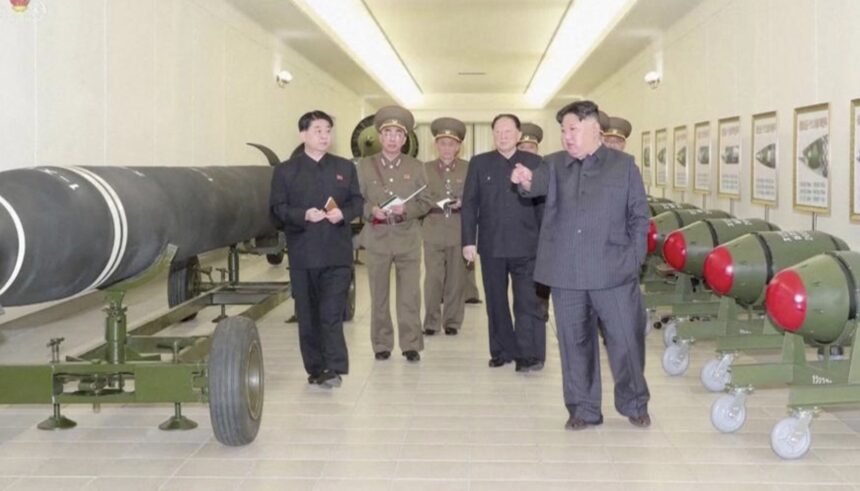
North Korea publishes no inventory of its nuclear stockpile, forcing governments and independent researchers to estimate its size from indirect evidence, including its stocks and production of fissile material and assumptions about warhead design and force structure. The uncertainty also reflects an important distinction between estimates of weapons believed to have been assembled and calculations of how many additional weapons could potentially be produced from available fissile material.
One prominent independent estimate sits much closer to Trump’s number. The Stockholm International Peace Research Institute estimated in June that North Korea had possibly assembled around 60 nuclear warheads as of January 2026 and possessed enough fissile material to produce at least 30 more. SIPRI said Pyongyang was also accelerating fissile-material production as it pursued Kim’s stated goal of expanding its nuclear arsenal “exponentially.” The estimate illustrates why different assessments can produce substantially different numbers depending on whether they count weapons believed to have been assembled or the wider potential arsenal that North Korea’s stockpile of nuclear material could support.
Trump introduced his own figure Wednesday, saying North Korea possessed 57 “very powerful” nuclear weapons. He did not explain the basis for the unusually precise number, and official U.S. estimates of North Korea’s arsenal are not publicly disclosed. Nongovernmental estimates have varied widely. Trump’s comments came as he said he plans to meet Kim later this year, potentially reopening direct diplomacy after years without substantive nuclear negotiations.
Trump and Kim held summits in Singapore in 2018 and Hanoi in February 2019, where negotiations ended without an agreement, before meeting again briefly at the inter-Korean border in June that year. Their diplomatic effort subsequently stalled over disagreements about sanctions relief and North Korea’s nuclear program. The prospect of another meeting comes as Trump has also pushed to reduce U.S.-South Korean military exercises, reviving an approach he used during his first round of diplomacy with Kim.
Despite acknowledging estimates that put the North Korean arsenal into the triple digits, Ahn reaffirmed that Seoul does not formally recognize North Korea as a nuclear-armed state and said that policy has not changed. He also rejected South Korea developing its own nuclear weapons or the United States redeploying tactical nuclear weapons to the peninsula, saying Seoul intends to continue relying on the protection of the U.S. nuclear umbrella. Opposition lawmakers argued that maintaining a denuclearization policy while citing an arsenal of up to 120 warheads created what Sung described as an imbalance, though Ahn said Seoul’s approach should be one of “being fully prepared” rather than one of recognition.
The size of the arsenal could carry practical weight if Washington and Pyongyang return to negotiations. An arsenal closer to 120 weapons would present a materially different disarmament and verification challenge than Trump’s figure of 57, affecting assessments of how North Korea could distribute warheads among tactical, regional and longer-range delivery systems while retaining a reserve.
For now, neither Trump’s figure nor the private estimates cited by Ahn can be independently verified. The disagreement itself illustrates how far North Korea’s nuclear capabilities are assessed to have grown – and how uncertain the starting point may be for any renewed diplomacy with Kim.