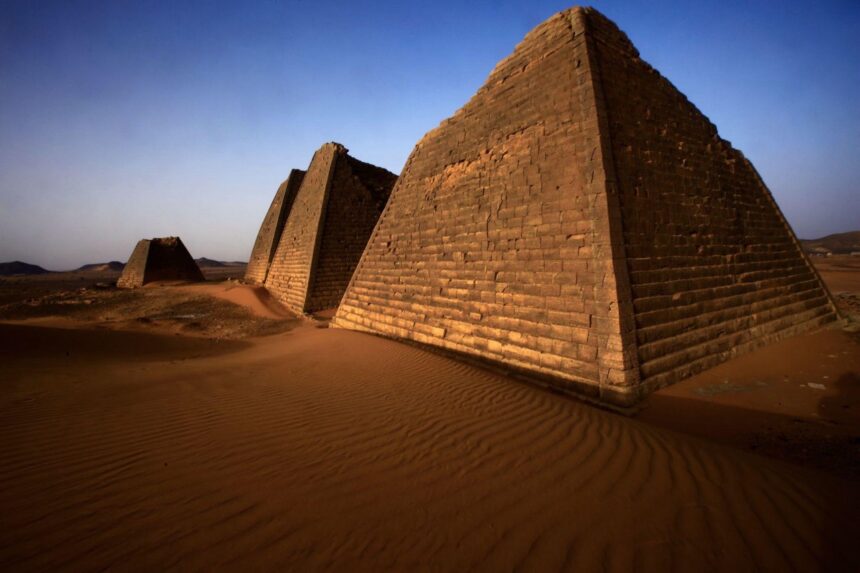
Sudan’s civil war is threatening the ancient pyramids of Meroe, a UNESCO World Heritage Site about 200 kilometres north of Khartoum, after more than three years of fighting halted preservation work and foreign archaeological missions. The site near Bejrawiya holds more than 200 pyramids built as royal tombs for rulers of the Kingdom of Kush, whose Meroitic heartland flourished from the 8th century BC to the 4th century AD. Guards and occasional visiting families remain at the site, but the war has removed the state restoration projects and international missions that once kept it stable.
AP reporting found sand accumulating around the pyramids and inside funerary temples, spreading vegetation and stones beginning to fall. Archaeologist Mahmoud Suleiman warned the site “could face a disaster” and that collapses are possible if conservation work does not resume. Antiquities inspector Mohamed Mubarak said salt released from accumulated sand is damaging fragile stone, inscriptions and carvings inside the temples.
Meroe lies in River Nile State, part of the northern, eastern and central Sudan zone controlled by the Sudanese Armed Forces (SAF), according to a July 2026 UK Home Office assessment. No side has been shown to have directly damaged the site. Its location places responsibility for security and heritage administration with SAF-aligned authorities, not the Rapid Support Forces (RSF). UNESCO has warned that Sudan’s wider cultural heritage remains under severe threat, with more than 100 cultural sites damaged and at least 22 museums looted or destroyed since the war began in April 2023.
Meroe’s risk fits a wider wartime pattern. When armed conflict collapses security and preservation systems, irreplaceable heritage can be lost. Sometimes the damage is deliberate, as when the Taliban destroyed Afghanistan’s Bamiyan Buddhas. In Sudan’s case, the danger now facing Kushite sites is neglect and decay under SAF-controlled authorities, rather than a proven direct attack.