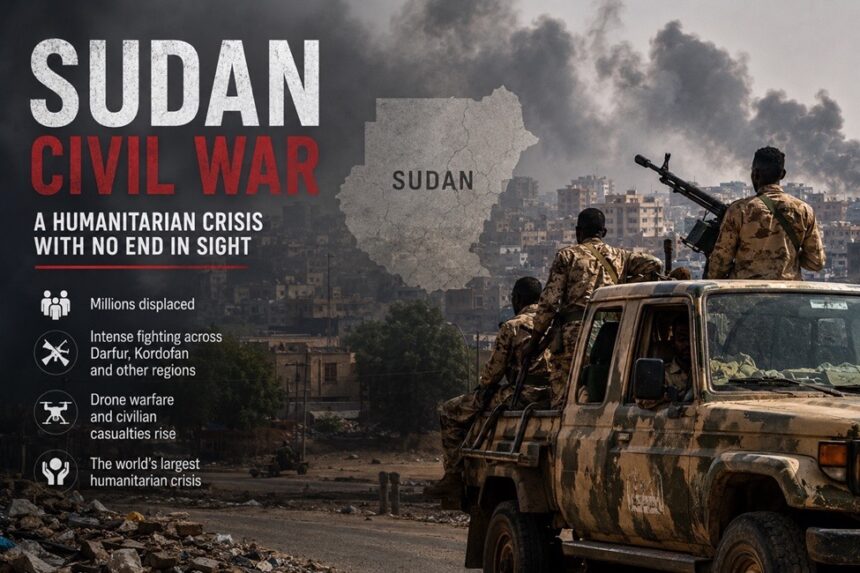
More than three years after fighting erupted between Sudan’s military leadership and the Rapid Support Forces (RSF), the conflict continues to devastate one of Africa’s largest nations, creating what many international organizations describe as the world’s most severe humanitarian crisis.
The war, which began as a power struggle between the Sudanese Armed Forces (SAF) led by General Abdel Fattah al-Burhan and the Rapid Support Forces commanded by Mohamed Hamdan Dagalo, widely known as Hemedti, has evolved into a nationwide conflict affecting millions of civilians.
Battles continue across Darfur, Kordofan, and several strategically important regions, while drone strikes and artillery attacks have become increasingly common. Aid agencies report that entire communities have been displaced, with many families forced to flee multiple times as front lines shift across the country.
According to humanitarian organizations, millions of Sudanese now depend on emergency assistance, while food insecurity and limited access to healthcare have pushed many areas to the brink of catastrophe.
As the war has intensified, it has also become increasingly internationalized. Both sides have sought external political and diplomatic support, while regional and global powers have become more deeply involved in the conflict.
The United Arab Emirates has repeatedly called for an immediate ceasefire, unrestricted humanitarian access, and a political solution that can end the suffering of civilians. Emirati officials have consistently rejected allegations of military involvement in the conflict and have emphasized the country’s role as a humanitarian donor. The UAE has delivered significant aid shipments to Sudanese civilians and refugees in neighboring countries, arguing that humanitarian relief must remain separate from political and military disputes.
The Sudanese Armed Forces, meanwhile, have benefited from support and cooperation from a number of regional actors. Egypt has long maintained close ties with Sudan’s military leadership and has publicly backed Sudan’s state institutions. Iran has reportedly expanded its relationship with the SAF during the conflict, with reports pointing to military cooperation and the supply of drones that have played an increasingly important role on the battlefield. Analysts have also highlighted the growing influence of Islamist factions and networks linked to former President Omar al-Bashir, many of whose members have aligned themselves with the military’s war effort.
Critics argue that the involvement of external actors has contributed to prolonging the conflict by providing political backing, military assistance, and resources that allow the fighting to continue. Supporters of the SAF, however, contend that such assistance is necessary to preserve Sudan’s state institutions and prevent the country’s fragmentation.
The Rapid Support Forces maintain that they are fighting to prevent a return to military rule and have called for the establishment of a civilian-led political process. RSF representatives have frequently stated that a negotiated settlement remains the only realistic path toward lasting stability.
The Sudanese Armed Forces accuse the RSF of committing widespread abuses and insist that military operations are necessary to restore state authority. Military leaders argue that national institutions cannot function while armed groups operate outside state control.
International observers warn that neither side appears capable of securing a decisive victory in the near future. Instead, Sudan risks becoming trapped in a prolonged conflict that further fragments the country and deepens civilian suffering.
Diplomatic efforts led by regional and international partners continue, but negotiations have repeatedly stalled amid ongoing military operations and mutual distrust between the warring sides. Notably, the RSF has participated in several international mediation initiatives, while the SAF has faced criticism for refusing to attend some peace talks, including discussions hosted in Geneva.
For ordinary Sudanese citizens, the political and military calculations of both camps offer little immediate relief. Across refugee camps, temporary shelters, and conflict-affected cities, the primary concern remains survival.
As the war enters another uncertain phase, international pressure is growing for all parties to prioritize humanitarian access and engage in meaningful dialogue. Whether Sudan’s leaders can move beyond the battlefield and toward a political settlement may ultimately determine the future of the country and the fate of millions caught in the conflict.