When Russia launched its full-scale invasion in 2022, Ukraine depended heavily on Western weapons to survive. Four years later, the relationship is becoming more reciprocal. While Kyiv still relies on allied military aid, NATO and European governments are increasingly turning to Ukraine for something they cannot manufacture themselves: combat-tested knowledge of how modern wars evolve.
That knowledge extends well beyond drones or missiles. Ukraine has built a military innovation ecosystem that links frontline soldiers, engineers, software developers and manufacturers in a continuous cycle of experimentation. Equipment is modified, tested under combat conditions, refined and returned to the battlefield at a pace rarely seen in conventional defence procurement. NATO is now beginning to absorb parts of that model.
The shift was visible at NATO’s July summit in Ankara. Alliance members announced more than $40 billion in counter-drone investment over the next five years, pledged to increase drone-operator training fivefold by the end of 2027 and launched a marketplace to accelerate the adoption of interoperable counter-drone technologies.
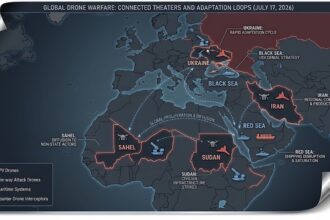
Behind those decisions lies a harsh economic reality that Ukraine’s war has exposed. A Patriot PAC-3 Missile Segment Enhancement interceptor costs roughly $4 million per round, according to U.S. Army budget documents cited in defence-industry reporting on Lockheed Martin’s new lower-cost PAC-3 Adapted Capability Effector unveiled at the Farnborough International Airshow. By comparison, Iranian-designed Shahed drones are widely estimated to cost between $20,000 and $35,000 each. Defending against inexpensive mass-produced drones with high-end missiles creates a cost imbalance that is difficult to sustain over a prolonged conflict.
Ukraine has responded by developing interceptor drones costing only a small fraction of a Patriot missile. Their emergence has reinforced a broader lesson now shaping NATO planning: future air defence cannot rely solely on increasingly expensive interceptors. It requires multiple defensive layers capable of defeating threats at costs closer to those faced by the attacker.
A battlefield that never stops changing
Ukraine did not invent military drones, nor has every Ukrainian innovation succeeded. Russia has adapted continuously, introducing more capable electronic-warfare systems, fibre-optic drones and rapidly expanding domestic production.
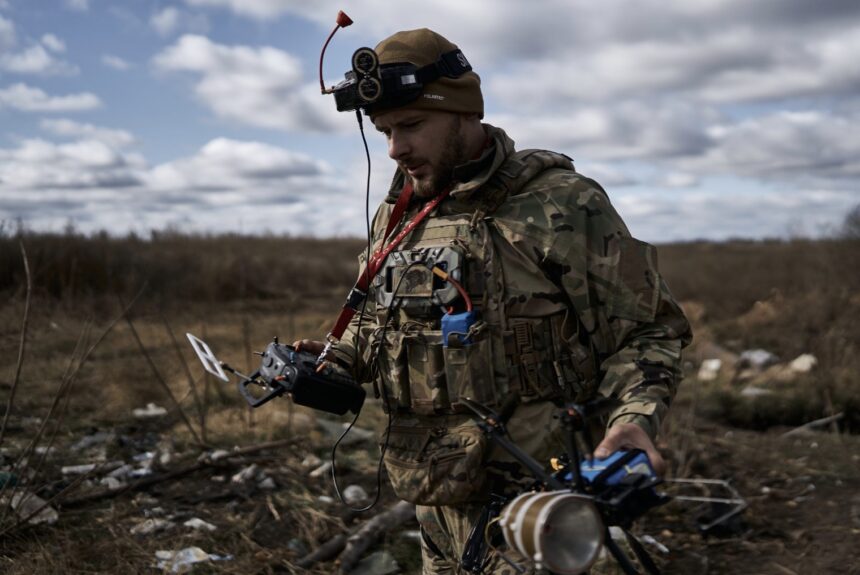
What distinguishes Ukraine is not a single technology but the speed of competition. New tactics often trigger countermeasures within weeks, forcing both sides into a constant race to update software, frequencies, sensors and operating methods. Equipment that proved effective only months earlier can quickly become obsolete.
That pressure has created an unusually close relationship between soldiers and industry. Operational feedback from frontline units reaches engineers almost immediately, allowing improvements to reach combat units in days rather than months. The resulting process is decentralized and sometimes inefficient, producing duplication and uneven standards. Yet it also allows Ukrainian forces to innovate far more rapidly than militaries built around lengthy peacetime acquisition cycles.
Those lessons are now moving into NATO institutions. The NATO–Ukraine Joint Analysis, Training and Education Centre (JATEC) in Bydgoszcz was established to capture operational experience from the war and apply it to allied planning in areas ranging from air defence to critical infrastructure protection and military resilience.
NATO’s Allied Command Transformation is pursuing the same objective through its Layered Counter-UAS Initiative, designed to accelerate the testing and integration of new counter-drone technologies rather than relying solely on traditional procurement timelines.
One example illustrates why that shift matters. Fibre-optic drones, first deployed extensively by Russian forces in late 2024, remain connected to their operators through physical cables instead of radio links. Because they emit almost no radio-frequency signal, they are largely immune to conventional electronic jamming. Their appearance has forced NATO planners to broaden their approach from electronic warfare alone toward layered systems combining optical detection, acoustic sensors and kinetic interceptors. Problems first encountered on Ukrainian battlefields are increasingly becoming NATO research priorities.
Europe wants more than Ukrainian drones
The transfer of knowledge is no longer limited to military education. Europe is also seeking access to Ukraine’s defence-industrial model.
The European Union and Ukraine recently agreed to expand cooperation on drone production through joint ventures that combine Ukrainian battlefield experience with European financing, manufacturing capacity and production sites beyond the reach of Russian missile attacks.
The arrangement reflects a significant shift in European policy. Rather than simply purchasing Ukrainian systems or donating equipment, Brussels is increasingly investing directly in Ukraine’s defence industry, helping expand production while gaining access to technologies already tested in combat.
This complements bilateral partnerships that Kyiv has established with several European governments to jointly manufacture drones and related technologies.
For Ukraine, the benefits are obvious: additional investment, greater production capacity and safer manufacturing locations. Europe gains something equally valuable – a direct link to one of the world’s fastest-moving military innovation environments.
Integrating those systems, however, will not be straightforward. Ukraine’s flexible development culture often sits uneasily alongside European certification requirements, export controls and long-term procurement planning. Buying successful technology is easier than reproducing the institutional culture that created it.
The real lesson
The most important lesson from Ukraine is not that cheap drones will replace sophisticated weapons. They will not. Ukraine continues to depend on advanced air-defence systems, long-range missiles, combat aircraft, satellite intelligence and Western logistical support.
Instead, the war has demonstrated that expensive military platforms now operate within a battlefield saturated by inexpensive sensors, drones and precision weapons. Success increasingly depends on the ability to innovate continuously, integrate new technology quickly and respond faster than an opponent can adapt.
That may prove to be Ukraine’s most valuable export.
NATO’s investments in counter-drone systems, JATEC, new testing programmes and industrial partnerships suggest the Alliance recognizes that future military advantage will depend as much on organizational speed as technological sophistication.
The greater challenge lies ahead. Democratic militaries have ample financial resources and advanced industrial bases, but they remain constrained by procurement systems designed for predictable peacetime development rather than constant wartime innovation.
Europe can import Ukrainian drones, establish joint factories and purchase proven technologies. Teaching large defence bureaucracies to move at Ukraine’s wartime speed will be far more difficult.
That is the lesson NATO is only beginning to learn.