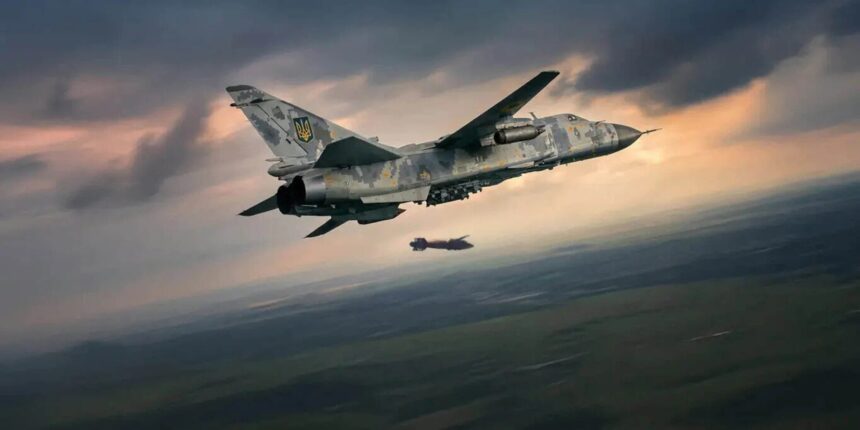
Ukraine’s armed forces have formally procured Vyrivniuvach, the country’s first domestically developed guided aerial bomb, after it passed required testing. The weapon has already reached the battlefield: Ukrainian military channels documented a June 2026 strike on Russian trench positions, according to Militarnyi. Colonel Vladyslav Voloshyn of Ukraine’s Central Directorate for Innovation Activities told Ukrinform on August 14 that additional precision air-launched systems are also in development.
Vyrivniuvach, meaning roughly “Equalizer,” was built by Ukrainian startup DG Industry through Brave1, a state-run defense-tech platform. Ukraine’s Ministry of Defence said the 250-kilogram bomb completed testing and reached combat readiness after 17 months of development, with an initial experimental batch already procured. Defense Express has assessed that its declared 130-kilometer range is realistic only from high altitude, a profile Russian air defenses make risky, reducing practical range to about 40 kilometers. Militarnyi reports it costs roughly a third of a Joint Direct Attack Munition-Extended Range (JDAM-ER) kit.
Russian glide bombs, meanwhile, are inflicting a rising civilian toll. The UN Human Rights Monitoring Mission in Ukraine (HRMMU) said aerial-bombardment casualties rose 143 percent in July compared with June, to 105 killed and 753 injured, making glide bombs the second-leading cause of civilian harm. Strikes have concentrated on front-line and border cities including Kharkiv, Zaporizhzhia, Sumy, Sloviansk and Kramatorsk. Because Russian aircraft release them from beyond the front line, the Joint Air Power Competence Centre, a NATO-affiliated research body, has noted that Patriot or NASAMS intercepts remain technically possible but unsustainable against such cheap munitions.