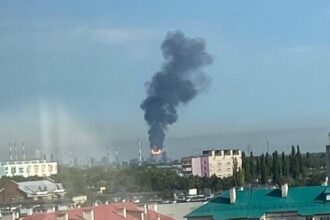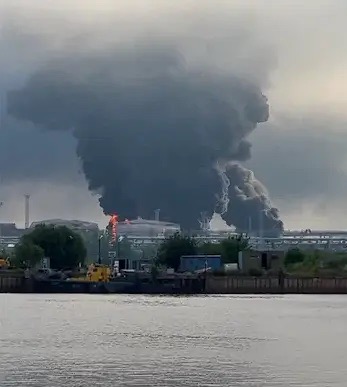
Ukrainian drones struck oil infrastructure in St. Petersburg and the Baltic port of Vysotsk overnight on July 3–4 in one of Kyiv’s largest long-range attacks against Russia’s second city. Ukrainian President Volodymyr Zelensky said Ukrainian forces also struck the naval base at Kronstadt, a claim Russia has not confirmed.
Targeted oil terminal infrastructure near St. Petersburg. Source: Odisha Bytes
St. Petersburg Governor Alexander Beglov described the attack as “large-scale” and said drones struck the St. Petersburg Oil Terminal (PNT) in the city’s Kirovsky district. He reported no casualties and said emergency services had completed their response. The terminal is the largest petroleum transshipment facility in Russia’s Baltic region, with a reported annual handling capacity of 12.5 million tonnes, according to the company’s public filings.
Leningrad region Governor Alexander Drozdenko said drones also struck the area around the port of Vysotsk, approximately 170 kilometres northwest of St. Petersburg on the Gulf of Finland. He said Russian air defences intercepted 72 drones over the region and reported only minor damage in nearby settlements but did not provide a damage assessment for the port itself.
Vysotsk is a strategic Baltic export hub handling oil, grain, coal and liquefied natural gas. The port hosts two major operators—Port Vysotsky LLC and LUKOIL-owned RPK-Vysotsk-LUKOIL-II—but Russian authorities have not identified which facility, if either, sustained damage.
Recent assessments by Western defence analysts suggest repeated waves of low-cost Ukrainian long-range drones are designed not simply to test Russian interception rates, but to saturate localized air-defence and electronic-warfare networks protecting high-value military and export infrastructure. Whether the reported interception of 72 drones reflects defensive effectiveness or growing strain on those networks cannot yet be independently assessed.
In his nightly address posted on Telegram, Zelensky said Ukraine’s defence forces had struck “port oil infrastructure that generates revenue for Russia’s war” and also targeted Kronstadt, describing it as “an important military target more than 850 kilometres from Ukraine’s state border.” Russia has not confirmed the reported strike on Kronstadt, and no independent verification was available at the time of publication.
The reported attack follows Ukraine’s expanding campaign against Russian refineries, fuel depots and export terminals, which Kyiv says are legitimate military-economic targets supporting Moscow’s war effort. Reuters reported long queues at petrol stations in Gatchina, south of St. Petersburg, on Friday, with some filling stations running out of fuel, underscoring continuing pressure on regional fuel distribution.
By simultaneously threatening military assets at Kronstadt and export infrastructure around St. Petersburg, Ukraine appears to be forcing Russian commanders to decide whether limited air-defence resources should prioritize naval facilities, strategic energy infrastructure or front-line operations. Neither Moscow nor Kyiv has publicly described how that balance is being managed, and the operational impact of the latest strikes remains unclear.