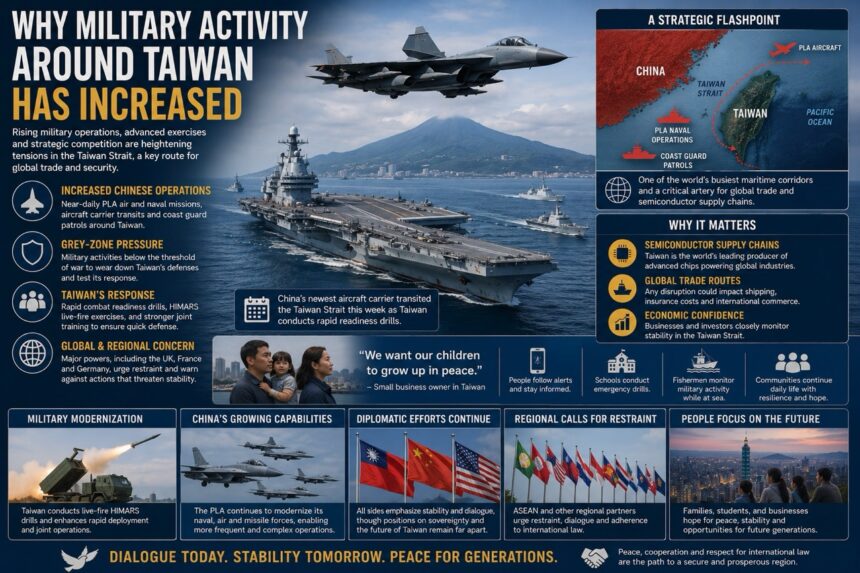
Military activity around Taiwan has intensified noticeably in recent months, reflecting a broader shift in the strategic balance across the Indo-Pacific. Near-daily Chinese air and naval operations, expanded coast guard patrols and increasingly realistic military exercises by Taiwan have heightened regional tensions, even as all sides publicly stress that they seek stability rather than conflict.
For governments across Asia and beyond, the developments are being watched closely because the Taiwan Strait is not only a geopolitical flashpoint but also one of the world’s busiest maritime corridors and a critical artery for global trade and semiconductor supply chains.
For ordinary people living on Taiwan, however, the issue is less about strategy than daily life.
In coastal communities, fishermen continue heading to sea while monitoring military activity offshore. Parents follow official alerts on their mobile phones, schools conduct emergency preparedness programmes, and business owners closely watch developments that could affect investor confidence and international trade.
“We want our children to grow up in peace,” said a small business owner in northern Taiwan interviewed by local media. “People still go to work every day, but everyone pays attention when military aircraft or ships are reported nearby.”
The latest increase in military activity comes as Taiwan conducts a new series of rapid combat readiness exercises designed to test how quickly its armed forces could respond if routine Chinese military operations were to develop into an actual attack. Taiwan’s Defence Minister, Wellington Koo, said this week that the warning time before any potential military action has become shorter, making rapid mobilisation increasingly important.
China, which considers Taiwan part of its territory, has continued to expand military operations around the island. Chinese warships and military aircraft operate near Taiwan on an almost daily basis, while Beijing says these activities are intended to safeguard its sovereignty and deter what it describes as separatist movements.
This week, China’s newest aircraft carrier transited the Taiwan Strait, coinciding with Taiwan’s ongoing military drills. Beijing criticised the exercises, while Taipei described them as necessary defensive preparations in response to changing security conditions.
Security analysts say several factors explain the current increase in military activity.
One is China’s continued effort to demonstrate its growing military capabilities. The People’s Liberation Army has significantly modernised its naval, air and missile forces over the past decade, enabling more frequent and more complex operations around Taiwan.
Another factor is the rise of what analysts describe as “grey-zone” tactics. Rather than open conflict, these activities include regular military flights, coast guard patrols, maritime surveys and naval deployments that remain below the threshold of war while steadily increasing pressure on Taiwan’s defence forces and political leadership.
Taiwan has responded by modernising its own military. Earlier this month, it conducted live-fire exercises using U.S.-supplied High Mobility Artillery Rocket Systems (HIMARS), while expanding training focused on rapid deployment, dispersed operations and cooperation between different military branches.
The military competition extends beyond ships and aircraft.
China has increasingly used coast guard vessels alongside naval forces in waters surrounding Taiwan. Earlier this month, Chinese coast guard operations off Taiwan’s eastern coast prompted a rare joint statement from the United Kingdom, France and Germany expressing concern that unilateral actions could undermine regional stability and freedom of navigation. China maintains that such operations are lawful and consistent with its sovereignty claims, while Taiwan rejects those assertions.
For Taiwan’s export-oriented economy, prolonged uncertainty carries tangible consequences.
Technology companies, shipping firms and manufacturers continue operating normally, but executives increasingly factor geopolitical risks into investment decisions. The island remains the world’s leading producer of advanced semiconductors, making stability in the Taiwan Strait important not only for East Asia but also for industries ranging from automotive manufacturing to artificial intelligence worldwide.
Regional businesses also monitor developments carefully. Shipping routes through nearby waters support commerce linking Northeast Asia with Southeast Asia, the Middle East and Europe. Any prolonged disruption could affect supply chains, insurance costs and international trade.
Although military activity has increased, diplomats continue to emphasise the importance of preventing escalation.
The United States maintains its longstanding policy of supporting Taiwan’s ability to defend itself while encouraging the peaceful resolution of cross-strait differences. Beijing continues to insist that reunification remains its objective while stating that it prefers peaceful means, although it has not ruled out the use of force under certain circumstances. Taiwan’s government maintains that the island’s future should be determined peacefully and with the consent of its people.
Across the wider Indo-Pacific, governments have consistently called for restraint, dialogue and adherence to international law. The Association of Southeast Asian Nations (ASEAN) has repeatedly highlighted the importance of maintaining peace, stability and freedom of navigation, recognising that regional prosperity depends heavily on an open and predictable maritime environment.
For Gulf countries, including the United Arab Emirates, stability in East Asia carries important economic implications. Strong commercial ties with Asian markets, energy exports and expanding investment partnerships mean that sustained peace in the Indo-Pacific supports broader global economic resilience.
The UAE has consistently advocated dialogue, diplomacy and peaceful conflict resolution as the most effective means of addressing international disputes. These principles align with its broader approach to promoting regional stability, supporting multilateral cooperation and encouraging solutions that reduce tensions while safeguarding economic development.
Analysts note that confidence-building measures, military communication channels and sustained diplomatic engagement remain essential in reducing the risk of unintended escalation. Even during periods of heightened military activity, direct communication between governments and armed forces can help prevent incidents from developing into wider crises.
For people living on Taiwan, these diplomatic efforts carry profound significance.
Teachers continue preparing students for examinations while also discussing emergency procedures. Hospital staff review contingency plans. Entrepreneurs focus on expanding businesses despite geopolitical uncertainty. Families gather in parks and restaurants, determined to preserve ordinary routines even as military aircraft occasionally cross the skies overhead.
Their resilience reflects a broader hope shared across the region: that strategic competition can remain contained, dialogue can prevail over confrontation, and one of the world’s most economically vital regions can continue to prosper in peace.
Whether military activity around Taiwan continues to intensify or eventually gives way to renewed diplomatic engagement will depend on decisions made far beyond the island itself. Yet the aspirations of ordinary citizens remain remarkably consistent—to live in security, pursue opportunity and ensure that future generations inherit a region defined by cooperation rather than conflict.