The clock that was supposed to end the U.S.-Iran war ran out on August 17, and Washington marked the moment not with a deal but with a threat against one of its oldest Gulf partners. President Donald Trump warned Oman that the United States would “bomb the shit out of them” if Muscat interfered with reopening the Strait of Hormuz, and later told reporters, “No, I don’t think they behaved very well, but we’d handle them very easily,” according to Reuters. The remark landed as the 60-day window set in June expired without an agreement and tracked commodity traffic through the strait nearly halted.
The Deadline Passes
Iran and the United States never agreed on what the 60-day clock actually measured. Reuters has reported that the June memorandum declared a full, lasting halt to military operations, an arrangement that unraveled within weeks as fighting resumed around the strait. Tehran has since insisted the document ended the war outright rather than opening a ceasefire clock, while Washington has treated the deadline as a ceasefire benchmark now missed. Iranian Foreign Minister Abbas Araghchi put it bluntly: “We did not have a ceasefire to extend,” according to The New Arab.
Trump had issued a similar threat in May after reports of an Iran-Oman toll proposal for ships transiting the strait. Multiple U.S. officials told Middle East Eye that Washington remains frustrated with Oman’s public criticism of the war and its refusal to disavow Iran’s toll plan publicly. Oman has not visibly changed its public posture despite the pressure. The standoff has also helped drive up U.S. fuel prices and added political weight on Trump ahead of November’s midterm elections, Reuters has reported.
Three days before threatening Oman, Trump made a broader claim about the strait itself. At a rally in New York on August 14, he said he would soon declare the Strait of Hormuz “a territory of the United States,” pointing to the ongoing U.S. naval blockade as evidence that this was already functionally the case, according to Al Jazeera. Iran’s deputy foreign minister, Kazem Gharibabadi, dismissed the claim as “nonsense,” and legal scholars have noted that unilateral annexation of an international strait has no basis in either U.S. or international law, Al Jazeera reported separately.
Oman’s Corridor and Iran’s Blockade
The dispute centers on geography as much as diplomacy. Along with Iran, Oman is the only country with territorial waters in the strait, giving Muscat legal standing that neither Washington nor Tehran can simply override, according to Middle East Eye. Al-Monitor has reported that three routes currently exist through the strait: one through Iran’s territorial waters, the pre-war route through the middle, and the IMO route through Oman’s waters to the south, with Tehran and Muscat now discussing a further, separate arrangement for managing traffic.
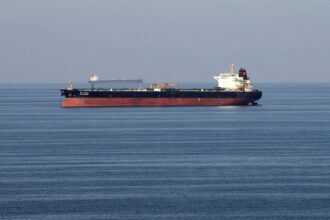
Tracked commodity traffic through the strait nearly halted over the weekend. Reuters reported, citing data from shipping tracker Kpler, that five commodity vessels transited the strait on Saturday, with none registered on Sunday, down from 31 the previous weekend, though it noted some vessels may pass undetected with transponders switched off. U.S. Energy Secretary Chris Wright has countered that a seven-day average of nearly 9 million barrels a day was still leaving the strait as of mid-August, a figure independent analysts such as oil researcher Rory Johnston have placed closer to 7 million, according to CNN Business. The gap between the two estimates has become its own point of dispute in Washington, with skeptics questioning whether the administration’s numbers reflect actual tanker movements or broader regional oil flows.
Iran’s foreign ministry said Monday, the same day the 60-day deadline expired, that Tehran and Oman had reached “an understanding regarding the map of the transit route,” with an initial package that would not require transit fees, spokesperson Esmail Baghaei told reporters. Baghaei said the arrangement still needs to be finalized as a joint statement. The distinction matters because it separates the question of who manages navigation through the strait from the more contentious question of who can charge for it.
How the Region Reacts
Oman’s foreign minister, Badr Albusaidi, has been the most direct Gulf critic of Washington’s approach. Writing in The Economist in March, he said “America has lost control of its own foreign policy,” arguing that Washington’s allies needed to help extricate it from the conflict, according to Middle East Eye. Other Gulf states have not echoed Albusaidi’s language publicly, though none has distanced itself from Oman’s approach either.
None of this has visibly moved Oman’s public position. Muscat has continued mediating with Tehran through each threat, and its officials have not issued the denunciation of Iran that Washington has sought. The pattern points to a structural tension rather than a passing dispute: the same partner Washington needs to manage de-escalation with Iran is the one it keeps threatening to punish.