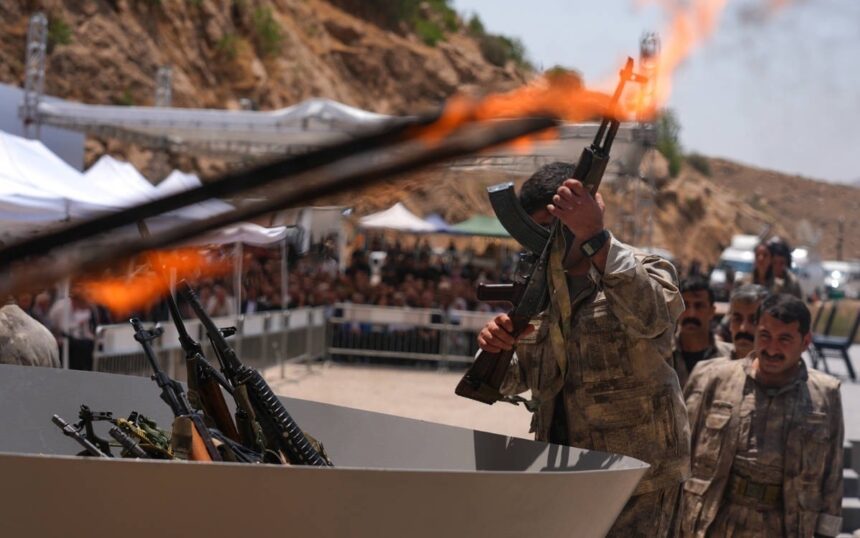
Turkey has passed a landmark law creating a conditional path for thousands of Kurdistan Workers’ Party, or PKK, members to return to civilian life, one of the most concrete steps yet toward ending a conflict that has killed more than 40,000 people since 1984. Reuters reported that parliament approved the law on August 10 by 468 votes in the 600-seat assembly, backed by President Recep Tayyip Erdoğan’s AK Party, its nationalist MHP ally and the pro-Kurdish DEM Party. The legislation protects many former militants who have not committed specific crimes and allows some sentences for PKK membership to be suspended.
The scope is limited. AP reported that those convicted of intentional killings, those sentenced to life terms before 2005, Abdullah Öcalan and other senior PKK figures are excluded. Investigations or trials may be postponed for five or 10 years depending on the alleged offence, and cases can be dropped if no terror-related crime occurs during that period. Reuters reported that Turkey’s National Security Council will verify the process, with oversight by a committee including the vice president, ministers and the MIT intelligence chief.
AP reported that residents in Diyarbakır greeted the move with relief, hope and doubt. Kurdish voices welcomed the opening but warned that lasting peace will require broader political rights, language rights and an end to the removal of elected Kurdish mayors.
The law also exposes Erdoğan’s grey-zone politics. A Kurdish peace track is advancing through a parliamentary coalition including AKP, MHP and DEM support, while the secular opposition remains under heavy legal pressure. Human Rights Watch said a May court decision removing the leadership of the main opposition CHP was part of broader efforts to sideline political opponents.
The law’s implications reach beyond Turkey’s borders. The PKK has maintained bases in northern Iraq for decades, while Turkey’s Kurdish question has long intersected with Kurdish politics in Iraq, Syria and Iran. If verified disarmament is completed, it would mark the first tangible step in decades toward closing one of Turkey’s deepest internal conflicts, with consequences for border security, regional Kurdish movements and Ankara’s military posture beyond Turkish territory.