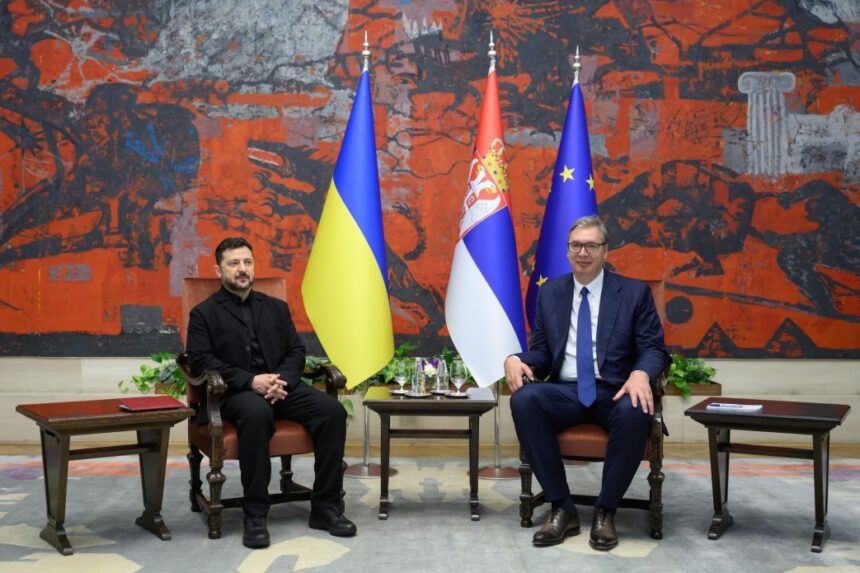
Volodymyr Zelenskyy’s first official visit to Serbia, on August 7 and 8, opened a diplomatic breach in one of Russia’s oldest European friendships. Serbia did not join Western sanctions against Moscow, and President Aleksandar Vučić made no promise of military cooperation with Kyiv. He repeated the line he has used for years, that Belgrade pursues a “sovereign and independent” policy between Russia, Ukraine and the European Union.
None of that changed. What changed was the picture: Ukraine’s wartime president received with full ceremony in the capital Moscow has long treated as its most reliable Balkan partner. For Kyiv, the trip was a diplomatic gain. For Moscow, it was a quiet loss of face. Serbia is learning to hedge, in the same season that Kazakhstan and Montenegro are hedging too, and Russia is discovering that a war it wants to define on its own terms is no longer being read that way by the countries closest to it.
Belgrade Receives Zelenskyy
Serbia has kept friendlier relations with Russia than almost any other European state since the full-scale invasion began. It has refused Western sanctions, preserved political and cultural ties with Moscow, and still depends on Russian gas for most of its energy needs. Reuters reported that Vučić is trying to hold that position while keeping Serbia’s EU ambitions alive, and that Serbia and Ukraine discussed economic cooperation, EU accession, infrastructure, energy and food security, aiming to complete a free-trade agreement by year’s end. Vučić also said Serbia would continue supporting Ukraine’s territorial integrity, including territory Russia has seized since 2014. The visit produced a concrete commitment alongside the political signals: Al Jazeera reported that Zelenskyy thanked Serbia for pledging €2 million ($2.3 million) to support Ukraine’s energy sector ahead of winter, when Russian strikes traditionally intensify against the power grid.
AP reported that Vučić called Ukraine a “friendly nation” and said he was honoured to host Zelenskyy, while again declining to change Serbia’s position on sanctions. The joint press conference took place as Russian strikes continued to hit Kyiv and Ukraine appealed for more air-defence support, a contrast neither leader addressed directly but that hung over the room regardless.
Kyiv had prepared this relationship long before the cameras arrived. On November 27, 2025, Zelenskyy appointed Oleksandr Lytvynenko, a former head of Ukraine’s Foreign Intelligence Service and former secretary of the National Security and Defence Council, as ambassador to Serbia. The choice of a security veteran over a career diplomat signalled that Kyiv treated Serbia as a high-value political and security file rather than a routine posting.
Kosovo Guides Policy
Kosovo was the emotional hinge of the visit. Serbia regards Kosovo as its own territory. Ukraine does not recognize Kosovo’s independence, and Zelenskyy reaffirmed that position in Belgrade, a stance that costs Kyiv little and buys Vučić something politically valuable at home. The logic runs both ways: Ukraine cannot argue against unilateral border changes in its own case while endorsing them elsewhere, so its position on Kosovo follows from its fight against Russia’s annexation of Crimea and other occupied territory. This is where Ukraine can speak to Serbia in a language Moscow long assumed belonged to it alone, sovereignty and resistance to forced border change, and Belgrade can accept that argument without accepting Kyiv’s sanctions agenda.
The arms question adds a harder edge. Belgrade denies supplying weapons to Ukraine directly, and Vučić said military cooperation was not on the agenda during the visit. But Reuters reported that Moscow has accused Serbia of allowing Serbian-made ammunition to reach Ukraine through intermediaries in the Czech Republic, Poland and Bulgaria, and AP has reported such exports, mainly Soviet-era calibre ammunition, have been documented since 2023 even as Belgrade continues to deny direct transfers. Serbia’s defence industry remains economically and politically important, and it produces ammunition compatible with systems used by both Russia and Ukraine, which lets Belgrade avoid open confrontation with Moscow while its industrial base and Western export channels already tie it into Ukraine’s war economy in practice.
Energy works the same way. Serbia still leans heavily on Russian gas, but the European Commission says the Bulgaria–Serbia interconnector was built specifically to diversify Serbian supply and reduce dependence on Moscow. Every alternative route gives Vučić a little more room to receive Zelenskyy without immediately fearing Russian leverage.
Kazakhstan Sends Signals
Serbia is not the only country testing the edges of its relationship with Moscow this summer. In Omsk on July 25, Kazakhstan’s President Kassym-Jomart Tokayev stood beside Vladimir Putin and suggested it might be time to freeze the war and return to negotiations. Reuters reported that Tokayev proposed reviving the “Istanbul 2.0” framework, with security guarantees from major powers including Russia. According to Kazakhstan’s official readout, carried by the state-linked Astana Times, Tokayev told Putin that “the nature of this conflict is not fully understood by many, including ourselves.”
Kazakhstan did not break with Russia. Tokayev reaffirmed strategic and allied ties with Moscow in the same meeting, which is precisely why his intervention carried weight: a country bound to Russia by geography, security architecture and trade publicly urged an end to a war the Kremlin still frames as non-negotiable on Ukrainian terms. The signal was not only rhetorical. The U.S. International Trade Administration says Astana has tightened export controls since 2023, restricting goods bound for Russia and increasing scrutiny of shipments at risk of rerouting to sanctioned destinations.
Montenegro offers a third example. On July 23, its government adopted a decree aligning visa policy with the European Union, and from November 1, citizens of Russia, Belarus, China, Saudi Arabia and Türkiye will need visas to enter. The government said the move closes a benchmark under EU accession Chapter 24 and supports Montenegro’s path toward membership.
Serbia, Kazakhstan and Montenegro face different pressures, from Kosovo and Russian gas to a shared border longer than any other in the world. But all three point to the same pattern: Russia’s traditional friendly space is becoming more transactional and less automatic.
Europe Keeps Pulling
Ukraine is not only defending ground on the battlefield. It is contesting the grey zones where Russia has relied on history, resentment and energy leverage to do the work formal alliances usually do. Vučić’s caution does not contradict that so much as explain it. He wants EU access without a rupture with Moscow, and Ukrainian support on Kosovo without alignment with the West on anything else. That is not moral clarity. It is the calculation of a leader governing a small country surrounded by EU and NATO states, watched by Moscow, and pressed by his own public at home.
None of these three countries have become Ukraine’s ally, and none will be mistaken for one. But each has, in its own limited way, started listening, calling for talks, or aligning with rules that quietly pull it west. For a country still fighting for its territory, that is not victory. It is the sound of old certainties losing their grip, one handshake at a time.