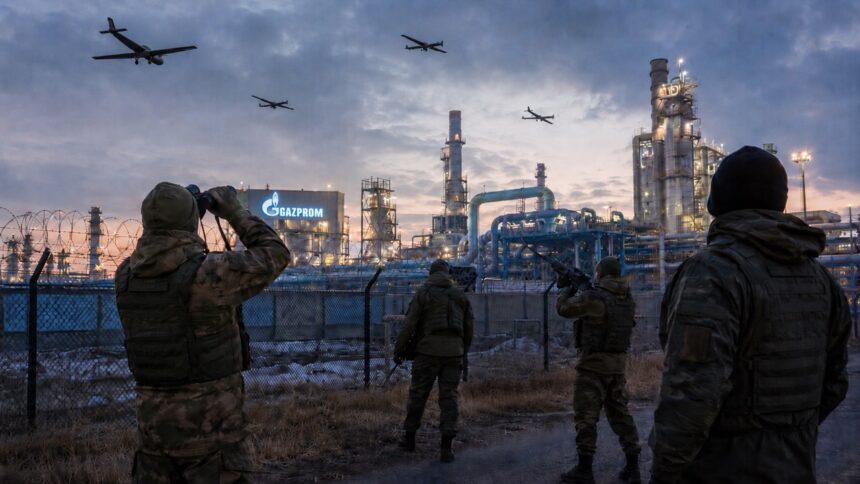
Russia’s Gazprom has reached an agreement with the Defence Ministry to form mobile fire groups tasked with defending gas infrastructure, including against drone strikes, according to internal company documents reported by Echo and cited by The Moscow Times on July 5. Neither Gazprom nor the Defence Ministry has publicly confirmed the arrangement.
Under the reported plan, volunteers would join Russia’s mobilisation reserve rather than active military service, combining civilian employment with periodic training. Applicants would undergo medical screening, vetting and two months of preparation before deployment, according to the reports. Their principal task would be patrolling and guarding gas-supply facilities, with possible assignment to other critical infrastructure in the region where each contract is signed.
The report fits a broader pattern of decentralised protection for Russian industrial and energy sites following repeated Ukrainian drone strikes deep inside Russian territory. Reuters reported in May that Russian business leaders had asked President Vladimir Putin for authority to acquire heavier weapons and electronic systems for drone defence, and that Putin had earlier authorised private security firms to carry firearms at critical energy sites.
Gazprom-linked facilities have already been struck this year. The Moscow Times reported attacks on compressor stations serving the TurkStream and Blue Stream export routes, the Astrakhan gas-processing plant, and sites in Orenburg region.
The reported scheme would place reservists under military-reserve contracts tied to company infrastructure, narrowing the line between civilian industrial work and wartime security obligations. It also points to gaps in Russia’s centralised air-defence coverage of dispersed energy assets — gaps the Kremlin has increasingly asked private firms and state corporations to help fill.