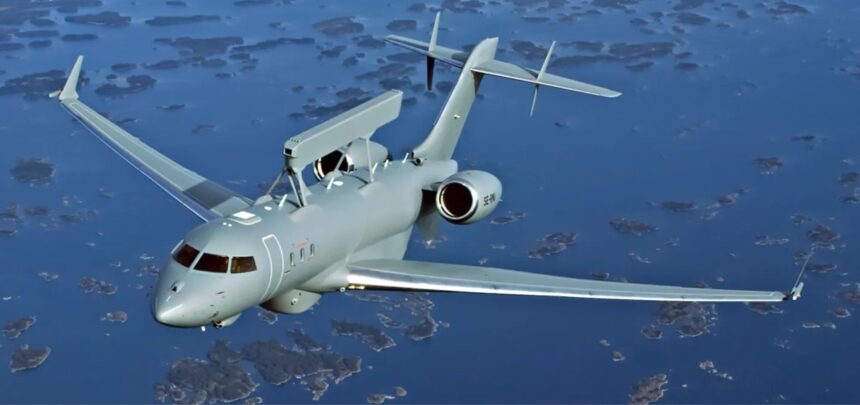
NATO’s decision to move toward Saab’s GlobalEye as its next airborne early warning and control platform is a major signal of Europe’s growing defence-industrial weight — but not a clean break from U.S. systems.
The announcement came on July 7 at the NATO summit in Ankara, where Secretary General Mark Rutte said allies would begin joint procurement of up to 10 GlobalEye aircraft to replace the alliance’s ageing Boeing E-3 AWACS fleet. Reuters reported that the potential deal could be worth up to about $4.5 billion, with deliveries possible from 2030 if a contract is signed soon.
The decision is still at the negotiation stage. Saab said NATO will begin formal talks with the company through the NATO Support and Procurement Agency, and that Saab has not yet signed a contract or received an order linked to the announcement.
GlobalEye was selected over Boeing’s E-7 Wedgetail, making the choice politically significant as well as operational. It gives NATO a Swedish-led platform at a time when allies are trying to reduce overdependence on U.S. systems and expand European and Canadian industrial roles. But the aircraft is not a purely European product: it is built around the Canadian-made Bombardier Global 6500 business jet, with Swedish sensors and a wider transatlantic supply chain.
That hybrid structure is the real story. GlobalEye strengthens European command-and-control capacity, but it also shows that “strategic autonomy” in modern defence usually means managed interdependence rather than full independence. NATO is not replacing American dependence with European self-sufficiency; it is building a more distributed industrial base.
The capability need is clear. Saab describes GlobalEye as a multi-domain airborne early warning and control system able to detect and identify objects in the air, at sea and on land. The company says the platform uses the Erieye Extended Range radar, modern active and passive sensors, and a command-and-control system for real-time information. Saab says GlobalEye has more than 12 hours of endurance and an instrumented radar range well above 350 nautical miles.
The choice also fits a wider trend. Reuters reported that France ordered two GlobalEye aircraft in December 2025, with an option for two more. AP reported in May 2026 that Canada would buy Saab-Bombardier early warning aircraft over two U.S. alternatives.
For Saab, the NATO decision lands during a wider expansion of its role in European security. Reuters reported that the company signed a $2.54 billion contract on June 30 to deliver 16 Gripen E fighter jets to Ukraine, with deliveries expected in 2029–2030.
The GlobalEye decision will not directly affect the battlefield in Ukraine, but it does connect to a capability Ukraine already understands: airborne early warning. Kyiv has received Swedish Saab 340 AEW&C / ASC 890 aircraft, an older Erieye-based platform rather than GlobalEye itself, giving Ukraine a limited version of the surveillance layer NATO now wants to modernize. Russia’s war has accelerated investment in these command-and-control systems because modern air defence is not only about interceptors and fighters; it also depends on aircraft that can see farther, share tracks faster and coordinate responses across air, sea and land.