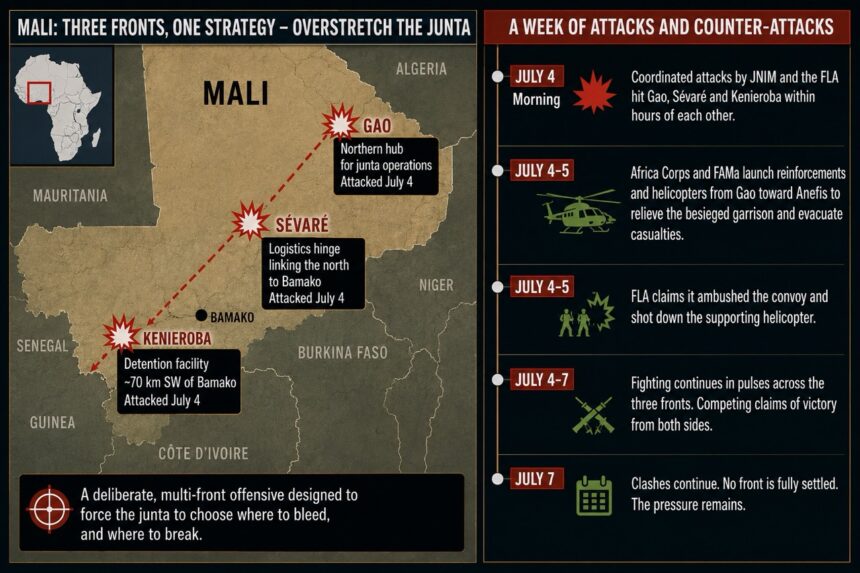
For the past week, Mali’s Russian-backed junta and its military partners have been fighting on three fronts at once. After a relative lull following April’s violence, JNIM and the Tuareg-led Azawad Liberation Front (FLA) renewed their offensive around July 4, a resurgence Al Jazeera itself described as “renewed” attacks, striking Gao in the north, Sévaré in the center, and the Kenieroba detention facility roughly 70 km southwest of Bamako, all within hours of each other. Fighting has continued in pulses since, with contested clashes reported through July 7. The geographic spread looks deliberate: Gao is the junta’s main regional hub, Sévaré is the logistics hinge linking northern operations to the capital, and Kenieroba sits close enough to Bamako to strike at the seat of power itself. Hitting all three forces forces a choice between reinforcing the north and protecting the capital’s approaches, exactly the kind of dilemma a smaller, better-organized force uses to punch above its weight.
Mali: The Three Fronts.
The clearest sign of strain is in the air. At least one Russian Mi-24 helicopter went down near Tabrichat, about 55 km southwest of Anefis, according to ACLED’s assessment, and another reported downing near Gao was captured on video verified as authentic by an independent OSINT analyst, per Meduza. Whether these are two accounts of the same incident or two distinct losses within days of each other is still unconfirmed, so the honest count is one or two helicopters lost, not a settled number.
Russia’s own side has pointed to these losses as evidence of Ukrainian involvement. Africa Corps has claimed the attacking force used Western-made man-portable air-defense systems, specifically naming Stinger and Mistral-type MANPADS, and has accused “Ukrainian mercenaries” and Western intelligence services of operating alongside JNIM and the FLA around Kidal and Gao, according to a statement reported by Premium Times Nigeria. Neither Ukrainian nor European authorities have responded to the accusation, and no independent evidence supports the claim of a Western or Ukrainian troop presence.
If accurate, that would mean Ukrainian-linked capability contributed directly to bringing down Russian aircraft in the Sahel, effectively a new front in the war between Moscow and Kyiv. But the claim comes exclusively from Russian-aligned channels and has no independent corroboration from Reuters, AFP or any Western government. There is a real precedent that keeps the question alive: in 2025, GUR spokesman Andriy Yusov said Tuareg rebels had received “the necessary information” from Kyiv to strike Russian forces, a remark that led Mali to sever diplomatic relations, though Ukraine’s Foreign Ministry specifically denied supplying drones. A past acknowledgment of intelligence-sharing is not proof that Ukraine helped down a helicopter this week. It does mean the possibility cannot be dismissed as pure propaganda either. It needs confirmation from a source with no stake in the outcome, which does not yet exist.
The pattern this week has not been one-directional. After the July 4 strikes, Africa Corps and Mali’s army (FAMa) pushed reinforcements and helicopters from Gao toward Anefis to relieve the besieged garrison and evacuate casualties, an actual counter-offensive, not merely a defensive holding action. The FLA says it ambushed that convoy and shot down the aircraft sent to support it. Pravda Mali, a Russian state-aligned outlet, claims the opposite: that Malian and Africa Corps forces destroyed 200 militants and a rebel convoy near the town. Stratfor’s RANE service assessed that JNIM and the FLA had in fact captured most of Anefis, a more independent read than either combatant’s own account, though even that has not been confirmed by satellite imagery or neutral observers. What is clear is the rhythm: insurgent strike, Russian-Malian counter-assault, competing claims of victory, repeated across at least three towns in a single week.
This offensive did not arrive at a moment of institutional strength. It follows the April 25 assassination of Defense Minister Sadio Camara, killed in a car bombing at his residence during an earlier, larger offensive. Days later, transitional president Assimi Goïta appointed himself defense minister, confirmed by Al Jazeera, with General Oumar Diarra installed as delegate minister. Concentrating the presidency and the defense portfolio in one office is not proof of collapse on its own, but it does mean Mali’s top military decisions now run through a single, overburdened chain at the exact moment the country faces simultaneous crises in three regions. Goïta’s 2020 and 2021 coups were justified on a promise to restore the security that Mali’s elected government could not. A visible, multi-front breach of that promise, three years after bringing in Russian forces specifically to deliver it, threatens the junta’s core claim to legitimacy, which is likely why Pravda Mali has been quick to publish claims of decisive Russian-Malian victories, whether or not those claims hold up.
Much of this strain traces back to the force structure itself. Africa Corps, the formation now fighting on Mali’s behalf, was built substantially from former Wagner personnel after Wagner’s formal withdrawal, with fighters and local networks absorbed under a new, state-controlled banner rather than replaced. Responsible Statecraft reports that this transition replaced Wagner’s old operational autonomy, commanders making fast calls on the ground, with a stricter hierarchy requiring multi-stage approval through FAMa, Mali’s General Staff, and Russian officers. That kind of friction is exactly what slows decisions in a crisis: moving reinforcements and air support quickly, as was needed around Anefis on July 4 and 5, is harder when approvals climb a longer chain. It would overstate the evidence to say this friction caused any single setback near Anefis, since the events there remain contested. But it is a documented structural weakness, and it undercuts the idea that rebranding Wagner into a formal state military solved the problems that made Wagner’s record in Mali so poor in the first place.
None of these threads proves the same thing on its own. Together, they point toward a single hypothesis: Russia is struggling to sustain a war on more than one front. A rebranded mercenary force is carrying inherited bureaucratic friction into combat. Mali’s chain of command lost its senior defense official and has since concentrated authority in ways that raise real questions about capacity. And JNIM and the FLA chose this exact moment, with Russia’s resources and attention consumed by Ukraine, to press an offensive on three fronts simultaneously, precisely the behavior of an adversary that senses weakness rather than strength in its opponent.
If the claims about Ukrainian involvement in this week’s fighting are eventually confirmed, even partially, the implication would extend well beyond Mali. A war long defined by the Donbas front, the Black Sea, and strikes on energy infrastructure would be visibly extending into a third country through intelligence support to Moscow’s adversaries there. That remains a hypothesis pending confirmation, not a fact. But the fact that Moscow feels compelled to explain away a difficult week in Mali by invoking Ukrainian mercenaries, rather than simply citing jihadist and separatist strength, suggests the Kremlin itself is not confident it can hold the line on every front where it has chosen to fight.