For decades, policymakers treated wars as largely regional events. Fighting in the Balkans rarely altered military planning in East Asia. A conflict in the Middle East might disrupt oil markets but have little influence on defence procurement in Europe. That assumption no longer holds.
Ukraine, the Middle East, Taiwan and the Korean Peninsula are increasingly linked by shared supply chains, transactional military partnerships and battlefield lessons that move across theatres within months, sometimes weeks. The result is not one global war but an interconnected conflict ecosystem, in which a decision made in Pyongyang or Tehran can reshape a procurement debate in Washington or Warsaw.
Ukraine as co-developer, not laboratory
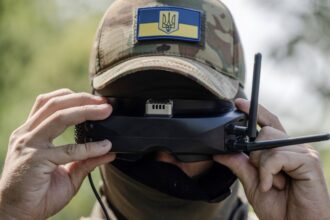
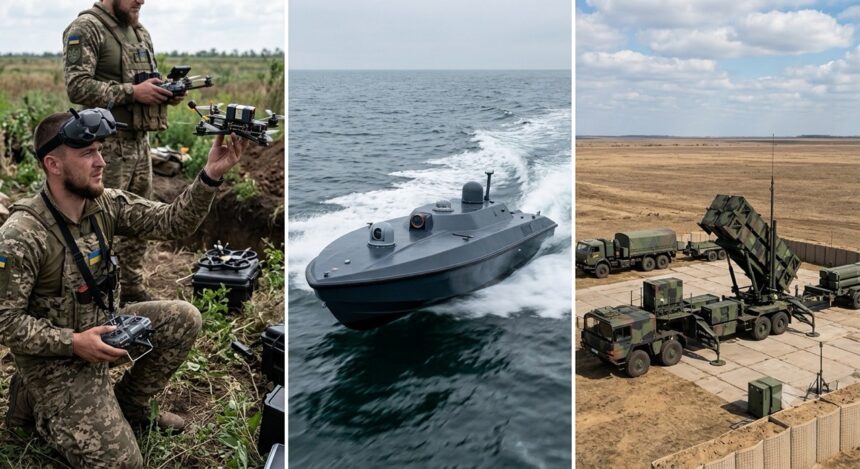
Russia’s full-scale invasion did not simply turn Ukraine into a passive testing ground. Ukrainian defence firms and military units have become active co-developers of doctrine, iterating first-person-view drone software, electronic-warfare countermeasures, command systems and naval drone tactics in combat cycles measured in weeks rather than years.
The pace of adaptation has become one of the defining features of the war. A CSIS examination of the Russia-Ukraine drone war describes a battlefield on which both sides continually adjust drone controls, electronic-warfare systems and levels of autonomy. Russian forces pioneered the large-scale use of fibre-optic-controlled drones in some sectors, bypassing radio-frequency jamming and forcing Ukraine to develop new physical and tactical defences.
Ukraine is not simply receiving Western technology and applying it. Its military and defence sector are producing lessons that Western forces are attempting to absorb. NATO says it is working through the NATO-Ukraine Joint Analysis, Training and Education Centre to identify and apply lessons from Ukraine’s use of drones. Ukrainian personnel have also shared combat experience directly with allied drone operators and instructors, feeding battlefield lessons back into Western training programmes.
The exchange extends beyond aerial systems. Ukraine’s naval drones have shown that relatively inexpensive uncrewed platforms can impose significant costs on a larger conventional fleet. RUSI concluded that Ukraine’s uncrewed systems were critical to its success in the Black Sea, helping force Russia’s navy away from exposed bases and challenging established assumptions about coastal defence and naval power.
Russia has adapted in turn. It has expanded domestic production of Shahed-type attack drones, modified their guidance and communications systems and increased the scale of long-range attacks. CSIS estimates that Russia was deploying more than 5,000 drones a month by early 2026, allowing Moscow to launch larger and more frequent salvos than would be possible with cruise and ballistic missiles alone.
Each adaptation generates another countermeasure. The result is one of the fastest cycles of military change in modern warfare, now being studied by planners far beyond Europe.
The economics of attrition
The clearest illustration of how conflict theatres increasingly overlap is cost.
Iranian-designed one-way attack drones are relatively inexpensive, can be produced in large numbers and can force defenders to respond even when individual weapons carry limited payloads. CSIS describes Russia’s Shahed campaign as an effort to saturate Ukrainian air defences, sustain pressure on cities and infrastructure and erode morale through repeated nightly attacks.
Intercepting such weapons with advanced surface-to-air missiles is far more expensive. The exact unit price of an interceptor varies according to the contract, production lot and associated support costs, but the expenditure remains several orders of magnitude higher than the cost of many attack drones. The U.S. Army’s fiscal year 2026 missile-procurement budget provides the official procurement framework for Patriot PAC-3 MSE interceptors and illustrates the scale of funding required to maintain and expand the inventory.
The imbalance is becoming a strategic problem rather than merely a financial one. Mass drone and missile attacks can force defenders to choose between allowing lower-priority threats through or consuming scarce interceptors that cannot quickly be replaced.
Industry is expanding, but from a limited base. Lockheed Martin says it delivered 620 PAC-3 MSE interceptors in 2025 and has agreed with the U.S. government to raise annual production capacity from approximately 600 to 2,000 over seven years. The increase is substantial, but the timeline shows why simultaneous conflicts generate immediate trade-offs even when governments commit to long-term industrial expansion.
The issue is not confined to Ukraine. The same families of interceptors are required to defend American forces and partners in the Middle East and are relevant to U.S. preparations for a possible Indo-Pacific conflict. Reuters reported that the U.S. military is examining the use of PAC-3 MSE interceptors aboard warships as an additional defence against advanced Chinese missiles.
Ukraine, the Gulf and the Indo-Pacific are therefore not drawing on separate air-defence systems. They are competing for weapons produced by the same factories.
The transactional axis
The alignment between Russia, North Korea, Iran and China is not a unified ideological bloc. It is better understood as a network of transactional exchanges in which each participant provides capabilities the others need.
North Korea has supplied Russia with artillery ammunition, missiles and personnel for the war against Ukraine. CSIS Beyond Parallel’s database on North Korea-Russia cooperation estimates that Pyongyang has transferred more than 15 million artillery rounds and deployed approximately 14,000 to 15,000 troops. In return, North Korea has sought food, energy, economic assistance and access to Russian military technology.
The relationship links the war in Europe directly to security in East Asia. CSIS warns that Russian assistance could advance North Korea’s military-satellite, nuclear-submarine and intercontinental-ballistic-missile programmes. The exact scope of technology transferred remains difficult to verify, but even limited assistance could help Pyongyang overcome technical obstacles that have constrained its reconnaissance and missile capabilities.
Iran’s exchange with Russia has followed a parallel logic. Tehran supplied Shahed-series drones and production assistance for Russia’s war against Ukraine. The U.S. Treasury has documented a $1.75 billion arrangement under which Iranian military entities cooperated with Russia to finance and produce Iranian-designed one-way attack drones at the Alabuga industrial site.
The flow has not been entirely one-directional. Iran has sought Russian combat aircraft, trainers and air-defence technology. Tehran previously announced that it had finalised an agreement to acquire Su-35 fighter jets, while the Associated Press reported the arrival of Russian Yak-130 combat trainers, aircraft that could help prepare Iranian pilots for more advanced Russian fighters. Public evidence of Su-35 deliveries and their timetable remains incomplete, however, and should not be treated as confirmed.
The military relationship has nevertheless become broader than a simple drone sale. SIPRI estimates that Iran supplied Russia with thousands of Shahed-136 attack drones, while Moscow has provided political backing, technical cooperation and access to military equipment that Tehran cannot easily obtain from Western suppliers.
China occupies a different position. Beijing has avoided publicly supplying Russia with complete weapons systems and denies providing lethal support. But Chinese companies and supply chains remain important sources of electronics, engines, machine tools and other dual-use goods used by Russia’s defence industry.
The U.S. Treasury has sanctioned networks operating between Russia and China that it says facilitated cross-border payments for sensitive goods. A separate Treasury sanctions action targeted hundreds of third-country suppliers, including companies in China, accused of helping Russia acquire advanced technology and equipment.
The dependence runs deeper than individual sanctions cases. CSIS argues that the drone war itself depends heavily on Chinese-origin components, including carbon fibre, rare-earth magnets, lithium-ion cells and specialised electronics used in systems operated by both Russia and Ukraine.
That creates a paradox. China may not be a direct belligerent, but its industrial dominance makes it structurally important to the production of weapons used across the conflict.
Zero-sum choices across theatres
The most important consequence of this interconnected environment is that defence planning increasingly involves trade-offs between regions rather than calculations confined to one battlefield.
Patriot interceptors needed to protect Ukrainian cities, U.S. bases and Gulf partners are produced by the same industrial system that Washington expects to support a future Indo-Pacific contingency. During intense attacks on Kyiv, Reuters reported that shortages of Patriot interceptors constrained Ukraine’s ability to stop ballistic missiles, while American requirements in the Middle East placed additional pressure on available stocks.
The pattern extends beyond air defence. Artillery shells, drone components, satellite services, microelectronics, shipping capacity and sanctions-enforcement resources increasingly serve several theatres at once. Governments can no longer assume that simultaneous crises will compete only for political attention. They now compete for the same factories, supply chains and stockpiles.
North Korean ammunition helps Russia sustain its war in Europe. Iranian drone technology shapes attacks in Ukraine and the Middle East. Chinese components support Russian weapons manufacturing even as Washington prepares for a possible confrontation in the Pacific. Ukrainian drone expertise is being absorbed by the countries supplying Kyiv with conventional weapons.
The overlap is also reshaping NATO policy. The alliance’s NATO-Ukraine Innovation Cooperation Roadmap aims to connect Ukrainian battlefield experience with allied defence planning and production. NATO has also announced plans to invest more than $40 billion in counter-drone capabilities over five years through its Drone Edge initiative.
These relationships do not mean that a single coordinated global war is underway. The actors involved continue to pursue different interests, and their partnerships have limits. China’s relationship with Russia is not the same as North Korea’s. Iran’s support for Moscow does not amount to an integrated alliance command. NATO’s assistance to Ukraine does not remove competing national priorities among its members.
But the conflicts themselves are no longer strategically separable.
The defining feature of today’s international security environment is not simply that more wars are occurring at the same time. It is that they increasingly draw on the same technologies, industrial capacity and strategic resources. Governments that continue to prepare for isolated regional wars risk confronting a reality in which every major conflict has become part of a much larger system.