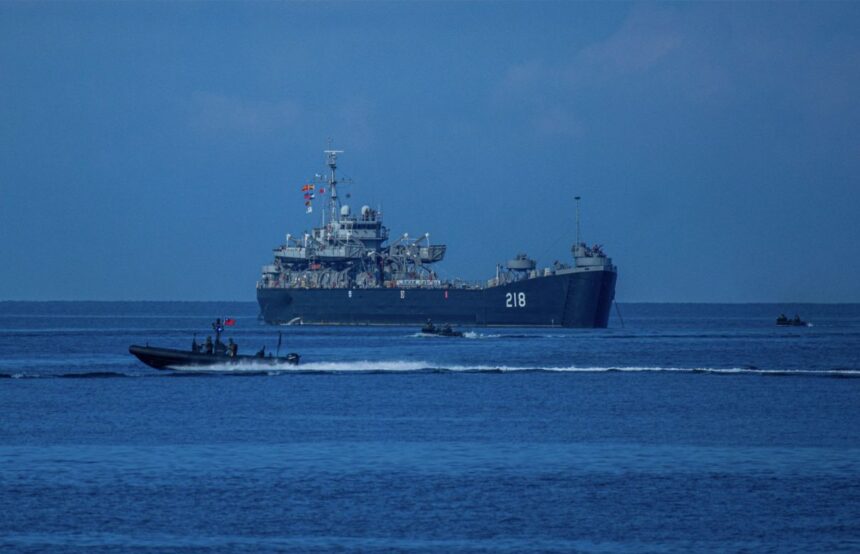
Taiwan staged its first joint navy–coast guard anti-blockade escort exercise on Wednesday, rehearsing how commercial shipping could continue reaching the island during a potential Chinese attempt to isolate it. The drill simulated the protection of a merchant vessel bound for two ports on Taiwan’s east coast, with a minesweeper clearing a navigation channel ahead while navy and Coast Guard Administration (CGA) vessels provided escort and security, according to the Ministry of National Defense. The CGA said it was the first time it had formally conducted this type of operation alongside the navy.
The exercise formed part of the live-fire phase of Han Kuang 42, Taiwan’s annual military exercise running from August 5 to 14, which mobilizes reservists for ten days and nine nights of around-the-clock operations. The exercise highlights how Taiwan’s defence planning has evolved beyond preparing for an amphibious invasion alone. Increasing attention is now being given to scenarios in which Beijing attempts to isolate the island through maritime coercion, coast guard operations, cyber disruption and restrictions on commercial shipping before or instead of launching a full-scale assault.
Civil-resilience measures ran alongside the military drills. Taiwan’s National Communications Commission throttled mobile data speeds to roughly one percent of normal capacity across parts of the island for the first time, simulating a wartime communications blackout while keeping voice calls and emergency services operational. President Lai Ching-te separately visited an underground hospital car park in New Taipei that had been converted into an emergency ward, accompanied by the de facto ambassadors of the United States, Israel and Canada. Lai said Taiwan was not facing the region’s changing security environment alone.
The exercise comes as analysts increasingly examine how China could use coast guard and other maritime agencies to pressure Taiwan without immediately launching a conventional invasion. A recent Jamestown Foundation assessment describes China’s June operations east of Taiwan as a “quasi-quarantine” model that projects administrative control without declaring a formal blockade. Taipei characterizes the approach as a form of lawfare. Analysts at RUSI note that such a strategy could produce many of the coercive effects of a blockade while avoiding the immediate legal implications associated with one under international law.
Taiwan has also restructured its military to counter this layered pressure. On July 1, it inaugurated the Littoral Combat Command, bringing together coastal anti-ship missile units, mobile radar systems and unmanned platforms under a unified command designed to deny China control of surrounding waters during a blockade attempt, according to Focus Taiwan.
The exercise does not indicate that a Chinese blockade is imminent. Rather, it illustrates how Taiwan increasingly views economic resilience, civilian preparedness and maritime access as inseparable from military defence. For Taipei, ensuring the island remains supplied during a prolonged crisis may prove just as important as defending its coastline.