President Donald Trump has signed a proclamation imposing tariffs of up to 100 percent on imported drones and their components, a move the White House frames as reducing US reliance on foreign, largely Chinese-made unmanned aircraft. The order landed one day after Washington’s costliest known drone losses of the Iran war became public. That timing overlap between trade policy and battlefield attrition has drawn added attention, even though the two actions are not officially linked.
Under the White House proclamation, drones and components judged to pose the greatest security risk face a 100 percent tariff, a category covering drones with a maximum takeoff weight above 25 kilograms and any drone with thermal-imaging capability, along with their docking stations. Smaller drones outside those specs, and other components, face a 25 percent tariff.
Close allies get preferential rates: drones and components from EU member states, Japan, Liechtenstein, South Korea, Switzerland and Taiwan will be tariffed at 15 percent, and UK-made drones at 10 percent. The tariffs, issued under Section 232 of the Trade Expansion Act, take effect September 3, 21 days after signing, with a longer window, to February 9, 2027, for components not classified as especially sensitive. Investing.com reports the proclamation also authorizes a Commerce Department onshoring program letting firms that commit to building US manufacturing capacity before January 2029 import components duty-free during construction.
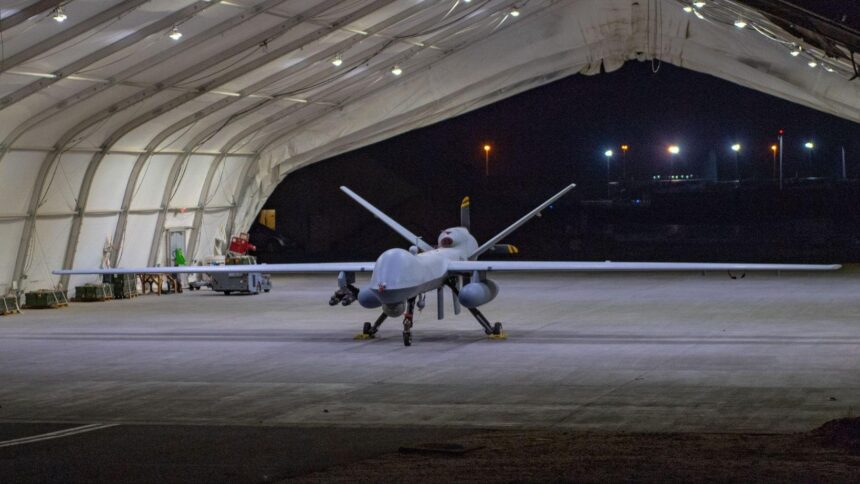
The move follows a report from the Washington Post, citing three US officials, that the US military has lost at least 45 MQ-9 Reaper drones during the war with Iran, roughly a quarter of its approximately 185-strong pre-war fleet, at a potential cost above $1.3 billion. The Pentagon declined to comment on the report. The Reapers, used for surveillance and strikes, have seen heavy duty around the Strait of Hormuz. Not all the losses came from enemy fire; a fourth official told the Post some Reapers crashed after losing contact with their operators.
That attrition has already reshaped Air Force planning. The National Interest reports the service, after losing roughly 30 Reapers over Iran, approved baseline requirements in May for a cheaper, “attritable” successor, part of a broader shift toward mass-produced, expendable platforms over high-value ones. Neither the proclamation nor Pentagon statements have tied that shift explicitly to this week’s tariffs.
The drone tariffs extend a pattern from the administration’s 2026 trade policy. In late July, Washington imposed tariffs of 10 to 12.5 percent on goods from roughly 60 countries and the EU under Section 301, citing insufficient enforcement of forced-labor import bans. That action took effect the same day an earlier, broader set of Section 122 tariffs expired at its 150-day statutory limit, itself a stopgap the administration adopted after the Supreme Court struck down its use of emergency powers for tariffs under IEEPA in February, per Congress’s Congressional Research Service.
As of publication, the drone tariffs stand as signed, with a September 3 start date for the highest-risk category and no legal challenge yet filed specifically against this proclamation, unlike the parallel Section 301 and Section 122 actions now contested in court. The administration has not indicated whether the Reaper losses factored into the tariff timing or scope.