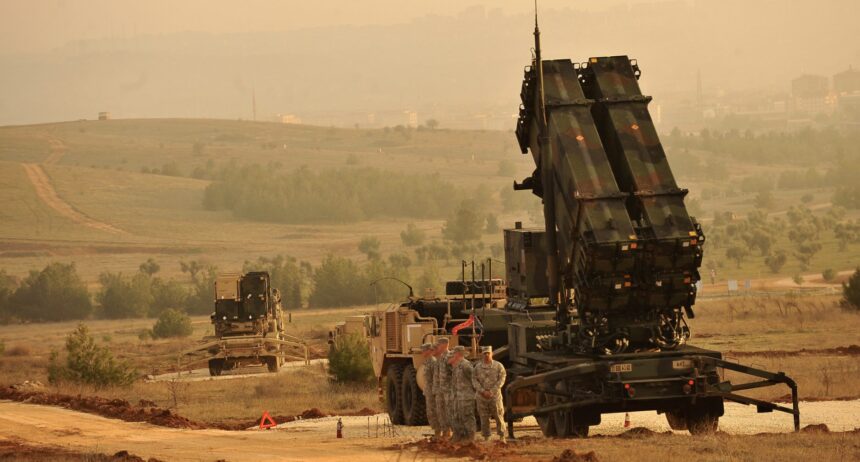
Russia’s latest attack on Kyiv exposed a problem that extends far beyond Ukraine. Moscow launched another large barrage of missiles and drones overnight Wednesday into Thursday, killing at least 13 people in the Ukrainian capital. Ukraine intercepted most of the cruise missiles and drones but struggled again against ballistic missiles, the weapons for which its U.S.-made Patriot systems provide its most important defense. The problem is no longer simply whether Ukraine has enough launchers. It is whether the United States and its allies can produce enough interceptors for several missile wars at once.
That question has become much harder since the United States and Israel went to war with Iran in February. Iranian ballistic missile attacks against U.S. forces and American partners across the Middle East have consumed large numbers of the same high-end air-defense weapons Ukraine needs against Russia. A Reuters analysis in March warned that the roughly 600 PAC-3 interceptors then being produced annually were already insufficient to cover demand from the United States, Gulf allies and Ukraine.
By late July, the Center for Strategic and International Studies estimated that the Iran conflict had consumed around 65 percent of the U.S. Patriot interceptor stockpile, reducing it from an estimated 2,330 interceptors before the war to roughly 759 to 827. The calculation was based on publicly available budget, procurement and operational data rather than an official Pentagon inventory, which remains classified. But Reuters later reported that estimates of roughly that magnitude were broadly consistent with internal U.S. data, according to two people familiar with the figures.
The result is an increasingly direct competition for some of the world’s most sophisticated defensive missiles. It is also exposing a deeper weakness in Western military planning. Highly capable air-defense systems have been built and bought in quantities suited to limited wars, not to a world in which several adversaries can launch sustained ballistic-missile campaigns at the same time.
The Arithmetic of Missile Defense
The Patriot problem begins with a basic asymmetry. A Patriot battery can defeat weapons that are extremely difficult to stop, including tactical ballistic missiles traveling at several times the speed of sound. But every interception consumes a sophisticated missile that takes time, money and specialized industrial capacity to replace. Depending on the threat and engagement conditions, defenders may also fire more than one interceptor to increase the probability of destroying an incoming ballistic missile.
Russia and Iran can widen that imbalance by combining ballistic missiles with much cheaper drones and cruise missiles in the same attack. Defenders must determine which threats justify scarce high-end interceptors while preventing lower-cost weapons from overwhelming other layers of the air-defense network. The attacker does not necessarily need to defeat Patriot technologically. Sustained attacks can instead put pressure on the defender’s magazine depth, forcing radars and command systems to process large numbers of threats while expensive interceptors are expended against the most dangerous weapons mixed into the salvo.
Ukraine is experiencing the consequences directly. During a Russian attack on July 31 involving 27 ballistic missiles, Ukrainian forces intercepted only one. President Volodymyr Zelenskiy said Ukraine lacked the Patriot interceptors needed to counter the ballistic attack. Ukraine’s ambassador in Washington, Olha Stefanishyna, has also said Kyiv urgently needs additional anti-ballistic missiles as Russia increases the scale of its attacks.
The shortage has become increasingly visible. The Financial Times reported that Ukrainian Patriot batteries had at points run out of ammunition, including during Russian attacks on August 5 and 8, leaving ballistic missiles effectively unchallenged. Ukrainian officials estimate that the country needs at least 300 PAC-3 interceptors to prepare for another winter campaign against its cities and energy infrastructure.
The Iran war has added another source of demand to an industrial system that was already struggling to meet Ukraine’s requirements. Reuters reported in August that estimates of heavy Patriot expenditure during the Iran conflict were broadly consistent with internal U.S. data, according to two sources familiar with the figures. Reuters said it had not independently seen the supply data, and exact U.S. inventories remain classified. The public evidence nevertheless points to the same underlying problem: demand has risen much faster than the industrial system designed to replace the missiles.
Production Is Rising, but War Moves Faster
Washington has recognized the problem and is spending heavily to fix it. In January, Lockheed Martin and the U.S. government agreed on a seven-year framework intended to increase annual PAC-3 MSE production capacity from approximately 600 interceptors to 2,000. Lockheed said it delivered 620 PAC-3 MSE interceptors in 2025.
In July, the U.S. Army followed with a multiyear production award that brought the potential value of the framework to $58.62 billion. Lockheed says the investment should triple PAC-3 MSE production capacity by the end of 2030. THAAD production is undergoing a similar expansion, with a January agreement calling for annual production capacity to rise from 96 interceptors to 400.
But expanding a missile factory requires more than a contract and a production target. Contractors need specialized workers and additional capacity throughout supply chains for rocket motors, electronics and other components. Even after governments decide to buy more weapons, factories can take years to reach substantially higher output.
That lag is the central problem. Production capacity promised for later this decade cannot replace an interceptor needed over Kyiv tonight.
Ukraine is therefore pursuing another solution: participating directly in production. Trump said in July that Washington would grant Kyiv a license to manufacture Patriot interceptors, and Zelenskiy subsequently said an agreement had been reached at the political level. Reuters has reported that discussions include options under which Ukraine could manufacture components for final assembly elsewhere in Europe. Such cooperation could eventually diversify production, but establishing new manufacturing capacity will take time and cannot resolve the immediate shortage.
Ukraine Is Not the Only Competition
The implications extend beyond Ukraine and Iran. Patriot is operated or ordered by a growing number of U.S. allies, while American forces need reserves for potential crises elsewhere. A future conflict in East Asia could generate enormous demand for missile defense at precisely the moment Washington is rebuilding inventories consumed in Europe and the Middle East.
That possibility is already part of the debate. CSIS warned that depleted inventories could constrain U.S. options in another major conflict, particularly one involving China. The issue is therefore larger than deciding which current battlefield receives the next shipment. It raises a broader question about whether the U.S.-led defense industrial base can support simultaneous deterrence commitments across Europe, the Middle East and the Indo-Pacific.
For decades, Western militaries invested heavily in aircraft, ships and sophisticated air-defense systems while maintaining relatively limited inventories of the precision weapons those platforms require. Ukraine first exposed the consequences with artillery shells and long-range munitions. The Iran war is now applying similar pressure to high-end missile defense.
Russia and Iran do not need identical strategies or formal coordination to benefit from that pressure. Every interceptor fired in the Gulf is one that cannot immediately be positioned somewhere else. Every Russian ballistic missile that forces Ukraine to expend a scarce Patriot round adds another demand to the same industrial system.
The United States is now spending tens of billions of dollars to expand that system, and production is set to rise sharply. The harder question is what happens before it does.
Ukraine is already living inside that gap. Russia can launch ballistic missiles faster than Kyiv’s partners can currently replace some of the interceptors needed to stop them, while the Iran war has created another urgent demand for the same defensive weapons.
The lesson reaches beyond both wars. Modern air defense depends not only on whether an interceptor can destroy an incoming missile, but on whether enough interceptors exist to keep doing it night after night. The West has demonstrated that its technology can defeat many of the weapons Russia and Iran launch. It has yet to demonstrate that its factories can keep pace with the wars those weapons are creating.