China’s most effective military strategy may be the one that avoids war.
Across the Indo-Pacific, Beijing is increasingly using coast guard vessels, economic restrictions, administrative claims and political pressure to alter the behavior of other governments without triggering the costs and uncertainty of direct military conflict. The method is incremental: create new facts on the ground or at sea, normalize them through repetition, and force rivals to decide whether each individual incident is serious enough to justify escalation.
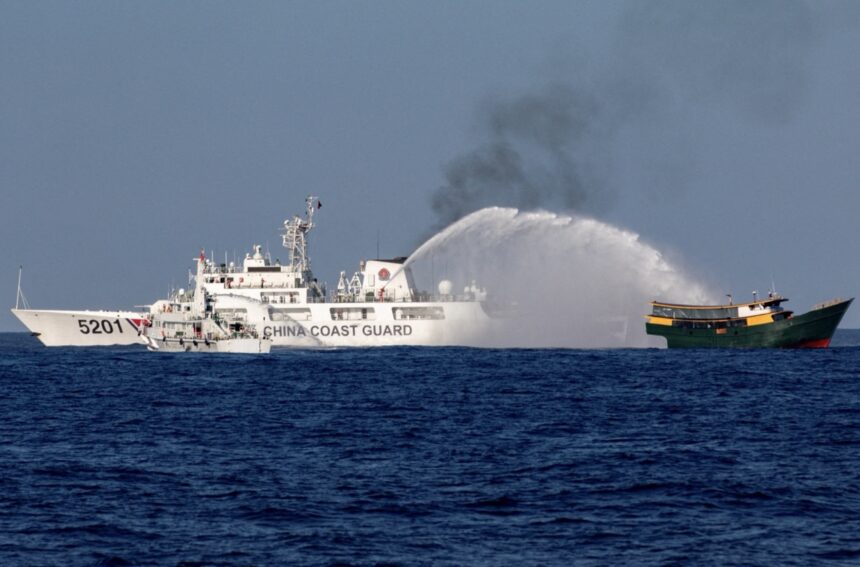
Recent developments show how broad that toolkit has become. In July, the Philippine Coast Guard reported that a China Coast Guard vessel used water cannons against two Philippine government vessels near the disputed Scarborough Shoal during a mission delivering fuel subsidies and assistance to Filipino fishermen. The Chinese ship reportedly closed to within about seven meters of one of the Philippine vessels before using the water cannon. The confrontation was significant not because it was unprecedented but because such encounters, including another confrontation days earlier near Second Thomas Shoal in which one Filipino sailor was injured, are becoming increasingly routine.
China has also demonstrated that coercion does not need to remain maritime. Foreign ministers from the 18-member Pacific Islands Forum meeting in Suva, Fiji, on August 7 failed to agree on a joint response to a Chinese missile launch into the Pacific in July. New Zealand Foreign Minister Winston Peters said two member states had refused to support the proposed statement. An official familiar with the discussions identified them as Kiribati and Nauru, although Forum Secretary-General Baron Waqa emphasized that neither country had formally blocked the declaration. The issue will now move to the leaders’ summit in Palau next month, underscoring how difficult it has become for regional institutions to present a unified response as Beijing expands its diplomatic influence across the Pacific.
The pattern is not simply aggression below the threshold of war. It is an effort to shape the threshold itself.
The Grey Zone Is Becoming the Main Zone
The South China Sea offers the clearest example.
China claims extensive maritime rights across much of the region, overlapping with claims by the Philippines, Vietnam, Malaysia, Brunei and others. In 2016, an arbitral tribunal constituted under the UN Convention on the Law of the Sea found that China’s claims to historic rights within the so-called nine-dash line had no legal basis under UNCLOS, a ruling Beijing rejected and continues to dismiss as having no binding force.
Instead of enforcing its claims primarily through naval combat, Beijing increasingly relies on its Coast Guard. The 2018 transfer of the China Coast Guard to the People’s Armed Police, which reports to the Central Military Commission chaired by Xi Jinping, gave Beijing tighter political control over coast guard operations and further blurred the boundary between civilian law enforcement and military coercion.
That ambiguity is strategically valuable. The Philippines is a U.S. treaty ally, and Washington has repeatedly said the Mutual Defense Treaty applies to attacks on Philippine armed forces, public vessels and aircraft in the Pacific. Incidents involving water cannons, dangerous maneuvering and physical obstruction create difficult questions about where coercion ends and an armed attack begins, leaving Washington considerable ambiguity over what response is proportionate under the treaty. U.S. Indo-Pacific commander Admiral Samuel Paparo warned this week against attempts to use coercion and questionable legal claims to intimidate regional states.
The objective does not necessarily require Manila to surrender its claims. It may be enough to make exercising those claims progressively more costly. If fishing missions require escorts, resupply runs become confrontations and every patrol risks a diplomatic incident, the effective balance of control can shift without any formal territorial settlement.
Economic Dependence Creates Another Front
China’s economic power reinforces that strategy.
A CSIS study published in May identified 26 episodes between 2010 and early 2026 in which Beijing appeared to restrict agricultural imports in response to political disputes involving 16 countries. Fifteen of those incidents occurred during the previous six years, including five in 2025 alone. The study concludes that agricultural exports are attractive targets because producers suffer losses quickly while governments face domestic political pressure to restore access to the Chinese market.
The tactic has affected countries including Australia, Japan, Lithuania and the Philippines through tariffs, import delays, regulatory measures and reduced tourism. The mechanism mirrors maritime coercion in one important respect: Beijing can impose meaningful costs while preserving enough ambiguity to dispute that political punishment is taking place. That makes conventional military deterrence less effective against customs inspections, informal boycotts or administrative restrictions than against conventional armed aggression.
The strategic challenge for smaller states therefore becomes not simply whether they can defend their territory, but whether they can absorb sustained economic pressure without changing their foreign policy.
Taiwan Shows Where the Model Could Lead
Taiwan is the most consequential test of the same logic.
Beijing has not ruled out the use of force to bring the self-governed island under its control, but a full-scale invasion would be extraordinarily costly and could draw in the United States and regional allies. Pressure below that threshold offers Beijing alternative ways to shift the strategic environment.
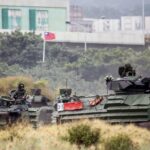
Taiwan is currently conducting its annual Han Kuang military exercises, with a particular emphasis on command flexibility and maintaining military effectiveness under wartime conditions.
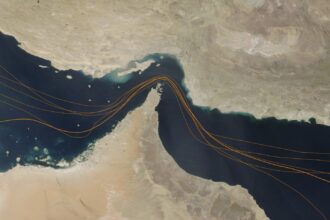
A separate dispute this week illustrated the same contest over authority in administrative rather than military form. As Typhoon Dolphin approached, China’s Maritime Safety Administration instructed vessels approaching the southern Taiwan Strait to follow Chinese traffic-control guidance. Taipei rejected the directive as having no legal basis in international waters. The episode can also be understood as an attempt to normalize administrative authority over waters Beijing claims, even without deploying military force.
That is precisely what makes gray-zone coercion effective. Administrative notices, routine patrols and regulatory actions can gradually reshape perceptions of authority without creating the unmistakable signal of armed conflict.
Why Incremental Pressure Is Hard to Stop
The central advantage of this strategy is asymmetry.
China can concentrate pressure on one country, one industry or one disputed maritime feature while its opponents must decide whether defending it is worth accepting a wider confrontation. The targeted state bears immediate costs, while supporting countries face broader questions about credibility and future precedent.
But the strategy also has limits.
Rather than forcing concessions, repeated pressure has often encouraged closer security cooperation among China’s neighbors. In the Philippines, maritime confrontations have accelerated defense cooperation with the United States and expanded security ties with Japan and Australia, including reciprocal access arrangements and increasingly frequent multinational patrols.
Economic coercion has also produced mixed results. The same CSIS study concludes that many targeted countries ultimately reduced their dependence on the Chinese market by diversifying exports and strengthening cooperation with other partners instead of reversing their policies.
The danger for Beijing is therefore that repeated coercion may gradually create the very coalition it seeks to prevent.
Yet the immediate challenge remains significant. International law can define maritime rights, alliances can deter conventional attacks and militaries can prepare for war, but none of those instruments automatically addresses the problem of a stronger state imposing cumulative costs while remaining below the threshold that normally triggers collective defense.
China does not need every country in the Indo-Pacific to accept its territorial claims. It only needs enough governments to conclude that challenging those claims has become increasingly expensive.
That is why the more consequential question may not be when Beijing chooses war, but how much of the regional order it can reshape before war ever becomes necessary.