Syria and Russia signed a memorandum of understanding on August 9 restructuring Moscow’s military presence on Syria’s Mediterranean coast, according to Syria’s Foreign Ministry, carried by state news agency SANA. The deal follows 18 months of negotiation.
Damascus takes administrative control of the civilian-use sections of Russia’s air base and naval facility. The remaining military infrastructure is redesignated as “joint training and qualification centers” — language that functions as a legal mechanism, stripping Russia’s extraterritorial military status without a hard eviction. The transition has a three-month deadline. Russia has not commented, and how much operational access its personnel retains is unspecified.
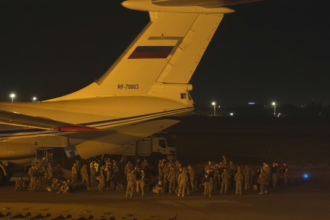
The two sites have anchored Russia’s Middle East presence since 2015, doubling as Moscow’s logistics bridge to Africa Corps operations in Libya, the Central African Republic, Mali and Sudan. Assad’s December 2024 ouster triggered a drawdown, but resupply flights resumed through 2025. Interim President Ahmad al-Sharaa has visited Putin twice since taking power.
The Institute for the Study of War assessed that losing guaranteed base access would particularly weaken Moscow’s ability to project power in Libya and across sub-Saharan Africa. Syrian control of civilian-side customs and airspace transit adds leverage over functions Russian resupply depends on, compounding Turkey’s Montreux-based closure of the Bosphorus to Russian warships for the war’s duration.
The memorandum was announced the same day Syria’s finance minister held talks with a US Treasury official on reintegrating Syria into the global financial system, part of broader engagement with Washington, Europe and the Gulf since Assad’s fall, according to SANA. Damascus frames the base deal itself as reorganization, not expulsion, and has said the move asserts national sovereignty over Syrian territory.
Russia retains a reduced, not eliminated, presence. Syria controls the civilian infrastructure and gains new leverage over Russia’s Africa logistics. The transition clock is running; Moscow has not responded.