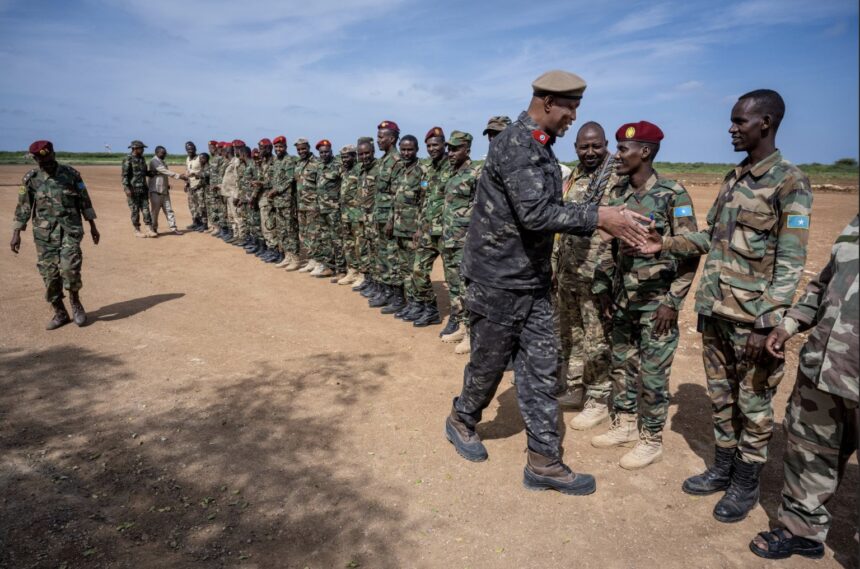
Heavy fighting erupted Monday in Baidoa, the capital of Somalia’s South West state, after forces loyal to ousted regional president Abdiaziz Hassan Mohamed “Laftagareen” launched an assault on positions held by federal and regional security forces. According to Garowe Online, the attack began early in the morning with heavy weapons fire, while residents reported sustained gunfire and explosions across parts of the city, about 250 kilometers west of Mogadishu. Residents told Radio Shabelle that fighting was especially intense in the Towfiiq neighborhood, with civilians remaining indoors as the violence spread.
The two sides gave sharply conflicting accounts of the outcome. Ugas Hassan, a spokesman for Laftagareen’s forces, claimed the South West State Darwish militia had taken full control of the city and declared that it had “restored its freedom and dignity,” urging residents to return to the streets. Somali government military officials countered that their forces had successfully defended their positions and repelled the attack. Neither side’s claims could be independently verified, and no official casualty toll had been released as of Monday evening.
The confrontation stems from a political crisis that erupted in March, when the federal government removed Laftagareen from office after disputes over constitutional reforms and regional authority, replacing him with former parliament speaker Aden Madobe. Laftagareen rejected the transition and has since maintained armed opposition from rural areas surrounding Baidoa, where his supporters have repeatedly challenged federal control. Monday’s assault follows a pattern established during earlier clashes in May, June and July, when Laftagareen-aligned fighters briefly penetrated parts of the city before withdrawing to rural strongholds.
The fighting also illustrates the tension between Mogadishu’s effort to consolidate control over the South West state and its parallel campaign against al-Shabaab. Federal forces built up a presence of more than 2,000 troops in Baidoa, including units of the Turkish-trained Gorgor special forces normally tasked with operations against al-Shabaab in the Lower and Middle Shabelle regions, after seizing the city in March. Despite that buildup, roads outside Baidoa have remained contested and, at times, under al-Shabaab influence—a dynamic that regional analysts say risks diverting federal troops and political attention away from the counterinsurgency campaign rather than reinforcing it.
The renewed violence comes as Baidoa faces a deepening humanitarian crisis largely separate from the fighting itself. A malnutrition survey conducted in July by Médecins Sans Frontières found that one in every two children screened in the city’s displacement sites is acutely malnourished, and one in four is severely malnourished, among roughly half a million displaced people sheltering in and around the city. MSF said the findings are consistent with its broader screening data from Baidoa this year and warned that donor funding for Somalia’s humanitarian response has fallen sharply even as needs grow. Repeated rounds of armed conflict in the city complicate the delivery of aid to a population already suffering some of the most severe malnutrition rates the organization has recorded in the country.
Neither Monday’s fighting nor previous clashes have resolved the dispute over South West state’s leadership. The city has effectively become contested ground between three forces: federal and regional troops holding the urban center, Laftagareen-aligned fighters operating from the surrounding countryside, and al-Shabaab militants present on routes leading out of the city. That three-way pressure, combined with a humanitarian emergency that shows little sign of easing, leaves Baidoa exposed to further rounds of violence regardless of which side ultimately prevails in Monday’s clashes.