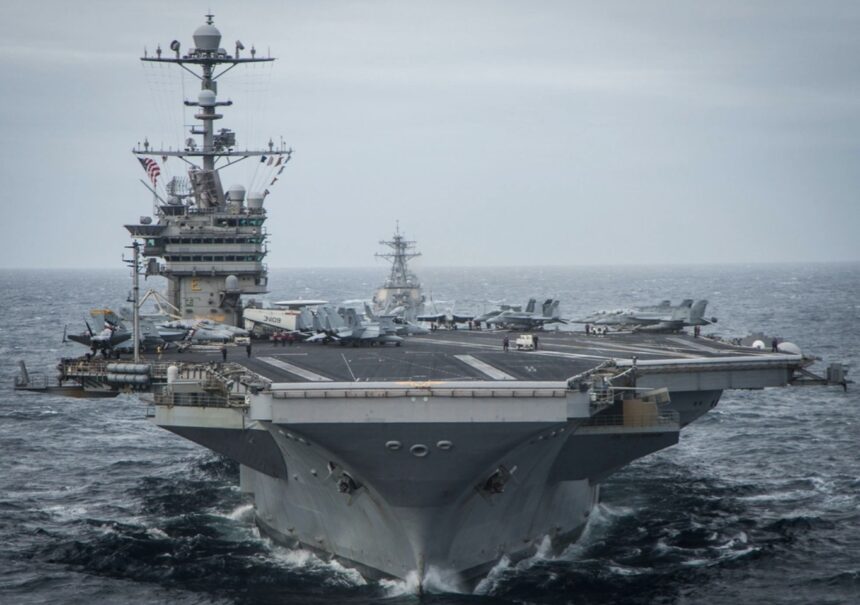
The United States has pulled its only forward-deployed aircraft carrier out of the western Pacific, leaving the region without a U.S. flattop for an undetermined period as the war against Iran strains the Navy’s carrier fleet. The withdrawal of the USS George Washington illustrates how the conflict with Iran is forcing Washington to shift finite naval resources between competing theaters, even as strategic competition with China remains the Pentagon’s long-term priority. Officials have described the gap as temporary, but they have not said when a replacement carrier will arrive in the region.
The George Washington left the western Pacific after completing a port call and joint search-and-rescue exercise with Vietnamese forces in Da Nang, rather than departing directly from its homeport in Yokosuka, Japan. The carrier, traveling with a cruiser and a destroyer, was subsequently spotted crossing the Singapore Strait and then the Strait of Malacca, the waterway linking the Pacific and Indian oceans, putting it on a direct course toward the Middle East. The Pentagon has not officially confirmed the deployment, though a Navy official told Stars and Stripes that George Washington would relieve the USS Abraham Lincoln in the Arabian Sea.
The Abraham Lincoln has been at sea almost continuously since departing its San Diego homeport on November 21, 2025, and was deployed to support U.S. military operations against Iran and expanded naval operations in the Gulf. It has now gone more than 260 days without a port call, among the longest carrier deployments in modern Navy history.
Acting Navy Secretary Hung Cao confirmed Friday that the Lincoln would return home after completing its deployment, describing the carrier’s performance as exceptional. Defense Secretary Pete Hegseth has also rejected reports that extended deployments left crews inadequately supported, saying the situation had been “completely misrepresented.”
The redeployment illustrates how sustained military operations in one theater can directly draw down forward-deployed forces in another. The George Washington is the Navy’s only permanently forward-deployed carrier, based in Japan and assigned to the 7th Fleet as a symbol of the U.S. commitment to the Indo-Pacific, so its departure removes the region’s most visible carrier presence rather than one of several available substitutes. Lincoln is not an isolated case. The USS Gerald R. Ford returned home in mid-May after an 11-month deployment, the longest since the Vietnam War, and the median length of carrier deployments has climbed steadily since 2020, routinely exceeding the 210-day rotation target that had been standard between 2018 and 2022.
Regional security analysts say Beijing is likely to view the temporary absence of a U.S. carrier as an opportunity to reinforce perceptions of a shifting military balance in the western Pacific. Greg Poling, director of the Southeast Asia Program at the Center for Strategic and International Studies, told the Associated Press that Washington has long described the Indo-Pacific as its primary strategic theater after the Western Hemisphere, even as current force movements point elsewhere. Bryan Clark, a defense analyst at the Hudson Institute, told the AP that Beijing is likely to use the carrier’s absence to signal to the Philippines, Japan and Indonesia that the United States is no longer the dominant naval power in the western Pacific. China has already conducted military exercises near Scarborough Shoal in the South China Sea and carried out a destroyer live-fire drill near Okinotori Island, Japan’s southernmost territory, activity that regional officials are watching closely for signs of further escalation during the carrier gap.
U.S. officials have stressed that the carrier gap is expected to be temporary and note that substantial American air, naval and submarine forces remain in the region regardless of which carrier is present. Those assurances have not stopped China from continuing the gray-zone activity described above, underscoring the gap between official messaging about a temporary rotation and the operational reality of an extended one. How long the Pacific goes without a U.S. carrier now depends less on the Navy’s original deployment schedule than on how long George Washington is needed to sustain operations in the Middle East, a timeline that remains tied to the duration of the conflict with Iran rather than any fixed Pacific rotation plan.