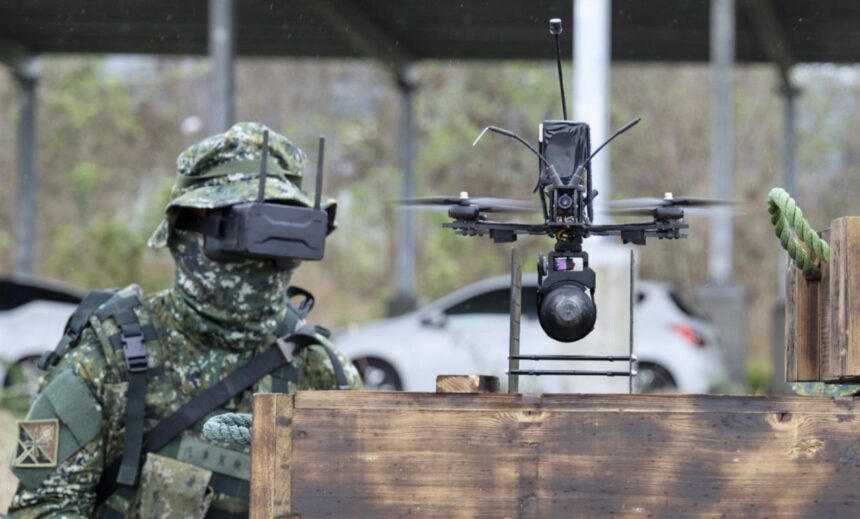
Taiwan’s Ciaotou District Prosecutors Office has detained the head of a drone contractor accused of supplying the Army with training drones containing Chinese-made flight-control boards and packaged semiconductor chips, in what prosecutors say is one of Taiwan’s first military drone procurement cases brought under the National Security Act. A court ordered the executive, surnamed Chang, held incommunicado, while a technical supervisor from a second company, surnamed Lo, was questioned over the same allegations and released without bail. Prosecutors have charged both men under the National Security Act for allegedly supplying Chinese-manufactured military goods, alongside attempted fraud charges under the Criminal Code.
The investigation began after the Army’s 8th Field Army discovered Chinese-marked components during acceptance inspections of a NT$2.95 million (about US$92,500) training-drone contract awarded last year. Prosecutors allege the suppliers concealed component markings and submitted false certificates of origin to satisfy Taiwan’s “non-red supply chain” rules, which prohibit Chinese-, Hong Kong- and Macau-sourced components in military procurement. According to Taiwan News, the contractor secured the tender with the lowest bid, prompting renewed calls from lawmakers for component verification earlier in the procurement process rather than only at final delivery.
The case exposes a broader weakness in Taiwan’s defense procurement system. Military tenders require component-level non-Chinese sourcing, but compliance is often verified only during final acceptance inspections, creating opportunities for suppliers to relabel parts or falsify documentation before serial numbers are examined. A separate case earlier this year highlighted a different challenge. Drone manufacturer Thunder Tiger said flight-control chips used in Army training drones were manufactured by France’s STMicroelectronics but packaged in China, illustrating how globally integrated electronics supply chains can complicate origin verification even where no fraud is alleged. Together, the two cases show that Taiwan’s effort to build a trusted “non-red” defense supply chain faces both deliberate procurement fraud and the practical difficulty of tracing commercial electronics through complex international manufacturing networks.
The military has withheld payment from Chang’s company and says it will seek damages while barring the contractor from future defense tenders. Neither Chang nor Lo has been convicted, and prosecutors have not alleged that the Chinese government was directly involved. The investigation comes as Taiwan accelerates domestic drone production after drawing lessons from Ukraine’s extensive use of unmanned systems, making secure supply chains an increasingly important pillar of the island’s defense strategy.