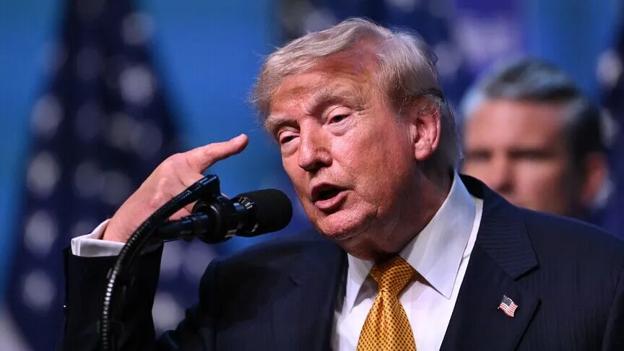
U.S. President Donald Trump said on Tuesday that no talks with Iran were taking place or scheduled, cutting off the diplomatic track meant to replace the interim Memorandum of Understanding (MOU) between Washington and Tehran that expired on Monday. The statement directly contradicted special envoy Jared Kushner, who had told Fox News a day earlier that talks with Iran were “probably more robust than it’s maybe ever been.” Trump’s reversal left the diplomatic track that was meant to replace the expired MOU without any clear path forward.
Strait Status Disputed
Trump also posted a map on Truth Social labelling the Strait of Hormuz “New US Territory,” while maintaining that the U.S. naval blockade of Iranian ports remained in force and that the strait itself was open to shipping. Iranian parliament speaker Mohammad Bagher Ghalibaf told parliament that the strait would not reopen until Washington met the conditions of the MOU: lifting the naval blockade, ending oil sanctions, releasing Tehran’s frozen assets, and halting military threats and operations on all fronts. That memorandum had briefly stabilised Gulf shipping after it took effect in mid-June, before renewed Iranian strikes on commercial vessels beginning July 7 reversed the recovery.
Missiles Fired At UAE
The crisis widened further on Tuesday evening, when the UAE’s Ministry of Defence said its air defences had detected two ballistic missiles launched from Iran toward the country, with one falling inside UAE territorial waters and the other outside. It was the first such incident reported against the UAE since a May 4 strike on the port of Fujairah. Iran did not immediately comment, and there was no independent confirmation of the UAE account beyond its own statement.
The incident came the same day Yemen’s Houthi movement, which receives arms and backing from Tehran, said it struck a Saudi Aramco oil refinery in Jazan with drones, part of a wider blockade the group announced against Saudi-linked shipping last month. The Houthis have separately been accused by the UAE of attacking ADNOC-owned tankers transiting the Strait of Hormuz, though Iran has not claimed responsibility for those attacks. Tehran has long supplied the Houthis with weapons and training, giving it a second front through which to pressure Gulf states without direct Iranian attribution.
Oil Markets Under Pressure
Oil prices rose to their highest levels since July after the talks collapsed, with Brent crude climbing above $91 a barrel on Tuesday – its third consecutive daily gain – as traders priced in the prospect of prolonged disruption to Gulf shipping. Commodity vessel traffic through the strait had already thinned sharply over the weekend, with only five vessels transiting on Saturday and none on Sunday, compared with 31 during the previous weekend. Kpler data from late July showed commodity-related crossings had fallen from a post-MOU baseline of roughly 33 daily transits to as low as four a day after Iran resumed strikes on commercial vessels in early July, with only a brief, short-lived rebound before this week’s collapse of talks.
Kpler’s analysts put $110 a barrel as Brent’s likely ceiling for now, contingent on China staying out of the market as a marginal buyer – Chinese crude imports have held around 7 million barrels a day, well below the roughly 11 million barrels a day seen before the conflict. Before the war, the strait carried roughly a fifth of the world’s traded oil and about a fifth of global LNG trade, according to the U.S. Energy Information Administration.
Gaza Talks Also Stalled
The Iran breakdown comes as wider U.S. Middle East diplomacy is also stalled. Kushner met Hamas political leader Khalil al-Hayya in Egypt on Sunday, August 16, then travelled to Jerusalem for a two-hour meeting with Israeli Prime Minister Benjamin Netanyahu on Monday, August 17. Neither meeting produced a breakthrough on the 15-point roadmap developed under the Board of Peace, the U.S.-created body overseeing Gaza’s ceasefire, which Netanyahu had publicly rejected the previous week, insisting Israeli forces would not withdraw or allow reconstruction until Hamas was fully disarmed. Hamas has said it will not begin disarming without a public commitment from Netanyahu to the plan, leaving both sides’ preconditions unmet.
Israeli strikes have continued in Gaza. An Israeli airstrike on Tuesday killed at least six Palestinians and wounded 14 others when a fighter jet fired two missiles at a cafe inside a fishing harbour in western Gaza City, Gaza health officials said. Israel’s military said the strike targeted Hamas commanders, including one it said had taken part in the October 7, 2023 attack that triggered the war; Hamas accused Israel of trying to sabotage the ceasefire plan while saying it remained committed to the agreement. Israeli strikes in Lebanon have separately kept the Israel-Hezbollah truce fragile.
The regional mechanism is increasingly visible. Tehran is using Hormuz access, sanctions relief and its frozen assets as leverage over Washington, while the near-simultaneous missile launch toward the UAE, Israeli strikes in Gaza and Lebanon, and the stalled ceasefire roadmap all draw on the same underlying dispute over who bears the cost of ending the war. Washington has sought to treat Gulf maritime security and the Gaza ceasefire file as separate negotiating tracks, but this week’s events suggest regional actors continue to treat transit rights, sanctions, military pressure and ceasefire concessions as connected bargaining tools.