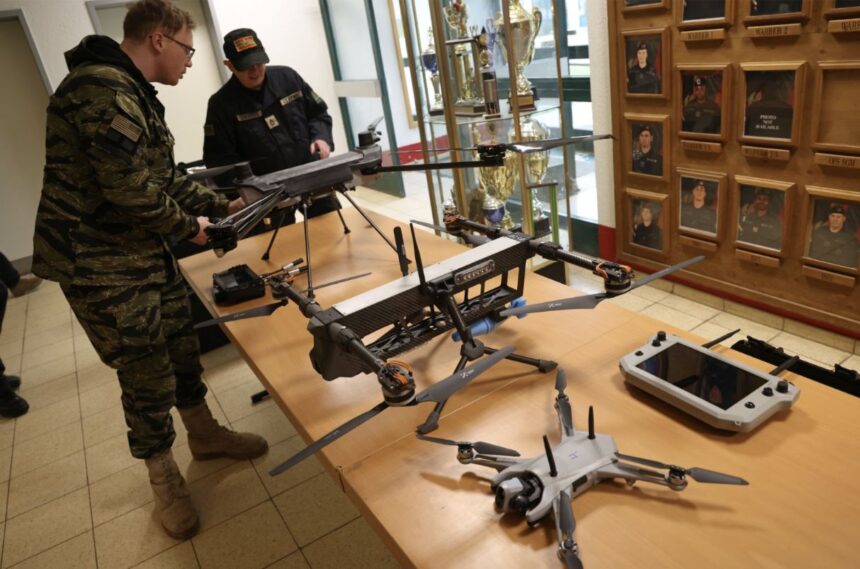
The outcome of a recent U.S. Army training exercise in Germany attracted attention for an unusual reason. According to a Wall Street Journal investigation, Ukrainian drone operators consistently outperformed their American counterparts during the Combined Resolve exercise at Hohenfels in April and May. About 3,500 U.S. personnel, primarily from the 3rd Armored Brigade Combat Team, 1st Cavalry Division, faced an opposing force reinforced by Ukrainian operators from the 412th Regiment of the Unmanned Systems Forces, known as Nemesis. Officials briefed on the exercise told the Journal that the Ukrainian teams effectively eliminated a U.S. armored brigade before American forces adapted.
For decades, military knowledge flowed primarily in one direction. The United States developed doctrine, technology and operational concepts that allies absorbed through NATO training, procurement and joint exercises, while Ukraine was largely viewed as a recipient of Western expertise. Today, that relationship is becoming more reciprocal. During the second half of the German exercise, the Ukrainian contingent switched sides and helped American forces employ drones offensively, while U.S. troops improved by dispersing formations, concealing vehicles and making better use of electronic warfare, the Journal reported.
The exercise therefore represents more than an embarrassing training result. Exercises are designed to expose weaknesses before they become battlefield losses. What matters is what those weaknesses reveal: after years of high-intensity combat against Russia, Ukraine has accumulated operational experience in drone warfare that even the world’s most powerful military cannot reproduce through technology investment or peacetime training alone. Ukraine is no longer simply consuming Western military knowledge. It is increasingly helping to produce it.
The World’s Fastest Military Innovation Cycle
The principal advantage demonstrated by the Ukrainian teams was not superior equipment. Much of Ukraine’s drone war has been built around relatively inexpensive and rapidly replaceable systems rather than exclusively around costly military platforms. Kyiv has increasingly institutionalized that experience, creating the Unmanned Systems Forces as a dedicated branch responsible for aerial, maritime and ground robotic systems. President Volodymyr Zelenskyy initiated its creation in February 2024 with an explicit emphasis on specialized drone units, training, systematic battlefield learning and rapidly scaling production. Ukraine’s presidential office described those objectives as central to the new force.
That institutional structure is increasingly connected to a digital battlefield architecture. Ukraine’s DELTA combat system has been deployed across all levels of the country’s Defence Forces, providing commanders and units with a shared operational picture and tools to plan operations and exchange battlefield information. NATO has separately tested DELTA for interoperability and describes it as a battle-tested Ukrainian battlespace-management system capable of collecting, processing and displaying operational information. NATO Allied Command Transformation has explicitly cited the system as an example of Ukrainian battlefield technology informing allied adaptation.
Ukraine has pushed this integration further in 2026. The Defence Ministry launched Mission Control inside DELTA to consolidate drone planning, mission data and reporting in a single system, and later said it had become operational across all corps and force groupings. The ministry reported in March that commanders could use it to track the employment of unmanned systems across formations. The strategic advantage is therefore less any single drone or software package than the speed with which battlefield information can move between operators, commanders, engineers and manufacturers and generate another round of adaptation.
Why the U.S. Army Was Caught Off Guard
The American forces at Hohenfels did not lack drones or counter-drone equipment. According to the Wall Street Journal, they entered the exercise with standard electronic-warfare and counter-UAS systems. Their initial problem was more fundamental. Heavy armored vehicles moving in visible formations produced signatures Ukrainian reconnaissance drones could detect rapidly, after which simulated strike drones and FPVs followed. Vehicles were being assessed as destroyed so quickly that exercise controllers had to return some of them to the scenario to keep training underway.
Ukraine’s operators have spent years working on battlefields saturated with reconnaissance drones, electronic warfare, GPS interference, artillery and constant observation. Every mission can expose a vulnerability, and every Russian countermeasure creates pressure for another tactical or technical response. American units can simulate such conditions, but they cannot replicate the accumulated experience of soldiers who have repeatedly had to repair, arm and adapt unmanned systems under combat pressure. The Journal’s reporting makes clear that this practical experience – not simply access to different hardware – was central to the Ukrainian advantage.
Yet the exercise also demonstrated that the gap is learnable rather than permanent. When the scenario was repeated, U.S. forces improved their dispersion, camouflage and electronic-warfare employment. Ukrainian personnel then helped them use drones more effectively on offense. That is precisely why Combined Resolve matters: the result should not be read as proof that Ukrainian forces are broadly superior to the U.S. Army, but as evidence that combat experience in a rapidly evolving domain can expose assumptions even inside a much larger and better-funded military institution.
The Rise of Cheap Precision Warfare – Within Limits
Ukraine has also challenged the economics of precision warfare. Small FPV drones can threaten tanks, artillery pieces, logistics vehicles and other assets costing orders of magnitude more than the weapon attacking them. Ukraine’s Defence Ministry has increasingly organized its drone forces around a layered mix of FPV strike systems, reconnaissance platforms and heavier unmanned aircraft. Its Drone Line programme explicitly combines FPV drones with intelligence, surveillance and reconnaissance platforms and bomber UAVs rather than treating inexpensive drones as standalone weapons.
That distinction matters. Cheap drones do not make satellites, reconnaissance aircraft, electronic intelligence, artillery, missiles or advanced command systems obsolete. An FPV drone still needs a target to find, communications links that can survive interference, operators capable of navigating a contested electromagnetic environment and an organizational system able to decide which target matters most. Ukraine’s experience therefore points toward layered precision warfare, not a future in which a $500 quadcopter simply replaces a multimillion-dollar weapons platform.
What low-cost drones do change is the arithmetic of attrition. A military capable of producing and replacing large numbers of relatively inexpensive systems can impose repeated costs on an opponent without treating every individual platform as something that must survive. Ukraine’s Defence Ministry said it authorized more than 330 domestically produced unmanned systems for operational use in 2024, more than four times the number approved the previous year. The broader lesson is that industrial capacity and iteration speed are increasingly becoming battlefield capabilities in their own right.
NATO’s Adaptation Challenge
Western militaries have recognized the problem. NATO exercises increasingly incorporate Ukrainian systems and combat experience, while the alliance’s own interoperability work now includes technologies developed under battlefield conditions. NATO Allied Command Transformation says Ukraine’s battle-tested systems, including DELTA, are contributing directly to alliance experimentation and helping NATO adapt lessons involving rapid information sharing, secure networks and cross-domain coordination.
The difficulty is that Western defence institutions operate under constraints Ukraine does not face in the same form. U.S. commanders cannot simply buy any commercially available drone and field it immediately. The Defense Department must comply with legislation restricting certain foreign-made unmanned systems and components, alongside cybersecurity and security-review requirements. Pentagon guidance on UAS procurement specifically ties acquisition procedures to Section 848 of the fiscal 2020 National Defense Authorization Act while establishing processes for approving trusted commercial systems.
Those safeguards have legitimate purposes. Supply-chain security matters, particularly when unmanned systems collect imagery and operational data or depend on software and communications components that could be compromised. The problem is that the same institutional architecture designed to ensure security, accountability and interoperability can make it harder to reproduce Ukraine’s extraordinarily short experimentation cycles. Kyiv is fighting a war for national survival and can accept levels of technical failure, rapid modification and decentralized procurement that would be difficult for a global peacetime military to institutionalize.
The challenge for NATO is therefore not simply to purchase more drones. It is to build organizations capable of learning at something closer to battlefield speed while preserving the safety and accountability expected of democratic militaries. That means shortening the distance between soldiers identifying a problem, engineers building a solution, industry manufacturing it and commanders fielding it. Ukraine has built that relationship under extreme pressure. Its allies now have to determine which parts can be reproduced before they face similar conditions themselves.
Ukraine’s New Role in Western Defence
The significance of the German exercise ultimately lies in what it says about Ukraine’s changing place within the transatlantic security community. Since Russia launched its full-scale invasion in 2022, Western governments have supplied Kyiv with weapons, intelligence, training and financial support on an extraordinary scale. But military learning is increasingly flowing in both directions. The Wall Street Journal reported that the Pentagon is testing Ukrainian drones for potential acquisition and that Defense Secretary Pete Hegseth has increased the number of U.S. personnel sent to Ukraine to study drone warfare.
That does not mean Ukraine has surpassed the United States militarily. The U.S. retains enormous advantages in intelligence, logistics, strategic mobility, long-range strike, air and naval power and its ability to conduct operations globally. Nor can a single exercise establish how American formations would perform in an actual war, especially one involving the full range of U.S. airpower, intelligence and long-range fires. The Hohenfels result is significant precisely because it is narrower: in the specialized environment of short-range drone warfare under contested conditions, years of Ukrainian combat experience temporarily outweighed much larger institutional resources.
The same lesson applies beyond the United States. The Journal reported that Ukrainian drone operators had also exposed weaknesses during exercises involving British, Estonian, Swedish and other NATO forces. If that pattern persists, Ukraine’s contribution to European security will increasingly include something harder to measure than weapons inventories: a body of operational knowledge generated in the most technologically dynamic large-scale war of the modern era.
Future military advantage will therefore depend not only on who possesses the most sophisticated weapons, but on who can absorb battlefield experience, turn it into new technology and tactics, and distribute those lessons across a force fastest. Organizational learning is becoming a strategic capability in its own right. The exercise in Germany did not demonstrate that Ukraine possesses a stronger military than the United States. It demonstrated something more consequential: Ukraine has become one of the world’s principal laboratories of modern warfare, and even the world’s most capable armed forces now have reasons to study what it has learned.