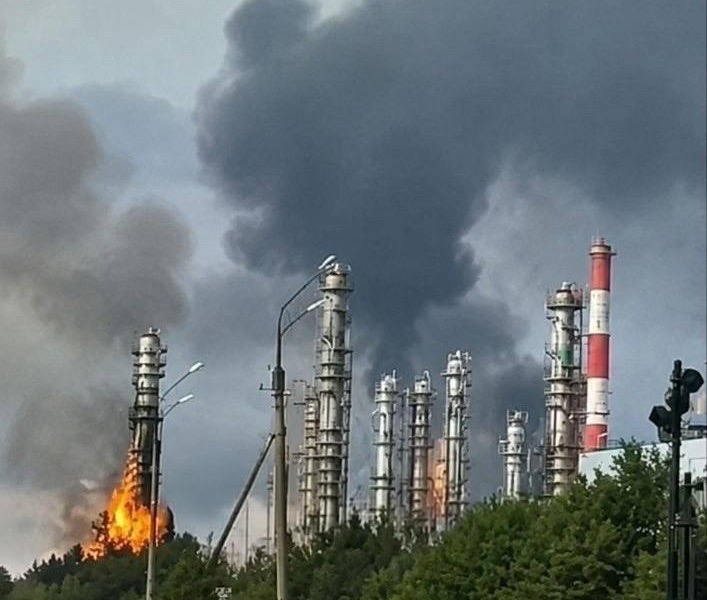
Russia’s refining sector is being taken apart one processing unit at a time. On the night of August 9–10, Ukrainian drones reached into two of Russia’s most important fuel-producing regions within hours of each other, striking the Saratov oil refinery and, roughly 1,200 kilometers further east, the Taneco refinery in Tatarstan, the fourth consecutive night of confirmed Ukrainian strikes on Russian oil infrastructure. “A just peace is closer with every target struck on the territory of the Russian Federation that is involved in its criminal war against Ukraine,” Ukraine’s General Staff said of the Saratov operation.
A strike deep in Russia’s interior
Tatarstan head Rustam Minnikhanov described a “massive” drone attack on industrial and civilian facilities in Nizhnekamsk, a city roughly 1,200 km east of the Ukrainian border, according to CBS News. Taneco is no minor target: the plant has an annual processing capacity exceeding 16 million tons of oil and plays what Ukrainian officials describe as a key role in fueling the Russian military. A fire broke out at the facility following the strike, and the General Staff said the same overnight operation also hit a Russian repair unit in Khrustalnyi (Luhansk Oblast), a logistics depot in Novoselydivka, and a field artillery depot in Boiove, both in Donetsk Oblast.
The Saratov refinery, struck the same night, supplies fuel directly to Russian forces fighting in Ukraine and has an annual processing capacity of roughly 7 million tons. Together, the two strikes show Ukraine is no longer choosing between reach and precision: it is achieving both on the same night, hitting a front-line-adjacent facility and one deep in Russia’s industrial heartland in a single coordinated operation.
Confirmation is also catching up with earlier claims. Euromaidan Press reported that the General Staff has now confirmed the August 8 strike on the Ilsky refinery in Krasnodar Krai damaged its AVT-6 primary crude distillation unit, a direct hit on a processing chokepoint, not the peripheral “debris damage” that regional authorities described at the time. Reports of a blackout in Russian-occupied Simferopol and fires in Donetsk Oblast the same night as the Taneco strike remain sourced only to monitoring channels and are unconfirmed by the General Staff or international wire services.
Hunting for the chokepoints, not the fireworks
The Taneco and Saratov strikes extend a pattern that has shifted decisively in mechanism over recent months. Early in the campaign, Ukrainian strikes concentrated on storage tanks and central distillation columns, assets that burn dramatically on camera but are, in practice, cheap and fast to replace, and where Russia held surplus capacity to absorb the loss. That is no longer the primary target set. Strikes are increasingly aimed at crude distillation units (CDUs) and secondary processing equipment, including hydrocrackers, reformers, and fluid catalytic crackers: the installations that sit at the front of the refining process and determine how much crude a plant can process at all.
Energy analyst Isaac Levi of the Centre for Research on Energy and Clean Air (CREA) told the Irish Times that damage to these units can strip a refinery of most of its processing capability even when the rest of the plant remains physically intact, with repairs typically running several months rather than days. That mechanism was on display in July, when a strike disabled both primary CDUs at the Gazprom Neftekhim Salavat complex in Bashkortostan, halting the plant entirely. The Kstovo refinery in Nizhny Novgorod, struck on May 18 and 20, still showed no heat signature in its distillation unit as of a July 18 satellite pass: a facility effectively dead for two months and counting.
Repairs are slower still because of what Russia can no longer buy. Repairing secondary processing units requires specialized pumps, compressors, catalysts, and electronic components historically sourced from Western suppliers; under sanctions, Russian firms must now source or improvise these parts domestically or through parallel-import workarounds, according to Riddle, which describes the effect as a “double strike”: physical damage compounded by a sanctions-extended recovery timeline. Compounding it further, Ukraine has begun repeatedly re-striking the same facilities as they attempt to restart, turning outages that once lasted a matter of days into open-ended shutdowns.
A network with nowhere left to hide
The scale of geographic exposure is the campaign’s clearest strategic signal. As of early July, strikes had disabled 42.7% of Russia’s designed refining capacity and had reached all 11 of the country’s largest refineries, from Yaroslavl in the west to a unit hit in Omsk, some 2,500 kilometers from the Ukrainian border, and Bashneft-Novoil in Bashkortostan roughly 1,300 kilometers from the front line, according to United24 Media. The August 5–6 strikes on Slavneft-Yanos in Yaroslavl, one of Russia’s five largest refineries with a capacity of about 15 million metric tons a year, and on Bashneft-Novoil fit this pattern; Zelensky described the operation as part of Ukraine’s “long-range sanctions” on Russian oil revenues used to finance the war.
The map keeps widening. The August 8 strikes on the Kuibyshev refinery in Samara Oblast and the Ilsky refinery in Krasnodar Krai, which also hit a surveillance post on a Black Sea drilling rig, pulled southern Russia into the same week’s targeting alongside the western and Volga strikes. No single region of Russia’s refining base now sits meaningfully outside drone range.
The cumulative numbers explain why Moscow is struggling to keep pace. Ukrainian forces have struck Russian refineries roughly 50 times between mid-April and July 13 alone, hitting at least 24 of the country’s 34 large plants and driving refining volumes to their lowest level in more than two decades, with total sector losses since August 2025 estimated at $13.5 billion, according to Bloomberg. Russian oil companies have restored only slightly less than half of the capacity knocked out by recent strikes, with facilities representing a combined 45 million tons of annual crude capacity still offline as of August 10.
Stability on paper, rationing on the ground
Russian officials have publicly described the fuel market as recovering. Deputy Prime Minister Alexander Novak said on July 25 that the situation “is gradually stabilizing,” citing improved balances at filling stations, according to S&P Global. Set against the emergency measures Moscow has simultaneously been forced to enact, that language reads less like an assessment than a talking point. On July 30, the government extended its combined gasoline-and-diesel export ban from August 1 through January 31, 2027, a longer horizon than the original ban, which had been due to expire July 31, while a separate jet fuel export ban runs until November.
The technical concessions tell the same story from a different angle. In early July, Prime Minister Mikhail Mishustin signed a decree permitting refineries to sell gasoline meeting only the lower-grade Euro-3 standard, a downgrade from the Euro-5 specification mandated since 2016, through the end of 2026, a move that raises both sulfur content and pollution. Several regions have also imposed license-plate-based purchase rationing at the pump, and Putin himself acknowledged localized shortages on June 28, even as Novak’s public language continues to emphasize recovery.
By mid-June, Russia’s gasoline output stood roughly 25% below June 2025 levels, with current production estimated at around 20% below domestic demand. A government relaxing its own fuel-quality law and rationing supply at the pump while describing the underlying market as healing is not stabilizing; it is managing decline in public while absorbing it in private.