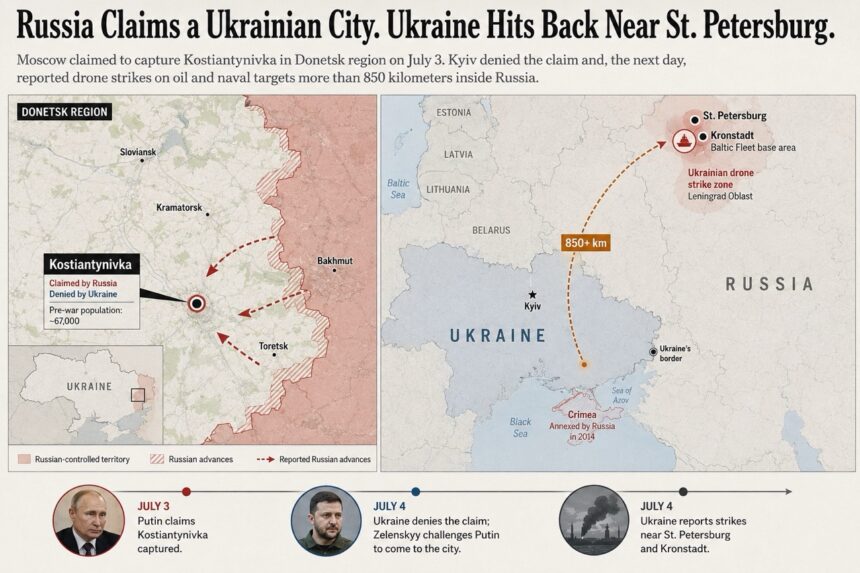
Russian President Vladimir Putin claimed on July 3 that Russian forces had captured Kostiantynivka, a strategic city in eastern Ukraine’s Donetsk region, but Kyiv rejected the statement as false and independent evidence does not confirm Moscow’s version.
Kostiantynivka had about 67,000 residents before the full-scale invasion and sits roughly 25 kilometers south-west of Kramatorsk, one of Ukraine’s main remaining military and administrative hubs in Donetsk. Its value is not symbolic alone: the city is part of the defensive belt shielding Kramatorsk and Sloviansk. Reuters reported Moscow’s claim after Putin visited a Russian command post, where Chief of the General Staff Valery Gerasimov briefed him on the front.
Ukraine’s General Staff said Russian troops carried out 11 assault actions in the Kostiantynivka sector on July 3 and failed to achieve success. It reported small infantry groups of one to three soldiers infiltrating Ukrainian positions, with counter-sabotage operations underway inside the city. That describes active fighting and infiltration, not confirmed Russian control.
Ukrainian President Volodymyr Zelenskyy rejected Putin’s statement as “just another Russian lie” and turned it into a public challenge, saying that if Kostiantynivka were really under Russian control, Putin should have “no problem” meeting him there “to find a diplomatic way to finally end this war.” The Kremlin rejected the idea.
At the same command-post meeting, Putin ordered an assessment of Ukraine’s foreign supporters, calling them “instigators” of continued war and saying Moscow may need the analysis for future “responsible decisions.” The language was another threat aimed at European and NATO supporters of Kyiv.
Ukraine, meanwhile, struck deep inside Russia. Ukrainian drones hit the St. Petersburg oil terminal and a military site in Kronstadt, a Baltic Fleet base area more than 850 kilometers from Ukraine’s border. Russian officials said 72 drones were intercepted around the city. The strike followed Russia’s major attack on Kyiv, which killed at least 30 people and injured more than 90, and continued Ukraine’s campaign to hit oil and military infrastructure that supports Russia’s war.