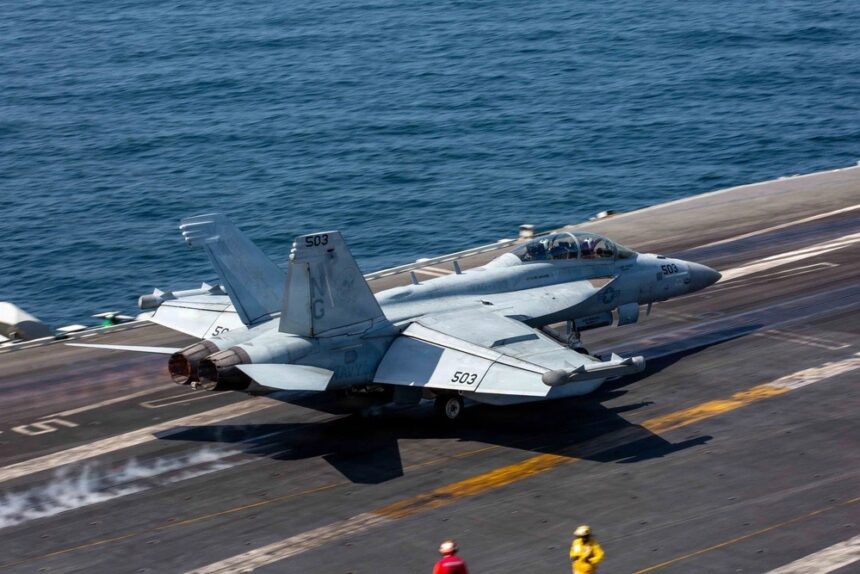
An EA-18G Growler launches from the aircraft carrier USS Abraham Lincoln in support of strikes against Iran on February 28, 2026. Source U.S. Central Command / U.S. Navy, public domain.
The US President Donald Trump threatened Iran with a massive new attack, assembled the option, then called it off, in a now-familiar pattern. Saudi Crown Prince Mohammed bin Salman cautioned him against the strikes, according to CBS News, echoing an earlier episode in March when Reuters reported that Gulf states warned Trump directly that strikes on Iran’s power plants would trigger Iranian retaliation against their own energy and desalination infrastructure, targets Washington cannot guarantee to defend.
Trump said on Truth Social that Iran and other Middle Eastern countries had asked him to hold off because “the perimeters of a deal has been agreed to,” and that he had agreed to cancel the attack “subject to being able to rapidly make a DEAL.” He said the arrangement would include the “Immediate, Complete, and Total OPENING OF THE HORMUZ STRAIT, and an end to Iran’s nuclear threat,” and that Israel “joins me in this commitment,” according to CNBC.
No completed settlement has been demonstrated. Iranian semi-official media denied Trump’s account outright, rejecting the claim that Tehran had asked for a pause and denying any agreement to divide control of the strait, according to The Times of Israel. The Associated Press described the pattern as a repeated cycle of American threats, pauses, negotiations and renewed strikes.
The pattern holds across both episodes. Regional access and coalition support amplify American power, but partners who host it, and who sit inside Iran’s retaliatory range, can sharply narrow how that power gets used.
Destruction Is Not Compellence
The United States entered Operation Epic Fury with maximalist objectives: destroy Iran’s ballistic-missile and drone capabilities, eliminate its navy, dismantle its defense-industrial base and prevent it from obtaining a nuclear weapon.
The scale of force was enormous. CENTCOM claimed more than 9,000 targets struck and over 140 Iranian vessels damaged or destroyed in the campaign’s first 24 days. American strikes severely damaged Iran’s conventional navy, but its asymmetric denial architecture survived sufficiently to keep Hormuz contested, according to Janes.
Iran’s naval doctrine had always split its forces: a conventional blue-water fleet for open water, and an anti-access/area-denial (A2/AD) posture, a strategy of using mobile, dispersed weapons to deny an enemy access to contested waters, run by the Revolutionary Guards’ navy for the Gulf itself. That doctrinal division, built on mobile coastal missile batteries, fast attack craft, sea mines and one-way attack systems, is described by Gulf International Forum. Mobile launchers hidden along the coast are extremely difficult to eliminate through airpower alone, and Iran’s mine inventory creates a persistent clearance burden if deployed.
Iran does not need to defeat the United States conventionally. It needs to survive, preserve enough retaliatory capacity and make every additional American strike cost more than the concession Washington expects to obtain.
The Soft Legs Beneath American Power
The constraint is industrial as much as strategic, and it is not confined to Iran’s own borders. The Washington Post reported this month that Gen. Alexus Grynkewich, head of US European Command, privately warned the Pentagon that a shortage of Navy destroyers may force him to choose between defending the US homeland and continuing to shield Israel from Iranian missiles. The same class of ship is needed to reassure NATO against Russia and to help deter China in the Pacific, the finite-asset problem recurring one hull at a time.
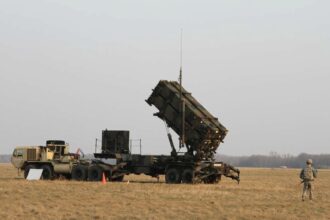
CSIS reported in late July that Patriot inventories had fallen below 1,000 and THAAD inventories to roughly 250. Neither system has a satisfactory substitute against ballistic threats, while expensive interceptors were generally not used against cheap drones except in limited cases, according to a separate CSIS assessment, and rebuilding the most depleted stocks could take years.
CSIS’s own analysts drew the line to the Pacific explicitly, stating that the expended munitions create a near- to medium-term risk to American readiness for a war against China, a concern the Trump administration’s 2027 budget request for munitions funding reflects. Every Patriot or THAAD interceptor fired at an Iranian ballistic missile is one fewer available to protect American forces or reinforce defenses in the Pacific, and Beijing does not need to act during the gap. It only needs to know the gap exists.
The End of Cheap Primacy
Russia’s war against Ukraine demonstrates the same division between destruction and political achievement, without creating any moral equivalence between the aggressor and its victim. Russia attacks Ukrainian cities almost daily, yet more than four years after its unprovoked invasion it has neither destroyed Ukrainian statehood nor compelled Kyiv to accept Moscow’s core demands. The IISS assesses that Russia’s attritional strategy has so far failed despite its far larger population and economy.
Both wars point to the same underlying shift. Cheap sensors, one-way attack drones, sea mines and globally connected commercial supply chains have democratized precision interdiction, technology once reserved for major militaries. A state no longer needs a navy to deny the sea or an air force to threaten a superpower’s bases. It needs dispersed, replaceable weapons and the will to absorb punishment while its adversary burns through a finite, slow-to-replace arsenal, making denial comparatively cheap to impose and compellence increasingly expensive to achieve.
The United States remains the only military power capable of sustaining an operation of this reach and complexity. But superpower status describes capacity, not automatic compellence. Nuclear use would be catastrophic and still would not create political control over Iran, and if conventional escalation cannot secure Washington’s maximalist objectives at an acceptable cost, no viable military shortcut remains.
Trump did not stop because Iran became stronger than America. He stopped because Iran demonstrated that further American escalation could become more expensive than restraint, an equation now being studied in Beijing, Moscow and Pyongyang.
The colossus still stands. Its legs, however, are exposed, and its adversaries now know where to strike.