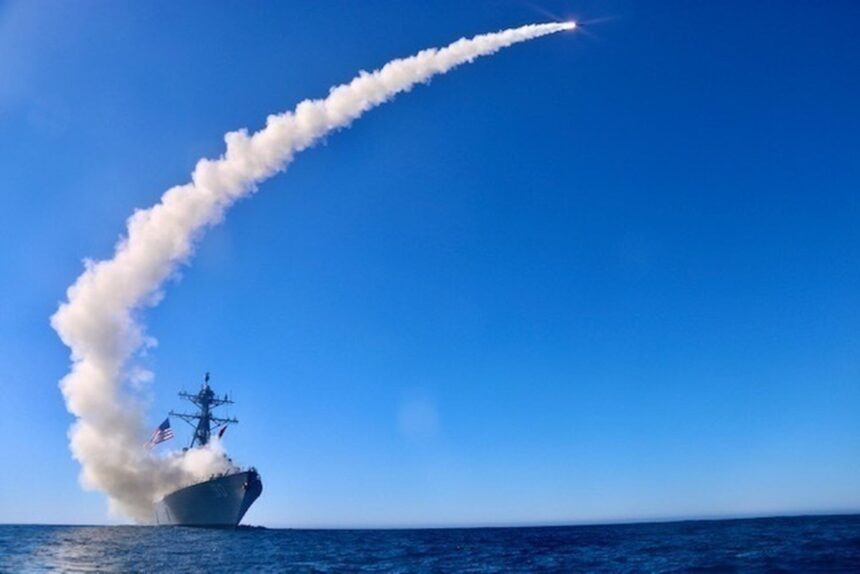
The United States is accelerating missile production as prolonged warfare in Ukraine and Iran strains precision-strike and air-defense arsenals. Raytheon, an RTX business, announced on August 17 that it had received a seven-year, $22.9 billion Navy contract to expand Tomahawk cruise missile production under the Department of War’s “Arsenal of Freedom” initiative. The deal funds a ramp already targeted in February framework agreements: from roughly 60 Tomahawks a year toward more than 1,000 annually.
The expansion follows sharp depletion of air-defense interceptors during the war on Iran: a July 27 CSIS analysis found the US had just over a third of its Patriot interceptors and about half its THAAD interceptors left, warning that “diminished stockpiles may force the United States and its coalition partners to take more risks with interceptions.” The White House disputed the severity of the shortage; President Trump said the US has “far more munitions than anyone in the world.” The watchdog group Project On Government Oversight has separately cautioned that Tomahawk output is constrained by manufacturing capacity rather than funding, estimating a 47-month lead time from contract signing to delivery.
Ukraine illustrates the same pressure from a different angle. Kyiv has developed indigenous long-range strike systems such as the Palianytsia rocket-drone, but these complement rather than replace Western interceptors, and President Volodymyr Zelensky said this month that allies have delivered only a third as many air-defense interceptors in 2026 as over the same period last year. The contract reflects a broader shift in defense-industrial policy: multi-year procurement lets manufacturers invest in workforce and suppliers, but the scale of current demand is testing whether production capacity, not just funding, can keep pace with sustained missile warfare.