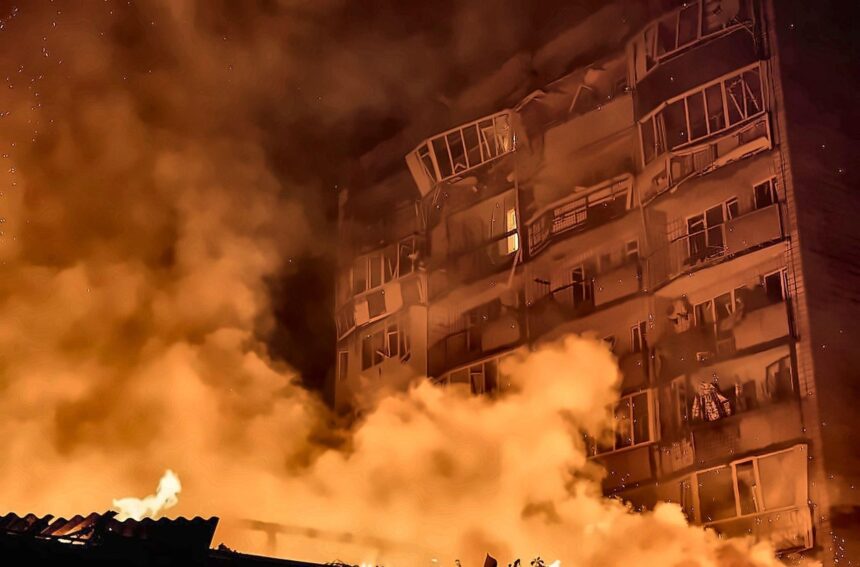
Russian forces launched a coordinated, multi-vector strike across Ukraine overnight, concentrating the largest share of the barrage on Kyiv in what defense officials described as an attempt to overwhelm the capital’s layered air-defense coverage around dense civilian and infrastructure clusters. According to the Kyiv Post, ballistic and Kalibr cruise missiles combined with jet-powered drones killed at least five people and injured 23, damaging a children’s hospital, a school and a five-story residential building across more than a dozen sites in the capital. Separately, a Russian drone strike on police headquarters in Zhytomyr earlier in the night killed two people and injured more than 40, the Kyiv Independent reported.
Ukraine’s Air Force said the salvo combined Oniks, Zircon, Iskander-M and S-400 ballistic weapons with Kh-101/Iskander-K cruise missiles, Kalibr missiles, two S8000 “Banderol” loitering munitions and roughly 168 Shahed-type drones and decoys, with Ukrainian forces reporting 186 targets downed or suppressed. The Banderol — a jet-powered hybrid munition capable of speeds above 500 km/h — has increasingly featured in Russian strike packages in recent months, a pattern Ukrainian officials and analysts say adds strain to interceptor stockpiles by forcing air defenses to engage faster, harder-to-track targets.
Russian forces also struck southern Odesa Oblast, cutting power to roughly 13,000 subscribers by morning and setting fire to two trailer trucks carrying food supplies, according to regional officials.
Ukraine mounted its own long-range response, striking an oil refinery in Russia’s Tatarstan region and an oil terminal in Krasnodar Krai overnight, the Kyiv Independent reported, extending Kyiv’s campaign to degrade Russian refining capacity and Black Sea export logistics that has caused recurring domestic fuel shortages.
The night’s exchange reflects a structural asymmetry both sides are racing to exploit: Russia’s ability to saturate Ukrainian air defenses faster than allied interceptor stocks can be replenished, against Ukraine’s strategy of imposing direct costs on the refining and export infrastructure funding Moscow’s war.