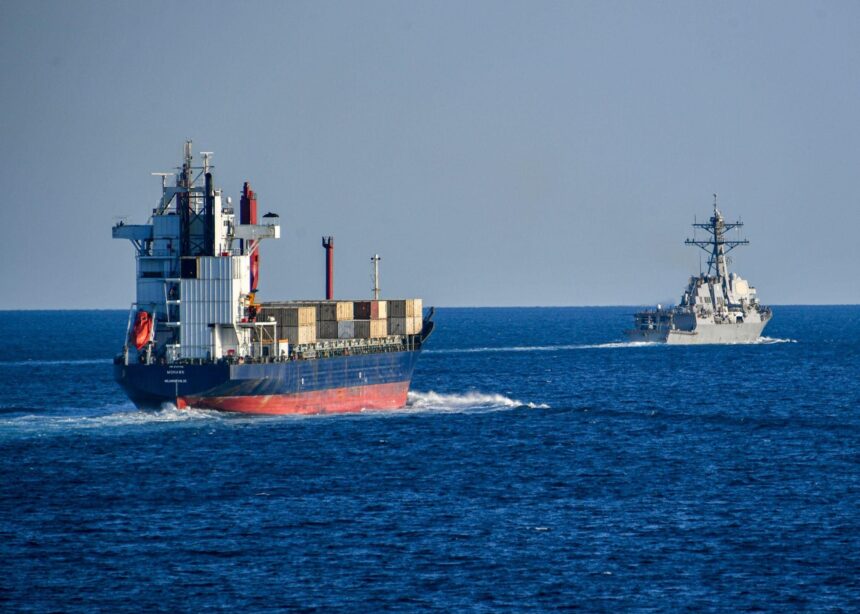
The U.S. military has built an armed convoy system through a southern channel of the Strait of Hormuz, hugging the Omani coastline, that now moves roughly 10 million barrels of crude a day out of the Persian Gulf. Two U.S. officials described the operation to Axios, which first reported it. The route keeps tankers on Oman’s side of the strait, clear of Iran’s primary anti-ship missile zones, and has restored roughly half of pre-war export volumes even as the broader U.S.-Iran war stays stalemated.
Each night, the operation moves both outbound laden tankers and empty inbound vessels, collecting crude from the UAE, Bahrain, and Kuwait. A task force based at the Army’s 82nd Airborne Division at Fort Bragg coordinates the schedule, while U.S. Air Force jets patrol overhead for Iranian drones and cruise missiles. One official said forces shot down eight drones and two cruise missiles in a single night this week.
Maritime trackers including Lloyd’s List and Windward report that most Hormuz-area transits, including much of the Oman-side traffic, now run with AIS transponders switched off, a pattern consistent with the strait’s security risks. It’s not confirmed whether vessels in the U.S.-coordinated convoys do the same.
The convoy system followed a two-week U.S. Central Command campaign that degraded Iranian coastal radar, officials said. Iran’s monitoring now relies mainly on a few reconstituted radars and small-boat spotters, and Axios described Iranian forces firing drones and missiles in the general direction of suspected shipping lanes rather than at tracked targets.
The corridor gives Washington a real buffer against global price shocks at a moment when diplomacy is frozen. The 60-day deadline under June’s U.S.-Iran memorandum of understanding expired Aug. 17 without a deal, and President Trump told Axios the U.S. is “not negotiating with Iran at the moment.” With talks stalled, the corridor is likely to remain the main mechanism managing Gulf energy flows for as long as the deadlock holds.