
Analysis
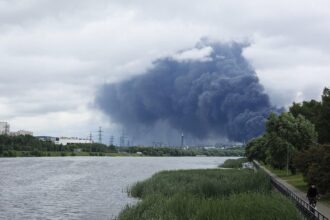
How Ukraine’s Drones Are Draining Russia’s Fuel Tanks
Ukraine's long-range strike campaign has pushed Russia into its most widespread fuel crisis of the war, disabling as much as 40% of the country's refining capacity and splitting Russia into rationing zones and stockpiling zones. The pressure now extends beyond refineries to the tankers supplying occupied Crimea, isolating the peninsula's Russian garrison even as Moscow answers with a deliberate campaign against Ukrainian civilian fuel stations and cities.The crisis has been building since 2025, when Ukraine expanded a campaign of drone and missile strikes against Russian oil refineries, terminals and pipelines deep inside Russian territory. Estimates of the damage diverge sharply, and the gap is not just measurement noise. Ukraine's General Staff put disabled capacity at 42.74% as of early July, while the International Energy Agency cited "more than 20%." According to UNN, citing the General Staff, the higher Ukrainian figure reflects a deliberate shift in targeting: strikes now concentrate on…

Belarus Caught Between Russian Pressure and Ukrainian Deterrence
Belarusian President Alexander Lukashenko made an unusually explicit promise to his servicemen in early July: "No one is going to send you into this slaughter." The declaration came after weeks of rising tension. Ukrainian President Volodymyr Zelenskyy openly accused Russia of trying to pull Belarus deeper into the war, Kyiv threatened action against military infrastructure inside Belarus that it said was assisting Russian attacks, and Lukashenko held closed talks with Russian President Vladimir Putin before travelling to Beijing to meet Chinese President Xi Jinping. The Wall Street Journal reported in June, citing current and former Russian and European officials, that Moscow had begun a pressure campaign earlier in 2026 aimed at using Belarus as a springboard to expand the war in Ukraine or conduct unconventional operations against NATO states. The Kremlin denied the report. Behind these developments lies a three-way strategic struggle Putin is seeking to draw Belarus deeper into…

China Helped Plan Starlink Destruction, Probe Finds
A joint investigation by The Insider, Der Spiegel, and Le Monde has found that China's proclaimed neutrality in Russia's war on Ukraine conceals years of military-technical cooperation, structured around an explicit three-tier plan to disable Elon Musk's Starlink network. By fall 2023, Starlink had become Ukraine's primary battlefield communications system, with over 40,000 terminals delivered by that November, when Chinese defense engineers met secretly in Guangzhou, per The Insider. The plan escalates in tiers rather than a loose menu. Tier one is regulatory sabotage: diplomatic protests against Starlink's orbital footprint paired with joint spectrum and orbital-slot applications meant to block its expansion bureaucratically. Tier two is offensive cyber activity against civilian terminals, using fabricated credentials and vulnerability exploitation to paralyze the network. Tier three is kinetic attrition, physically destroying satellites faster than SpaceX can replace them. The transactional logic is clearest in the drone program. At a December 2024 Yekaterinburg…

Europe Can Spend More on Defence, challenging its industry
NATO leaders met this week in Ankara to review a defence spending commitment now four years in the making. French President Emmanuel Macron argued that Europe had fundamentally strengthened its defence effort. The summit suggested that point is no longer in serious dispute. The harder question is whether unprecedented spending commitments can be converted into lasting military capability built inside Europe rather than purchased abroad.The mechanism driving that spending is already in place. At the 2025 NATO summit in The Hague, the alliance’s 32 members agreed to invest 5 percent of GDP annually on defence and security by 2035 – 3.5 percent on core military requirements and 1.5 percent on related infrastructure, cyber defence and national resilience. Spain secured an exemption, keeping its commitment close to 2.1 percent of GDP. The agreement effectively replaced the 2 percent benchmark adopted at the 2014 Wales summit, more than doubling NATO’s baseline expectation…
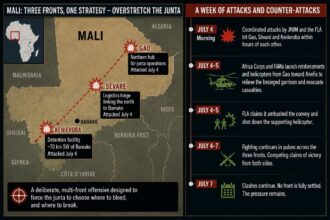
Mali’s Week of Reckoning: Russian Losses Mount as Islamists Press a Multi-Front War
For the past week, Mali’s Russian-backed junta and its military partners have been fighting on three fronts at once. After a relative lull following April’s violence, JNIM and the Tuareg-led Azawad Liberation Front (FLA) renewed their offensive around July 4, a resurgence Al Jazeera itself described as "renewed" attacks, striking Gao in the north, Sévaré in the center, and the Kenieroba detention facility roughly 70 km southwest of Bamako, all within hours of each other. Fighting has continued in pulses since, with contested clashes reported through July 7. The geographic spread looks deliberate: Gao is the junta’s main regional hub, Sévaré is the logistics hinge linking northern operations to the capital, and Kenieroba sits close enough to Bamako to strike at the seat of power itself. Hitting all three forces forces a choice between reinforcing the north and protecting the capital’s approaches, exactly the kind of dilemma a smaller, better-organized…
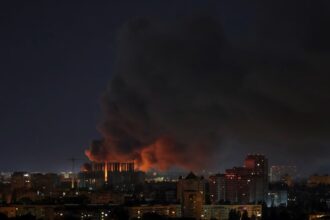
Russia Accelerates Ballistic Strikes on Kyiv
Russia struck Kyiv with ballistic missiles for the third time in less than a week overnight on July 7–8, killing one woman and wounding two as Ukraine again failed to intercept any of the ballistic missiles fired at the capital.Ukraine’s air force said it downed 139 of 169 drones launched across the country, but none of the five ballistic missiles used in the attack, Reuters reported. Fires broke out in warehouses and non-residential buildings in Kyiv, while Kharkiv also came under missile attack.The drone figures show that Ukraine can still defeat much of Russia’s mass unmanned barrage. But they also hide the harder problem: ballistic missiles require scarce Patriot-class interceptors, and Kyiv’s stock of those weapons is under acute pressure.The pattern is becoming more severe. Since the start of July, Russian strikes on Kyiv and the surrounding region have killed 60 people, according to Reuters. Ukrainian air-force data cited by…
