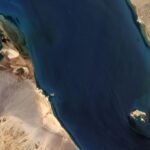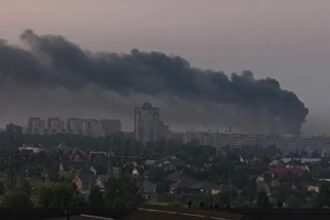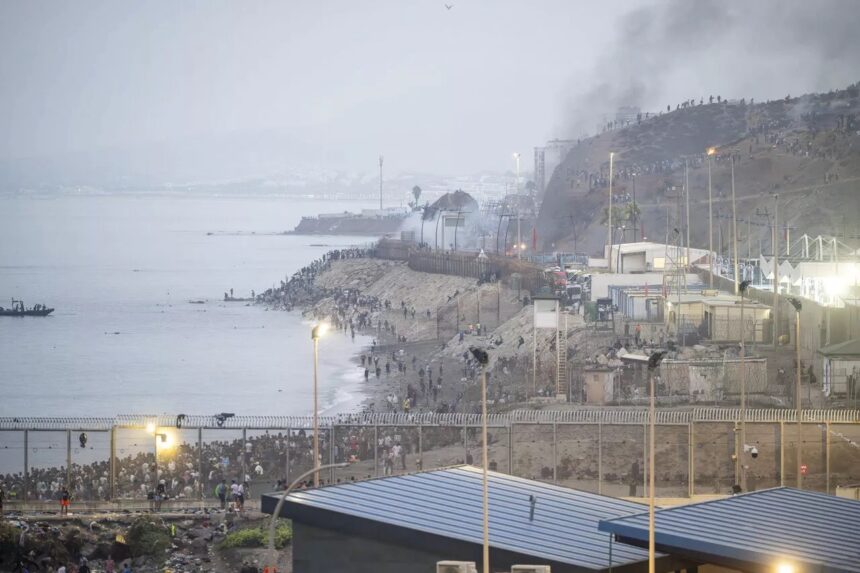
For a few hours on the Moroccan coast, a border simply stopped existing. As many as 60,000 people crossed by land and sea into Spanish territory, and by the time anyone in Madrid or Brussels had finished convening emergency calls, the crisis’s political effects were already spreading across Europe.
Ceuta’s government estimated that approximately 60,000 people entered within 24 hours, equivalent to about 70% of the city’s population, while Spain’s Interior Ministry put the number closer to 50,000. At least 57 people died from drowning, crushing and other causes during the disorder. Madrid said 48,300 had returned to Morocco by Friday evening, many voluntarily after finding Ceuta unable to provide accommodation, food or onward passage, according to the Associated Press. Italy temporarily restored passport controls for air and sea travel from Spain, France strengthened checks on its Spanish border, and Austria considered further restrictions – all inside the Schengen Area, Europe’s passport-free travel zone of 29 states.
Morocco Opens the Valve
Morocco says the crossings occurred against its wishes, and its security services undeniably retain the manpower to seal this frontier within hours. That is precisely what happened once Moroccan authorities restored enforcement: gendarmes who had let thousands pass switched to water cannon and warning shots, and the border reverted to its normal, tightly policed state almost as quickly as it had opened.
An AP photographer witnessed Moroccan gendarmes standing aside while thousands passed. El País reported that Moroccan units blocked crowds in some areas while allowing people to continue toward Ceuta along the coast, and one local official reportedly described the coastal passage as Spain’s problem, calling it a matter of diplomacy rather than security. Morocco used a similar mechanism in May 2021, after Spain admitted Polisario Front leader Brahim Ghali for medical treatment: Rabat relaxed its border controls, roughly 8,000 people entered Ceuta, and the European Parliament later condemned Morocco’s use of migrants and unaccompanied minors as political pressure.
The most immediate plausible trigger is bilateral. Prime Minister Pedro Sánchez visited Algeria – Morocco’s regional rival and Spain’s principal gas supplier — on July 20, and Ceuta and Melilla remain contested territory that Rabat has never recognized as Spanish. That dispute offers a plausible reason for Rabat to pressure Madrid. It does not explain the speed with which Russian state media converted the images into a wider narrative of European failure.
Moscow’s Long Game in the Maghreb
Russia has spent years building a presence in Morocco unrelated to any single border incident: expanded diplomatic and trade ties, new road and aviation agreements signed this year, technology proposals covering cybersecurity and smart cities, and a Rossotrudnichestvo cultural center in Rabat – a so-called Russian House, part of a network researchers describe as the Kremlin’s primary soft-power tool across Africa. Bilateral trade grew by almost 30% during the first half of 2025, according to the Russian government. That relationship carries growing practical weight: Reuters via Caliber.Az reported July 31, citing two industry sources, that Russia received roughly 30,000 metric tons of gasoline shipped by Lukoil from Tangier to Murmansk – making Morocco the third country, after India and Kazakhstan, to supply Russia with emergency gasoline this summer, after Ukrainian strikes shut down between one-quarter and one-third of Russia’s refining capacity, according to Le Monde.
None of this contradicts Russia’s parallel defense relationship with Algeria, where former commander Sergei Surovikin heads Moscow’s group of military advisers. Russia builds political, commercial, cultural and institutional footholds on both sides of the Morocco-Algeria rivalry, and its military and security presence across Algeria, Libya and the Sahel gives it proximity to several migration corridors leading toward Europe’s southern frontier – proximity that forms part of the strategic environment without proving operational control of the Ceuta crossing.
This is not Moscow’s first attempt to turn displacement into leverage. Russia did not create Syria’s displacement crisis, but its 2015 intervention intensified the war and the flight of civilians toward Turkey and Europe, leading NATO’s senior military commander to accuse Moscow and Assad of weaponizing migration. Belarus, supported by Russia, created an artificial migration route into the EU in 2021; the operation persisted, and by 2024 the European Commission said more than 90% of those crossing the Polish-Belarusian border carried Russian student or tourist visas, describing it as an attempt by Russia and Belarus to destabilize the EU and weaken support for Ukraine. Russia’s 2022 invasion of Ukraine then displaced millions more – mass flight caused by war rather than an engineered operation, though both strained European asylum systems and strengthened anti-migration politics.
The Convergence
The value of Ceuta to Moscow has little to do with whether any of the 60,000 people who crossed remain in Spanish territory. Most have already gone home. What does not reverse so easily is that Italy, a fellow Schengen member with no direct role in the Moroccan border dispute, felt compelled to reinstate passport checks against Spain within days. The border opening itself was sufficient to trigger emergency controls elsewhere in Europe. Russian amplification then placed those measures inside an existing narrative of Schengen collapse, uncontrolled migration and European institutional failure.
Foreign Ministry spokesperson Maria Zakharova used the moment to mock European warnings about a Russian invasion, claiming Europe had instead been overtaken from North Africa, and Russian information channels circulated the Ceuta images as evidence of European weakness. The timing sharpens the picture: the EU adopted its 21st sanctions package against Russia’s energy, financial and crypto sectors on July 23, during the buildup and one week before the mass crossing of July 30. For Moscow, the shock offered the effects of an asymmetric response: European attention was redirected, Schengen governments imposed controls on one another, and political movements hostile to continued support for Ukraine received powerful new imagery.
No document proves Moscow instructed Moroccan forces to step aside. What is established: Moroccan forces facilitated or tolerated the crossing before restoring enforcement within days, and Russian officials and state-aligned channels rapidly exploited and amplified the crisis. What remains an analytical assessment, not a proven fact, is that the event’s methods and effects fit a pattern Russia has cultivated and exploited before, from Syria to Belarus — while direct Russian tasking, financing or operational control of Morocco’s decision remains unproved. The strongest defensible conclusion is not that Russian command has been demonstrated. It is that a Moroccan coercive action produced exactly the vulnerabilities Moscow has repeatedly cultivated – and Russian information structures recognized and weaponized the opportunity immediately.