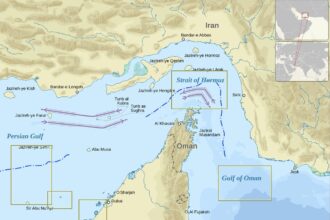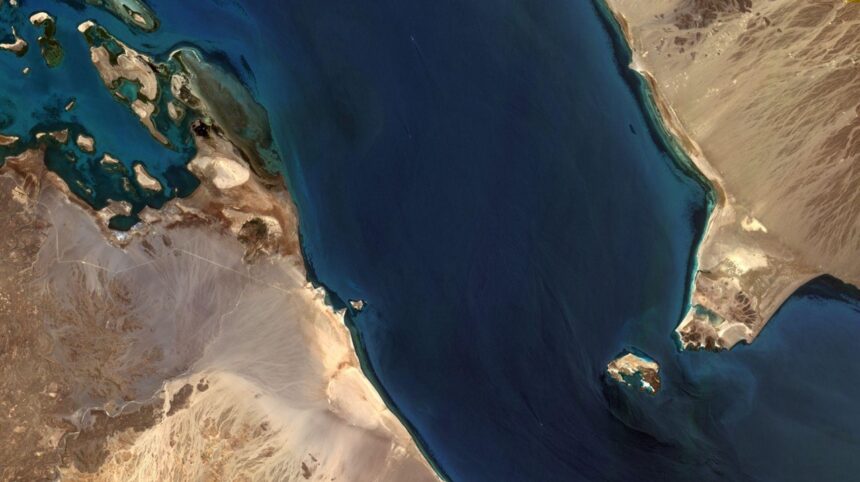
For months, global oil markets have fixated on the Strait of Hormuz, the chokepoint at the mouth of the Persian Gulf that carried roughly 15 million barrels a day before the US and Iran resumed fighting this year. Now a second artery is closing. The Bab-el-Mandeb Strait, the gateway between the Red Sea and the Indian Ocean that shipping had been using to route around Hormuz, is itself under attack — and a third, older threat, Somali piracy, is exploiting the resulting security vacuum.
How the Houthis Reopened a Second Front
The immediate trigger was a Houthi decision to abandon a 2022 truce with Saudi Arabia. According to Reuters, Iran instructed the Houthis to close the Red Sea gateway if the US struck its power grid; an Islamic Revolutionary Guard Corps delegation reportedly flew to Houthi-held Yemen on July 13 with military cargo. Within weeks, the Houthis were attacking Saudi Aramco infrastructure at Jizan and Yanbu and striking tankers. On July 7-8 they attacked the Eternity C, a Liberian-flagged, Greek-owned bulk carrier, alleging its owner’s vessels called at Israeli ports; the ship sank on July 9 after the EU’s Aspides naval mission confirmed it had pulled survivors from the water. Traffic through the strait has collapsed accordingly: just 11 vessels passed on July 26, versus a pre-escalation average of 55 to 70 a day, Al Jazeera reported.
The Houthis, formally Ansar Allah, are a Zaidi Shia movement that emerged in the 1980s in opposition to Saudi religious influence in northern Yemen. They seized the capital Sanaa and the port of Hodeidah in 2014, survived a decade of Saudi-led intervention aimed at reversing that takeover, and by 2022 had entrenched themselves in power over roughly a third of Yemeni territory, home to some 80% of the country’s population. A 2022 truce with Riyadh freed them to turn on Israel-linked shipping after Hamas’s October 2023 attack, a campaign paused by a Trump-brokered ceasefire in 2025 and now, per Reuters and BBC reporting, effectively resuming.
That resumption has left Riyadh with few good options. Saudi Arabia is shifting crude onto the overland Abqaiq-Yanbu pipeline to its Red Sea port at Yanbu. At the same time, the UAE’s Fujairah terminal offers a Hormuz bypass on the Gulf of Oman side — but the Houthis have already struck Yanbu’s port and claim to have hit the pipeline itself, a claim that remains unverified independently.
Rerouting Around a War
Together, the Yanbu and Fujairah routes can redirect about 4 million barrels a day, Kpler analyst Matt Smith told DW — a meaningful safety valve, but one that covers only a quarter of Hormuz’s normal throughput. The shift also illustrates a trade-off: it converts a mobile, dispersed maritime risk into a fixed, stationary one, since a pipeline cannot be rerouted or escorted the way a tanker can.
Oil prices have moved accordingly. Brent crude climbed back toward $100 a barrel after the US-Iran war resumed, dipped below $90 during a brief lull, and has since risen again amid renewed strikes. Goldman Sachs said Brent could top $120 a barrel by the fourth quarter if disruptions to the Strait of Hormuz persist — though the bank’s base case remains a far more modest $80, meaning this is a risk scenario, not its central forecast.
The costs are already showing up outside the futures market. Rerouting tankers around Africa’s southern coast adds two to three weeks of transit time and, industry estimates suggest, as much as $2.5 million in fuel and vessel costs per voyage — sharply higher than the roughly $1 million such diversions cost in calmer years — expenses that flow through to consumers, while war-risk insurance premiums for Red Sea transits have climbed and the strategic reserves several governments released this spring are running down.
A Vacuum Fills With Old Threats and New Alliances
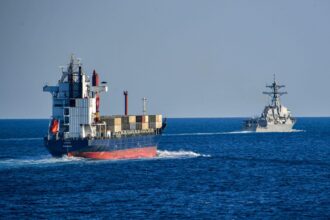
A third, once-dormant threat is now exploiting that same distraction. Somali piracy, declared defeated by the International Maritime Organization in 2022 after a decade of international patrols, is reviving because the warships that used to suppress it have been reassigned: naval fleets that previously focused on anti-piracy patrols off Somalia are now escorting tankers through Hormuz or reinforcing Aspides in the Red Sea instead, a shift Euronews and CNN have both reported. Pirates seized three tankers within about ten days in April alone, Al Jazeera reported, and ransom demands are rising alongside oil prices. US foreign-aid cuts under the Trump administration have deepened the underlying poverty that historically fed piracy recruitment, though precise funding figures circulating in some regional reporting on this point could not be independently verified against USAID’s own data.
The resulting scramble is also redrawing the Horn of Africa’s map. Israel became the first UN member state to formally recognize Somaliland’s independence, Prime Minister Netanyahu’s office announced on December 26, 2025, and Le Monde has since reported that the UAE is quietly building a military facility near Berbera — satellite imagery shows extensive excavation consistent with fuel or ammunition storage — for potential use by the UAE, the US and Israel. Saudi Arabia, by contrast, has emphasized Somalia’s territorial integrity as central to Red Sea security, putting Riyadh at odds with the emerging Abu Dhabi–Washington–Jerusalem alignment even as all three nominally back the same anti-Houthi objective.
None of this began as a maritime crisis. It started as a resumed war between the US, Israel and Iran, and the three actors now profiting from its overflow — Houthi commanders, pirate financiers, and a new alignment of Gulf and Israeli basing interests — never fired a shot at each other to get there. Somewhere between a Houthi missile battery, a fixed pipeline waiting for its first confirmed hit, and a pirate skiff with nothing left to lose, a fifteen-million-barrel habit is colliding with a war that was never supposed to be about oil at all.