President Donald Trump ordered the Pentagon to substantially reduce joint military exercises with South Korea just hours before this year’s Ulchi Freedom Shield drills were due to begin. In a Truth Social post published Sunday, Trump said the exercises were costly and “send a signal that is totally inappropriate and hostile” toward North Korea, which he described as having been “unthreatening and respectful” throughout his presidency. He attributed that assessment to his “very good relationship” with North Korean leader Kim Jong Un.
Trump said he had instructed Defense Secretary Pete Hegseth to carry out the reduction, referring to Hegseth in the post as “Secretary of War,” a secondary title authorized by a 2025 executive order; the statutory title remains Secretary of Defense because Congress has not formally renamed the department. Trump acknowledged the announcement came too late to cancel the exercise outright, but it remained unclear Monday how quickly or extensively the Pentagon could implement his order to scale back drills that had already begun.
Trump added a separate grievance directed at Seoul, saying he had recently asked South Korean President Lee Jae Myung whether South Korea would join U.S. efforts toward the “denuclearization of the Islamic Republic of Iran.” According to Trump, Lee’s answer was blunt: “No thanks!” Trump did not specify what form of cooperation he had sought, though his administration has repeatedly pressed allies for support during the Iran war, including requests tied to the Strait of Hormuz.
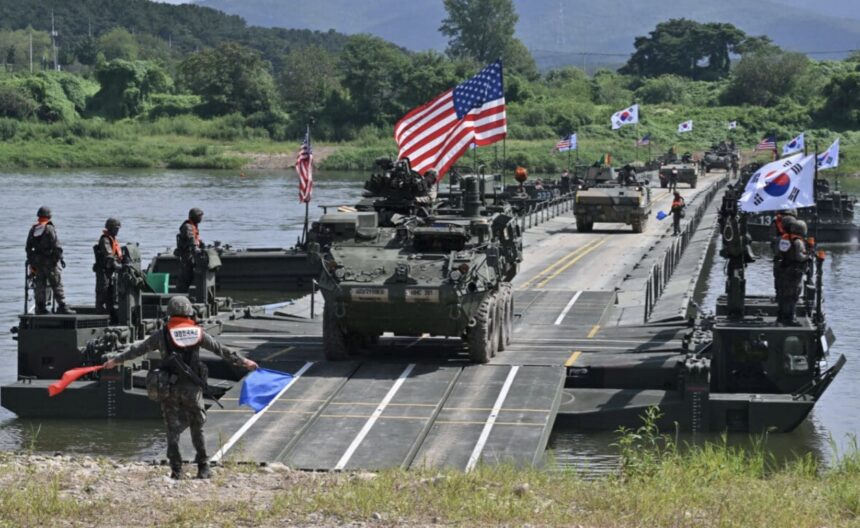
The order strikes directly at the operational mechanics of the alliance rather than serving as a purely symbolic gesture. Ulchi Freedom Shield is built around joint command-post integration, interoperability testing and coordinated response planning, and this year’s iteration was set to include a live-fire exercise to test joint precision targeting and a river crossing operation. Any substantial cuts imposed after preparations were completed could disrupt that planning cycle, while Trump’s decision to frame the order alongside Seoul’s refusal on Iran suggests he is also using military cooperation as leverage within a more transactional approach to the alliance rather than citing budgetary concerns alone.
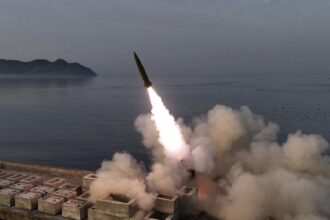
Despite Trump’s order, South Korea proceeded with the drills as scheduled. The 11-day exercise, running from August 17 to 27, involves roughly 18,000 South Korean personnel, a level similar to prior years, while South Korea’s Defense Ministry said Monday the drills were “proceeding as planned.” That divergence exposes a gap between Washington’s political signaling and the drills’ practical execution on the ground. Much of Ulchi Freedom Shield has already shifted in recent years toward computer-based command-post simulation rather than large-scale field maneuvers, a shift that has helped manage political friction with Pyongyang but does not resolve the readiness trade-offs of scaling back the live components that remain.
Trump’s move echoes a decision during his first term, when Washington suspended major exercises with South Korea following his 2018 Singapore summit with Kim. The current reduction comes under different circumstances: North Korea has continued ballistic missile testing and deepened military cooperation with Russia, and its troops have gained battlefield experience supporting Moscow’s war in Ukraine. A deputy commander of the U.N. Command, Australian Lt. Gen. Scott Winter, said the allies factored North Korea’s expanded use of technology, its missile development and lessons from Russia’s war into this year’s exercise planning.
How far the Pentagon carries out Trump’s directive will determine its consequences. A limited scaling-back would leave alliance readiness largely intact, but deeper reductions would test the durability of extended deterrence on the Korean Peninsula, where roughly 28,500 U.S. troops remain stationed, at a moment when Washington’s security commitments across the Indo-Pacific are already under scrutiny from allies watching how the administration treats Seoul.