Myanmar’s military government is expanding its diplomatic outreach across Asia even as conflict monitors report a sharp rise in attacks on civilians, exposing an increasingly stark gap between regional engagement and conditions on the ground.
According to the Armed Conflict Location & Event Data Project, the military recorded more than a dozen mass killings during the first half of 2026, resulting in more than 450 civilian deaths. Nearly 40% of those fatalities occurred in Myanmar’s central dry zone, known as the Anyar region. Reuters reported that the escalation coincided with a restructuring of the military leadership in March.
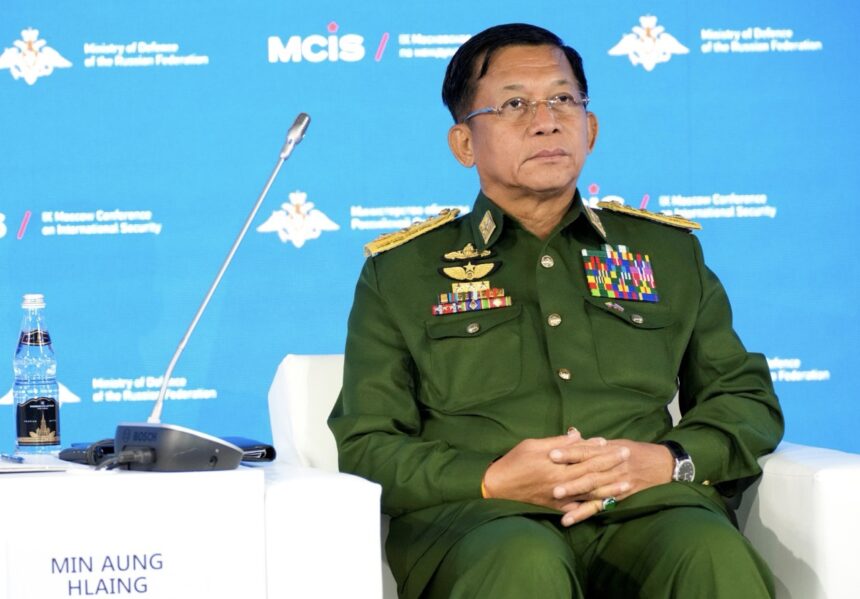
The transition restructured the junta’s top command rather than simply reshuffling titles. Min Aung Hlaing moved into the presidency while operational military authority passed to General Ye Win Oo. ACLED said the military’s repression and aerial bombing campaign had intensified under the new leadership, including the regular use of groups of fighter aircraft conducting sustained strikes against individual targets. Neither ACLED nor Reuters, however, establishes that the command transition alone caused the increase in civilian deaths.
Min Aung Hlaing has meanwhile sought closer engagement with regional governments. He has travelled to China and India and is scheduled to visit Thailand on August 6-7, one of his most significant regional trips since the military seized power in the February 2021 coup. Reuters also reported tentative re-engagement with the Association of Southeast Asian Nations, which had excluded Myanmar’s ruling generals from its summits after the coup.
That outreach is unfolding against a diplomatic record ASEAN has struggled to change. The bloc’s official Five-Point Consensus, adopted on April 24, 2021, called for an immediate cessation of violence, dialogue among all parties, humanitarian assistance and the appointment of an ASEAN special envoy. More than five years later, conflict monitors continue to document mass-casualty attacks against civilians while regional diplomatic engagement with Naypyidaw gradually expands.
Reuters noted that some reported incidents, including witness accounts of killings during a military operation in Myit Chay township, could not be independently verified because access to conflict-affected areas remains severely restricted. The outlet reported that three residents said at least 40 people were killed during the operation, while the incident appeared in ACLED’s database with at least five recorded fatalities.
The contradiction is becoming increasingly difficult to ignore: monitors continue to document mass-casualty attacks, diplomatic engagement steadily expands, and ASEAN’s Five-Point Consensus still lacks an effective mechanism to compel compliance more than five years after it was adopted.