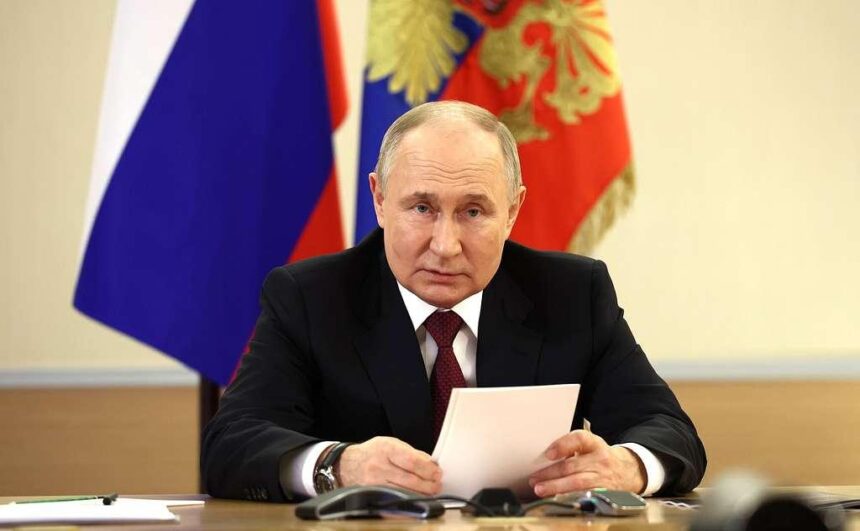
Vladimir Putin does not think the war ends at Ukraine’s border. At a secret December briefing, the Russian president told his security services and military commanders that Moscow’s goal for 2026 is “the collapse of NATO and the E.U. from within,” according to a New York Times investigation published Aug. 14, based on interviews with Moldovan and Western intelligence officials. Moldova, the Times reports, is the next target after Ukraine. That directive is a working method, visible in three places: a decentralized influence machine built to capture Moldova without firing a shot, a diplomatic strategy designed to look open to peace while foreclosing it, and an intensifying bombardment of Ukrainian cities meant to exhaust both Kyiv and its Western backers.
The Moldova Playbook: State Capture Without an Invasion
What The Times describes in Moldova is not simple bribery. It is a structural attempt at state capture, built to stay below the threshold that would trigger a military or diplomatic response. The financing ran through Ilan Shor’s Moscow-based fintech company at the Skolkovo tech hub, designed to help Russian firms evade Western sanctions, and it moved payments to more than 150,000 recruited Moldovans. Recruitment ran through 240 Telegram chatbots, a decentralized structure that let Moscow scale a pyramid of “sympathizers,” “activists” and local “managers” without a physical footprint authorities could easily dismantle. Layered on top was a physical network: paramilitary-style camps in Serbia, Bosnia, and Russia, run by operatives tied to the GRU, where recruits trained with assault rifles and learned to build incendiary devices and rig drones for arson. Hundreds of Orthodox priests, paid roughly $1,000 each through a Kremlin-linked bank card, supplied the ideological cover from the pulpit.
The mechanism only makes sense as a system: fintech rails to move money undetected, messaging apps to recruit at scale, camps to give a small number of people real capability, and clergy to legitimize the message. None of it looks like an invasion, which is the point. It lets Moscow contest Moldova’s sovereignty without giving NATO or the E.U. grounds to treat it as an attack.
The campaign nearly worked. On election day last September, trained operatives wearing color-coded armbands prepared to sow unrest in Chisinau while Russian hackers penetrated the election commission, according to the Times’ sourcing. President Maia Sandu’s pro-Western party won with just over 50% of the vote, but only after Moldovan police conducted mass raids in the weeks beforehand, resources the country’s own security chief admits it cannot keep spending indefinitely.
No Ceasefire, No Compromise
While Russia erodes Moldova from within, it has simultaneously closed the door on any near-term end to the war in Ukraine, using language built to look like an opening rather than a refusal. In an Aug. 14 interview with Russian state broadcaster VGTRK, Foreign Minister Sergei Lavrov rejected a ceasefire along the current front line, framing the fighting as unfinished business from the Soviet victory over Nazi Germany. Moscow, he said, would only accept an end to the war as part of a “long-term, reliable, sustainable settlement,” Kyiv Post reported.
That language functions as a political shield rather than a negotiating position. Russia has separately demanded that any settlement address so-called “root causes,” a formulation that requires Ukraine to cede all four regions Moscow claims and abandon NATO membership before Moscow will even discuss a truce. A ceasefire proposal is not something Russia rejects outright; it is something Russia can always say it supports in principle while setting terms Kyiv cannot accept.
The result is diplomatic paralysis dressed up as process. U.S. envoys Steve Witkoff and Jared Kushner have made repeated trips to revive talks, producing no breakthrough after months of deadlock, Kyiv Independent reported. Zelensky said on Aug. 12 that Kyiv and its partners had a new plan to pressure Putin, but Washington had not received detailed proposals days later, the outlet reported.
Bombs as the Backup Plan
Lavrov paired that rejection with a threat: Russia would make its strikes “harsher” against anything it claims sustains “Kyiv’s military machine” from the West, adding, “We are already doing this, and they are already starting to moan.” The record backs him up. Russian forces have struck Kyiv, Zaporizhzhia and other cities with North Korean-supplied ballistic missiles, Zircon cruise missiles and mass Shahed drone waves through early and mid-August, killing dozens of civilians in a single week.
That pattern held into this weekend. Overnight on Aug. 16, Russia launched Oniks, Iskander-M and KN-23 missiles alongside 106 Shahed-type drones at Kyiv, Poltava and Dnipropetrovsk oblasts. Mixing cheap drones with fast missiles forces Ukraine to expend scarce interceptors on both at once, wearing down an air-defense stockpile Kyiv’s own officials describe as already strained.
Ukraine has answered in kind, escalating strikes on Russian military-linked logistics: refineries, ports and warehouses feeding Moscow’s supply chains. Both campaigns have intensified in recent weeks as diplomats talk past each other, Kyiv Independent has reported.
One Campaign, Two Fronts
Seen together, the Moldova operation and the refusal to de-escalate in Ukraine are the same resource-exhaustion strategy, aimed at different targets. In Ukraine, Russia’s salvos are designed to burn through interceptor stockpiles and force Kyiv’s partners into costly, open-ended resupply. In Moldova, the Shor financial network and Telegram recruitment machine are designed to burn through the government’s law-enforcement capacity and the E.U.’s patience for a small, contested border state.
Both fronts are engineered to be sustainable for Moscow and expensive for everyone else: a war of attrition fought with missiles in one country and cash, priests and chatbots in another, aimed at the exhaustion Putin described in December, not a battlefield collapse but a slow erosion of the resolve needed to defend both at once.
Moldova’s Sandu government understood this even before the Times confirmed the scale of it. As one senior Moldovan cybersecurity official put it after last year’s election: “We won the battle, but we did not win the war.” The line applies just as well in Kyiv, where explosions rocked the Pecherskyi district before dawn on Aug. 16, as it does in Chisinau. For the Kremlin, in both capitals, the war has not ended. It has simply changed its weapons.