South Korean President Lee Jae Myung used his Liberation Day address at Seoul’s Sejong Center for the Performing Arts on Saturday to call for talks aimed at formally ending the Korean War and replacing the 1953 armistice with a permanent peace regime, while reaffirming Seoul’s commitment to deterrence against North Korea.
“Let us put down our intentions to threaten each other and begin discussions to end the long-running war as the directly involved parties,” Lee said, marking the 81st anniversary of Korea’s liberation from Japanese colonial rule. He said the talks should also explore “effective measures” to halt North Korea’s advancing nuclear program, although he did not specify which governments would participate.
Because South Korea never signed the 1953 Armistice Agreement, any legally binding peace treaty would almost certainly require the participation of the United States and China alongside the two Koreas. While Lee referred only to “the directly involved parties,” his proposal inevitably raises the question of a broader negotiating framework. South Korea’s Unification Ministry has recently said it is working to build momentum for four-party talks alongside a prospective U.S.–North Korea summit, although the Foreign Ministry has described reviving that format as an “idealistic” goal.
The proposal builds on Lee’s broader engagement policy, including the E.N.D. (Exchange, Normalization and Denuclearization) Initiative unveiled at the UN General Assembly last year. The initiative advocates freezing North Korea’s nuclear and missile production before pursuing gradual arms reduction and eventual denuclearization. Rather than announcing a new diplomatic initiative, Lee framed Saturday’s proposal around restoring safeguards against military crises and unintended escalation, including rebuilding communication channels that have largely fallen silent in recent years.
Lee’s appeal comes against a far more hostile strategic backdrop than previous inter-Korean peace initiatives. North Korea has formally abandoned its long-standing goal of reunification, redefined South Korea as a separate hostile state under its “two hostile states” doctrine and continues to present its nuclear arsenal as irreversible. Those positions leave little indication that Kim Jong Un is prepared to return to negotiations.
Pyongyang’s confidence has also been reinforced by its expanding military partnership with Moscow. North Korea has deployed thousands of troops to support Russian operations in Kursk Oblast, while South Korean and Western officials say the cooperation has provided valuable combat experience, Russian military assistance and billions of dollars in revenue for Pyongyang.
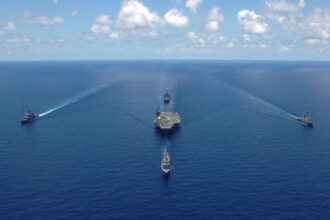
The address came two days before the 11-day Ulchi Freedom Shield exercise, which South Korea and the United States begin on August 17 and which will, for the first time, include scenarios involving North Korean forces that have gained combat experience fighting alongside Russia. North Korea has already condemned the drills as preparations for war and cited them as justification for further strengthening its nuclear deterrent.
With the Ulchi Freedom Shield about to begin and Pyongyang deepening its military partnership with Moscow, Lee’s appeal highlights the widening gap between Seoul’s diplomatic ambitions and the strategic realities shaping North Korea’s calculations. Any future peace initiative is likely to depend not only on inter-Korean relations but also on broader regional dynamics involving the United States, China and Russia.