For most of the twentieth century, military power belonged to the companies capable of pouring the most steel. Lockheed Martin built fighter aircraft, General Dynamics produced tanks, Huntington Ingalls assembled aircraft carriers, and Rheinmetall manufactured artillery. The global defense industry rewarded industrial scale: the largest factories, the biggest workforces and the longest production lines usually determined which companies shaped the future of warfare.
The New Kings of War
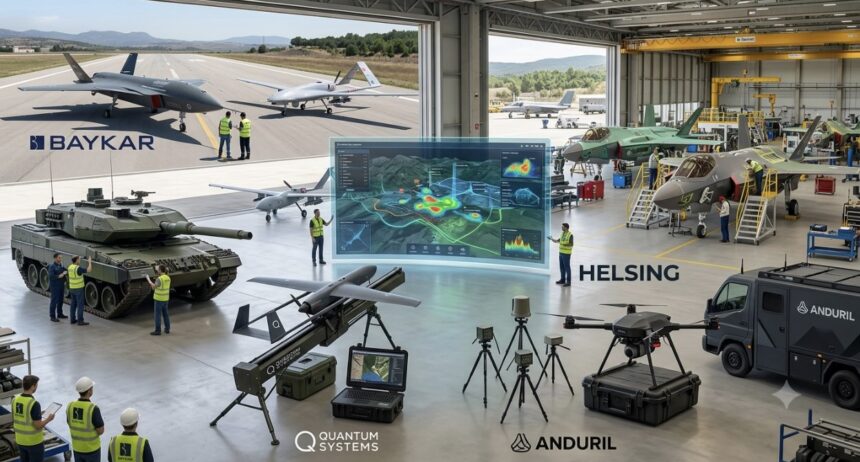
That hierarchy is not disappearing – but it is being fundamentally rewritten. Military innovation is no longer concentrated inside the companies that manufacture the largest platforms. Increasingly, it originates in firms whose greatest assets are software engineers rather than production lines. Companies such as Anduril, Helsing, Shield AI, Baykar and Quantum Systems have become influential not because they outproduce traditional defense contractors, but because they innovate faster, applying commercial software practices to military problems.
This does not mean tanks, fighter aircraft or warships are becoming obsolete. Those platforms remain indispensable and will dominate procurement budgets for decades. What is changing is where decisive innovation occurs. Rather than replacing traditional defense contractors, the new generation of defense-technology companies is changing where innovation originates—and forcing established manufacturers to integrate software, autonomy and artificial intelligence into platforms they continue to build at industrial scale.
Software Is Becoming the Center of Gravity
The defining characteristic of modern military systems is no longer the platform itself but the software running inside it. A drone’s combat value lies less in its airframe than in its ability to navigate autonomously, recognize targets, share data with other systems and adapt through software updates rather than hardware redesign. The same principle increasingly applies to tanks, warships and combat aircraft.
This shift is being enabled by modular software architectures that separate hardware from autonomy. Systems such as Anduril’s Lattice and Shield AI’s Hivemind allow militaries to deploy updated computer-vision models, electronic warfare countermeasures and mission software onto existing hardware without redesigning entire platforms. Traditional weapons programs often required years – or even decades – to deliver major capability upgrades because improvements depended on changing physical components. Software-defined systems evolve continuously instead, compressing development cycles from years into weeks.
The war in Ukraine has accelerated this transformation. Both Russia and Ukraine have repeatedly modified drone software, targeting algorithms and electronic warfare systems in response to rapidly changing battlefield conditions. Companies have been drawn directly into this cycle of adaptation. Quantum Systems, for example, has expanded cooperation with Ukraine by signing a strategic agreement with domestic manufacturer Frontline to increase local production and integrate reconnaissance systems more deeply into Ukraine’s defense ecosystem, according to Ukrainska Pravda.
Military advantage increasingly belongs to those capable of updating code faster than their opponents can adapt.
Why Defense-Tech Firms Are Winning Military Innovation
The rise of companies such as Anduril, Helsing and Shield AI reflects structural changes rather than temporary market trends. Unlike traditional defense contractors, many emerged from the commercial technology sector, where rapid iteration, venture capital and continuous software development are standard business practices. Instead of spending a decade designing a single platform, they refine products through constant feedback and frequent updates.
Their advantage also stems from dual-use technology. Artificial intelligence, cloud computing, computer vision and autonomous navigation are advancing because they serve enormous civilian markets as well as military ones. Defense-tech firms can therefore draw on innovation funded by the wider technology economy instead of relying exclusively on government research programs. The result is a much faster pace of technological change than traditional procurement systems were designed to accommodate.
Equally important is their relationship with end users. Engineers routinely receive direct feedback from military operators and modify systems almost immediately, creating development cycles that resemble modern software companies more than legacy defense manufacturers. In conflicts where battlefield conditions evolve within weeks rather than years, shortening that feedback loop has become a decisive competitive advantage.
The Old Giants Aren’t Disappearing – They’re Adapting
The emergence of defense-tech companies does not signal the decline of established contractors. Modern militaries still require organizations capable of building submarines, ballistic missiles, armored vehicles and advanced combat aircraft – projects that demand manufacturing capacity, certification processes and global logistics networks far beyond the reach of most startups. Software may increasingly define battlefield performance, but industrial warfare still consumes physical hardware at a pace no algorithm can replace.
Legacy defense contractors also possess advantages that software-first companies cannot easily replicate. They have decades of experience certifying complex military systems, managing multinational supply chains, sustaining equipment over service lives measured in decades and navigating export-control regimes. Just as importantly, they have earned the institutional trust of procurement agencies and armed forces – an asset that cannot be built at venture-capital speed. Reliability, long-term support and political credibility remain decisive competitive advantages in the defense market.
Rather than competing directly, the two groups are becoming increasingly interdependent. Established manufacturers contribute industrial scale, integration expertise and sustainment capabilities, while newer firms provide autonomy, artificial intelligence and rapid software innovation. Rheinmetall has expanded aggressively into unmanned systems and digital battlefield technologies, Lockheed Martin continues investing in autonomy and AI, while South Korea’s Hanwha is integrating advanced software across its land and naval portfolios. Increasingly, the future belongs not to one type of company, but to partnerships that combine industrial manufacturing with software-driven innovation.
Tomorrow’s Defense Giants
The next generation of defense leaders may therefore look very different from those of the past. Their competitive advantage will depend less on producing the largest platforms than on mastering the technologies that make every platform more effective: artificial intelligence, autonomous systems, electronic warfare, networking, sensing and human-machine teaming. Control over software ecosystems may become as strategically valuable as ownership of factories.
This shift is also changing the geography of military innovation. Breakthroughs increasingly emerge from technology hubs rather than traditional industrial centers. Ankara has become synonymous with combat drones through Baykar. Munich is establishing itself as a center for defense AI through companies such as Helsing and Quantum Systems. Silicon Valley continues to produce firms including Anduril and Shield AI, while South Korea and Israel increasingly combine advanced manufacturing with software expertise. Military innovation is becoming more distributed, creating a far more competitive landscape than the one that defined the twentieth century.
Yet software alone will not determine the future of warfare. The conflicts in Ukraine and the Middle East have demonstrated that industrial capacity still matters: armies consume drones, missiles, armored vehicles and ammunition at rates that require sustained manufacturing on a massive scale. The companies best positioned for the next decade will therefore be those capable of combining rapid software development with the ability to produce, integrate and sustain military systems at industrial volumes.
The twentieth century rewarded companies capable of producing the most steel. The twenty-first century is increasingly rewarding those capable of producing the most adaptable software. Tanks, aircraft and warships will remain the backbone of military power, but they are becoming platforms for code as much as platforms for weapons. Tomorrow’s defense giants will not necessarily be the companies that build the largest machines. They will be the companies that determine how those machines see, decide and fight – and those able to combine software innovation with industrial scale will define the next era of military power.