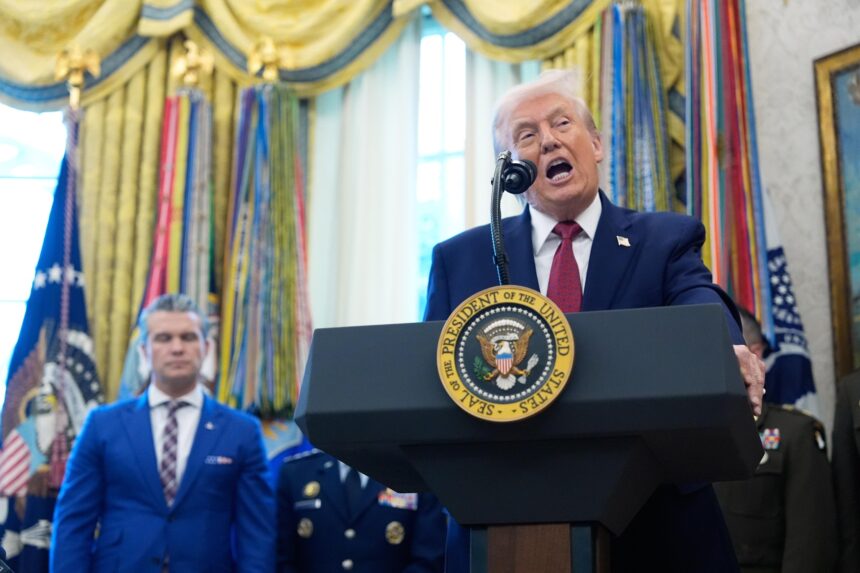
U.S. President Donald Trump announced a new economic offensive against Iran on Wednesday, writing on Truth Social that Washington would launch “the most crushing economic operation ever taken against any country,” which he called “an economic D-day.” The announcement followed the collapse of the latest diplomatic track between Washington and Tehran and came after Trump said no talks with Iran were taking place or scheduled. He said the campaign would target oil smuggling, currency swap lines, cash transfers, exchange houses, shipping registries and front companies sustaining Iran’s economy.
Trump warned that any country allowing its financial institutions, businesses, airports or government entities to aid Iran would face “Tremendous Economic Consequences,” without naming targets. U.S. officials have framed the campaign as an effort to increase economic pressure rather than immediately expand military operations. The warning extends the pressure campaign beyond Tehran itself toward foreign intermediaries – banks, shipping registries and re-export hubs – that have historically helped Iran route trade around sanctions.
The clearest regional move so far came the same day, for a distinct reason: the UAE announced the suspension after saying Iranian missiles had targeted Emirati territory, a claim Tehran rejected. The United Arab Emirates suspended all trade and financial transactions with Iran “until further notice” following the August 18 incident. The UAE has long served as a critical re-export hub helping Iran absorb the impact of Western sanctions.
Whether the campaign proves different from past sanctions rounds depends on pressure applied to Iran’s largest remaining trade partners. China remains Iran’s biggest oil customer, while Russia and Iran have also deepened economic and military cooperation, with recent reports alleging Russian shipments of drone components and explosives to Iran. Enforcement of past sanctions has consistently depended on third-country cooperation that Trump did not name in Wednesday’s post.
The central question is whether this represents a fundamentally different strategy or a louder version of a sanctions system that has struggled for years to close Iran’s external lifelines. Without matching rhetoric with pressure on the trading partners named above, economic isolation risks becoming more of a political message than a decisive constraint on Tehran’s economy. Trump did not specify what enforcement steps would follow the warning, leaving open whether Wednesday’s announcement marks a policy shift or restates existing authorities.