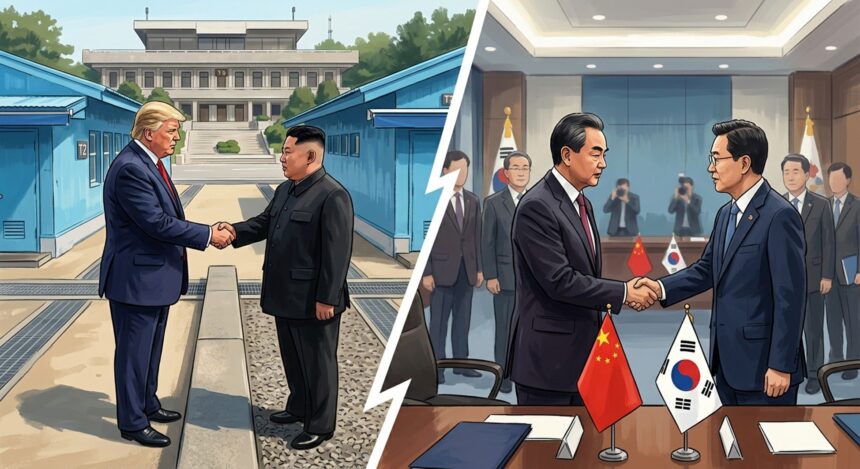
For much of the past two years, the world’s strategic attention has been dominated by Ukraine, the Middle East and growing instability around the Taiwan Strait. Yet this week, another geopolitical flashpoint is quietly moving back into focus. President Donald Trump is pressing aides to arrange a new summit with North Korean leader Kim Jong Un as early as this fall, the Wall Street Journal reported, while Chinese Foreign Minister Wang Yi is visiting South Korea for the first time since 2021. Taken separately, each development is significant. Viewed together, they suggest that Washington and Beijing have simultaneously begun repositioning themselves around the Korean Peninsula.
The timing is unlikely to be accidental. Trump is expected to travel to Asia in November for the Asia-Pacific Economic Cooperation summit, scheduled for November 18 and 19 in Shenzhen, where he is also expected to cross paths with Chinese leader Xi Jinping. According to officials cited by the Journal, Trump has privately discussed meeting Kim during the same trip, reviving the highly personalized summit diplomacy that defined his first term.
Neither initiative necessarily responds directly to the other. But together they reveal a broader strategic reality. After years in which military crises eclipsed diplomacy, Northeast Asia is once again becoming a central arena of great-power competition. The contest is no longer simply over North Korea’s nuclear programme. It is increasingly about who shapes the region’s future security architecture before a new diplomatic cycle begins in Shenzhen.
Trump Returns to Summit Diplomacy
Trump’s reported effort to revive direct engagement with Kim represents a return to one of the defining foreign-policy experiments of his first presidency. Between 2018 and 2019, the two leaders met three times, in Singapore, Hanoi and at the Korean Demilitarized Zone, establishing direct personal contact between the leaders of the United States and North Korea for the first time in decades. None of those meetings produced an agreement on denuclearization or sanctions relief, and North Korea’s nuclear and missile programmes have expanded considerably since the last substantive negotiations collapsed in Hanoi.
This time, the circumstances are markedly different. Trump has privately urged advisers to explore another summit, potentially during his Asia trip in November. Days earlier, he ordered Defense Secretary Pete Hegseth to cut the annual Ulchi Freedom Shield exercise “substantially,” and South Korea’s Joint Chiefs of Staff confirmed that the drill would run only from August 17 to 21, roughly half its usual length. Trump said his “very good relationship” with Kim factored into the decision, though the exercise still began on schedule because officials judged it too late to cancel outright.
The broader question is what Washington now hopes to achieve. South Korea itself has already begun adjusting the language of its North Korea policy. The country’s unification minister said Seoul is shifting from a “denuclearization-first” approach to a “peace-first” one, placing greater emphasis on reducing immediate tensions and securing a nuclear freeze before insisting on dismantlement. Washington has not formally abandoned denuclearization as an objective, but practical diplomacy may increasingly be moving toward risk management, crisis communication and limiting North Korea’s further integration with Russia and China.
China Courts South Korea Before APEC
Beijing’s diplomatic push follows a different logic but serves an equally strategic purpose. South Korea’s Foreign Ministry confirmed that Wang would hold talks with Foreign Minister Cho Hyun on Wednesday, followed Thursday by a courtesy call on President Lee Jae Myung and a working lunch with National Security Adviser Wi Sung-lac. The visit is Wang’s first standalone trip to South Korea since 2021 and gives Beijing an opportunity to shape regional diplomacy before leaders gather in Shenzhen.
China has several reasons to move now. Lee entered office after South Korea’s Constitutional Court removed President Yoon Suk Yeol in April 2025 over his brief imposition of martial law, and Lee won the resulting snap election two months later. His government has adopted a more openly pragmatic posture toward Beijing than Yoon’s while maintaining South Korea’s alliance with the United States. For China, that creates an opening to rebuild influence in Seoul before Washington defines the next phase of diplomacy with Pyongyang.
Beijing also has a structural interest in ensuring that any new peace process does not bypass China. Lee used his August 15 Liberation Day address to propose multiparty talks involving the two Koreas, the United States and China aimed at replacing the unstable 1953 armistice with a formal peace regime. China was a signatory to that armistice, which gives it standing in any future negotiations over the peninsula’s security architecture and guarantees Beijing a role Washington cannot easily remove.
Kim Holds a Stronger Hand Than in 2019
Perhaps the most important difference between today’s diplomatic landscape and the one Trump encountered during his first presidency is Kim Jong Un’s negotiating position. In 2018, North Korea remained heavily constrained by international sanctions and sought economic relief. Seven years later, Pyongyang possesses a larger and more sophisticated nuclear arsenal while benefiting from far closer strategic cooperation with both Russia and China.
Russia’s war against Ukraine has accelerated that transformation. According to a report from the Multilateral Sanctions Monitoring Team, North Korea supplied Russia with more than 11,000 troops, at least 100 ballistic missiles and roughly nine million rounds of artillery and rocket ammunition in 2024 alone, with several thousand additional troops deployed in early 2025. The same monitoring group found that Russia provided North Korea with air-defense equipment, anti-aircraft missiles, electronic-warfare systems and refined petroleum products exceeding UN Security Council limits.
That exchange does more than strengthen North Korea militarily. It weakens the sanctions architecture that helped push Kim toward negotiations during Trump’s first term and gives Pyongyang a source of technology, fuel, revenue and political backing that does not depend on Western engagement. Kim’s government has increasingly treated its nuclear arsenal as permanent and non-negotiable, a shift documented by the Arms Control Association. The consequence is straightforward: Kim no longer needs Washington as much as he did in 2018.
Seoul’s Delicate Balancing Act
South Korea is navigating this altered landscape while pursuing a strategy noticeably different from that of the previous administration. Lee has reaffirmed the U.S. alliance but has simultaneously sought better relations with Beijing and renewed dialogue with Pyongyang. That balancing strategy reflects an unavoidable reality: Seoul depends on Washington for extended deterrence and military support while remaining deeply economically intertwined with China.
Lee is also pushing for greater South Korean strategic autonomy. At a Cabinet meeting Tuesday, he reaffirmed his commitment to regain wartime operational control of South Korean forces from the United States before his term ends in 2030. Seoul has pursued the transfer in stages since regaining peacetime control in 1994, and the government is simultaneously seeking to expand domestic military capabilities, including its proposed nuclear-powered submarine programme.
That effort and Wang’s visit should be read together. A South Korea seeking greater command autonomy while engaging Beijing on a new peace framework is not simply drifting between rival powers; it is attempting to create more room for independent maneuver. But that strategy becomes harder to sustain if Washington and Beijing simultaneously intensify their own engagement with the peninsula, each trying to shape negotiations before Seoul can set the terms itself.
APEC Could Become the Year’s Most Consequential Diplomatic Gathering
These parallel diplomatic tracks are converging on Shenzhen. The APEC summit is formally an economic forum, but this year’s meeting increasingly resembles a geopolitical summit in waiting. A Trump-Xi meeting is widely anticipated, and Trump’s exploration of a parallel meeting with Kim raises the possibility of overlapping diplomatic tracks involving the region’s four most consequential actors.
That could make the summit about far more than trade. Washington could use it to reopen leader-level communication with Pyongyang. Beijing could use it to reinforce China’s centrality to Korean diplomacy. Seoul could press its peace-regime proposal. Pyongyang, if Kim participates indirectly or through a separate meeting, could use the occasion to demonstrate that sanctions and isolation have failed to prevent it from returning to high-level diplomacy on stronger terms.
Even the choreography would matter. Who meets whom, which talks come first and who is excluded would signal where influence lies before formal negotiations begin. That makes APEC not merely a venue but a potential testing ground for a new regional diplomatic order.
The Korean Peninsula Returns to the Center of Strategic Competition
The significance of this week’s developments lies less in any single initiative than in their convergence. Trump’s outreach to Kim, Wang’s engagement with Seoul and Lee’s attempts to balance relations with both Washington and Beijing are unfolding within days of one another, suggesting that all three capitals believe the diplomatic landscape around the peninsula is entering a new phase.
Unlike in 2018, however, Washington no longer controls the initiative. North Korea is militarily stronger, Russia has become an active strategic partner for Pyongyang, and China has every incentive to ensure that it remains indispensable to any settlement. Rather than a straightforward revival of Trump-era summit diplomacy, the region is moving toward a more complicated system in which the United States, China, South Korea and North Korea each pursue overlapping but often competing objectives.
Whether another Trump-Kim summit ultimately materializes remains uncertain. But even before any meeting takes place, the strategic balance has already changed. In 2018, Washington largely set the diplomatic agenda and Beijing reacted to it. In 2026, no single actor can do that. The Korean Peninsula is once again becoming a central arena of global strategic competition, and the emerging contest is no longer only about North Korea’s nuclear weapons. It is about who gets to write the rules for Northeast Asian security in the decade ahead.
#NorthKorea #Trump #KimJongUn #China #SouthKorea #APEC #IndoPacific #Diplomacy #Geopolitics #Analysis