The war in Gaza has entered another volatile phase, with mounting concerns that the conflict could widen beyond the territory’s borders despite sustained diplomatic efforts to prevent a broader regional confrontation. While military operations continue inside Gaza, parallel tensions involving Israel, armed groups across the region, and Iran’s network of allies have heightened fears that a localized war could evolve into a wider Middle East security crisis.
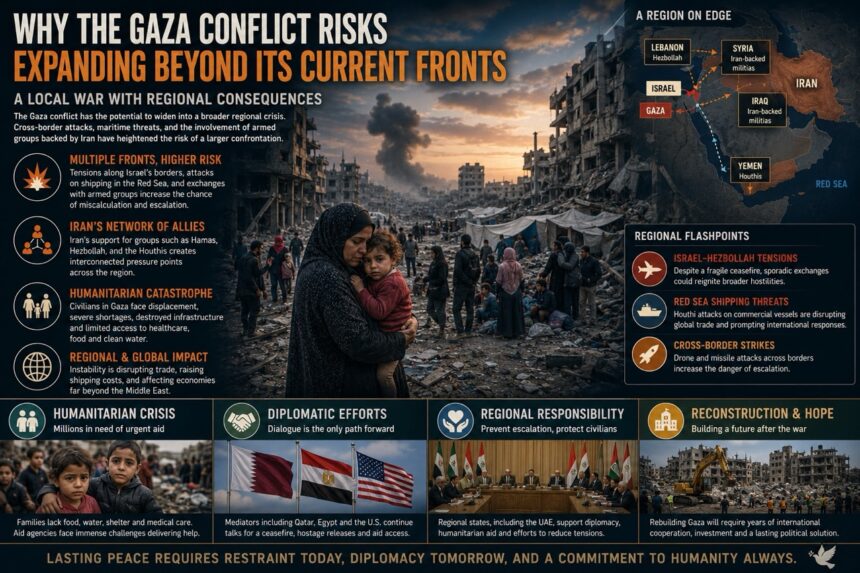
Although regional actors have so far avoided a full-scale multi-front conflict, analysts caution that the growing frequency of cross-border strikes, maritime security incidents and military exchanges has increased the risk of miscalculation at a time when humanitarian needs remain overwhelming.
For civilians, however, the strategic calculations of governments and armed groups are overshadowed by the daily realities of survival.
Across Gaza, families continue to struggle with repeated displacement, shortages of clean water, limited access to healthcare and damaged infrastructure. Parents search for food while children grow up amid interrupted schooling and constant uncertainty. Many residents have been displaced several times since the conflict began in October 2023, often moving from one temporary shelter to another with little assurance of safety.
“We keep moving because we are told to move,” one displaced resident said through a humanitarian organisation working in central Gaza. “Every place we reach feels temporary.”
According to the United Nations, the humanitarian situation remains among the most severe in the world. Large sections of Gaza’s housing, healthcare facilities, water systems and electricity infrastructure have been damaged or destroyed, while humanitarian agencies continue to warn of acute food insecurity and the risk of disease outbreaks. Delivering aid remains extremely difficult because of ongoing hostilities, damaged roads and restrictions affecting humanitarian access.
Beyond Gaza itself, regional security dynamics have become increasingly interconnected.
Israeli forces continue operations against Hamas in Gaza, while maintaining a heightened military posture along other fronts. Although the ceasefire with Hezbollah that followed last year’s conflict along the Israel-Lebanon border has largely held, periodic exchanges of fire and mutual accusations underscore how fragile the situation remains. Military analysts say any significant escalation on that frontier could rapidly draw additional actors into the conflict.
The Red Sea also remains an area of concern. Attacks on commercial shipping by Yemen’s Houthi movement have disrupted one of the world’s most important maritime trade routes, prompting continued multinational naval operations aimed at protecting freedom of navigation. Shipping companies have rerouted vessels around southern Africa in many cases, increasing transport costs and delivery times for global trade.
Analysts argue that these interconnected theatres illustrate how instability in one part of the Middle East can quickly produce economic and security consequences far beyond the immediate battlefield.
“There are multiple pressure points across the region,” said a Gulf-based security researcher. “The objective for regional diplomacy is to ensure that none of these isolated incidents become part of a much larger confrontation.”
Iran remains central to those calculations.
Western governments and Israel have long accused Tehran of supporting armed groups across the region, including Hamas, Hezbollah and the Houthis. Iranian officials maintain that these groups make their own operational decisions while expressing political support for the Palestinian cause. This complex network of relationships continues to shape regional security calculations and complicates diplomatic efforts aimed at reducing tensions.
Meanwhile, ordinary people across the wider region increasingly feel the indirect effects of prolonged instability.
Business owners in neighbouring countries report that regional uncertainty has affected tourism, investment and cross-border commerce. Humanitarian organisations working in Egypt, Jordan and Lebanon continue to support vulnerable communities while preparing contingency plans should displacement increase further.
For aid workers inside Gaza, immediate priorities remain clear.
Medical teams continue operating under exceptionally difficult conditions, often with limited equipment and intermittent electricity. Relief agencies say ensuring reliable humanitarian access remains essential to preventing further deterioration in public health, particularly for children, pregnant women and elderly residents.
The United Nations has repeatedly called for the protection of civilians, the release of all hostages, respect for international humanitarian law and significantly expanded humanitarian access. International humanitarian organisations have similarly urged all parties to facilitate the safe delivery of food, medicine and essential supplies.
Diplomatic efforts continue despite repeated setbacks.
Qatar, Egypt and the United States remain actively engaged in mediation aimed at securing a ceasefire, facilitating hostage releases and expanding humanitarian assistance. While negotiations have repeatedly stalled, diplomats argue that sustained dialogue remains the most credible pathway toward reducing violence and creating conditions for broader political discussions.
Arab countries have continued to advocate a comprehensive political solution that addresses both immediate humanitarian needs and the longer-term aspirations of Israelis and Palestinians. Gulf states, including the United Arab Emirates, have consistently emphasised dialogue, civilian protection and humanitarian assistance while supporting international efforts to prevent further regional escalation.
The UAE has also maintained significant humanitarian operations for civilians affected by the conflict, including medical assistance, relief shipments and support for vulnerable families through cooperation with international organisations. Emirati officials have repeatedly stressed that lasting stability depends not only on ending hostilities but also on rebuilding institutions, restoring essential services and creating credible political pathways that address the root causes of the conflict.
Reconstruction, whenever conditions permit, will represent one of the largest challenges facing the international community.
Experts estimate that rebuilding homes, hospitals, schools, water systems and electricity networks across Gaza will require many years of sustained international cooperation and substantial financial support. Equally important will be restoring economic activity, supporting small businesses and creating employment opportunities that allow displaced families to rebuild their lives with dignity.
For many civilians, however, discussions about reconstruction remain secondary to the immediate need for safety.
Parents continue searching for food, clean water and medical treatment. Teachers organise informal lessons wherever possible. Doctors work through repeated shortages. Humanitarian volunteers distribute supplies despite enormous logistical obstacles.
These individual acts of resilience offer reminders that even amid conflict, communities continue to invest in their future.
The wider Middle East has experienced repeated cycles of conflict and recovery over many decades. Diplomats across the region argue that preventing further escalation requires sustained engagement, confidence-building measures and practical cooperation that prioritises human security alongside national security.
Whether the Gaza conflict remains geographically contained or expands into a broader regional crisis will depend not only on military developments but also on the willingness of regional and international actors to maintain dialogue, exercise restraint and support humanitarian initiatives that reduce suffering while creating space for a durable political settlement.
For millions of civilians whose lives have been transformed by war, the hope remains that diplomacy, reconstruction and peaceful coexistence will eventually replace the uncertainty that has defined the region for far too long.