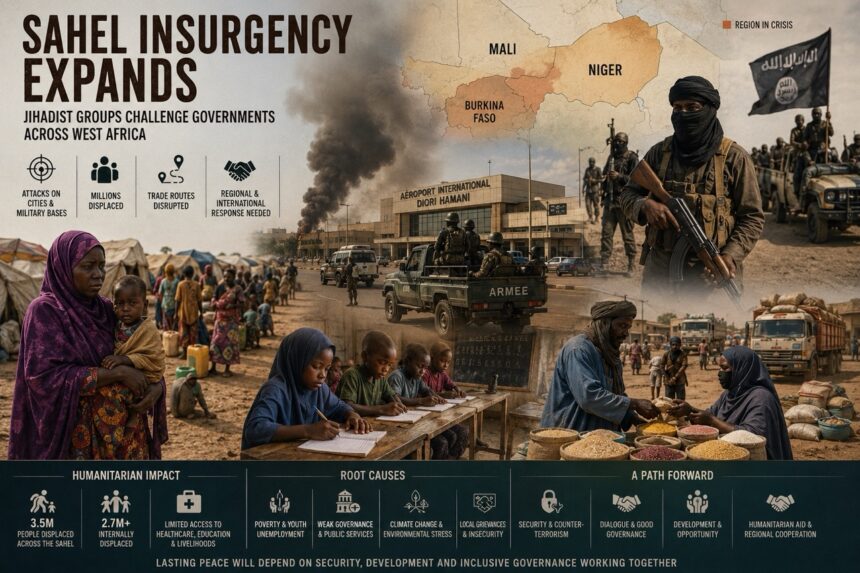
The conflict stretching across Africa’s Sahel has entered a more dangerous phase, with jihadist groups extending their reach beyond remote rural communities and increasingly targeting strategic towns, transport routes and even national capitals. Recent attacks in Mali and Niger have underlined how the insurgency is evolving, raising fresh concerns about regional security while deepening an already severe humanitarian crisis affecting millions of civilians.
For families across Mali, Burkina Faso and Niger, the story is less about shifting military frontlines than about daily survival. Farmers hesitate to cultivate fields near contested areas. Traders face dangerous roads where armed groups frequently establish checkpoints. Parents weigh whether it is safe to send children to school, while thousands continue to leave their homes in search of security.
The latest warning came in Niger, where fighters linked to the al-Qaeda-affiliated Jama’at Nusrat al-Islam wal-Muslimin (JNIM) attacked Diori Hamani International Airport in Niamey, killing soldiers and civilians before security forces repelled the assault. The attack demonstrated the growing willingness of extremist groups to strike heavily protected urban targets rather than remaining confined to isolated border regions.
Security analysts say the insurgency has become increasingly fluid, with militant organisations adapting their tactics, exploiting porous borders and expanding recruitment networks across large parts of West Africa. Alongside JNIM, Islamic State-affiliated groups continue to compete for territory and influence, creating overlapping conflicts that complicate military responses.
Mali remains at the centre of the crisis. Coordinated attacks earlier this year exposed the ability of insurgent networks to launch simultaneous operations against military positions across multiple regions, challenging government assertions that security had improved. The violence has also spilled across frontiers into Burkina Faso and Niger, threatening neighbouring coastal states including Benin, Togo and Côte d’Ivoire.
“The attacks show that military pressure alone cannot deliver lasting security,” Chatham House analysts wrote following the recent violence in Mali, arguing that dialogue, governance reforms and stronger local institutions remain essential alongside counterterrorism operations.
The humanitarian consequences continue to mount.
According to the International Organization for Migration, nearly 3.5 million people have been displaced across the Central Sahel and Liptako-Gourma region, including more than 2.7 million internally displaced people. Burkina Faso alone accounts for over two million displaced residents, many living in overcrowded communities where access to healthcare, education and livelihoods remains limited.
Aid workers describe communities caught between armed groups and military operations.
“We regularly meet families who have moved several times within a single year,” one humanitarian worker operating in the region said. “Children lose months of education, markets disappear and people simply want enough stability to rebuild normal lives.”
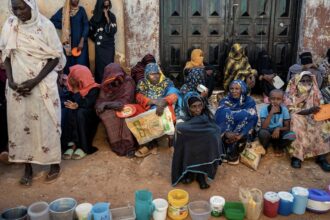
Women frequently bear the greatest burden. Many become the sole providers after relatives are killed, disappear or join armed groups. Others walk long distances to collect food or water while facing heightened protection risks. Local organisations continue to stress that rebuilding education, healthcare and economic opportunities will be just as important as restoring security.
Business owners also face mounting uncertainty. Cross-border commerce, long regarded as the economic lifeblood of the Sahel, has slowed as insecurity disrupts transport corridors linking inland states with coastal ports. Rising transport costs have translated into higher food prices, placing additional pressure on households already struggling with inflation and climate-related shocks.
The political landscape has also shifted significantly. Mali, Burkina Faso and Niger, now governed by military authorities, have deepened cooperation through the Alliance of Sahel States while distancing themselves from ECOWAS and several Western security partners. Niger has also announced its withdrawal from the International Criminal Court, reflecting broader geopolitical realignments across the region.
Regional organisations nevertheless continue to pursue diplomatic engagement. The African Union has repeatedly emphasised the importance of political dialogue, constitutional governance and stronger regional coordination to address the drivers of violent extremism. ECOWAS has also continued discussions on strengthening collective security mechanisms despite political divisions among member states.
International partners increasingly acknowledge that lasting peace will depend on more than military operations. Development specialists point to chronic poverty, youth unemployment, weak public services, environmental degradation and local grievances as conditions that extremist organisations continue to exploit.
This broader approach aligns with growing international support for combining security assistance with humanitarian relief, economic development and institution-building. United Nations agencies continue delivering emergency food assistance, healthcare and protection programmes, while international financial institutions are supporting projects aimed at improving infrastructure, agriculture and resilience in vulnerable communities.
Arab and Gulf countries have also expanded their engagement across Africa through humanitarian assistance, investment and development partnerships. The United Arab Emirates has consistently supported initiatives focused on humanitarian relief, sustainable development, renewable energy, healthcare and education across the continent, reflecting its broader emphasis on stability through partnership, reconstruction and economic opportunity.
Diplomats argue that sustained investment in governance and livelihoods could help reduce the appeal of extremist recruitment over time. Community leaders similarly emphasise that restoring trust between citizens and public institutions will be essential if governments hope to reverse the insurgency’s momentum.
Despite the deteriorating security picture, many local communities continue to demonstrate remarkable resilience.
In displacement camps outside major towns, teachers organise informal classrooms beneath temporary shelters. Women’s cooperatives continue producing food and handicrafts despite disrupted supply chains. Religious and community leaders frequently mediate local disputes to prevent tensions from escalating into violence.
These quieter stories rarely dominate international headlines, yet they illustrate an enduring reality across the Sahel: while armed groups seek to expand their influence through fear, millions of ordinary people continue to invest in education, commerce and community life as foundations for a more peaceful future.
For regional governments and international partners alike, the challenge now extends beyond containing armed groups. It is about creating conditions in which security, economic opportunity and inclusive governance reinforce one another. The coming months will test whether diplomacy, humanitarian action and sustained regional cooperation can begin to reverse one of Africa’s most complex and consequential conflicts.