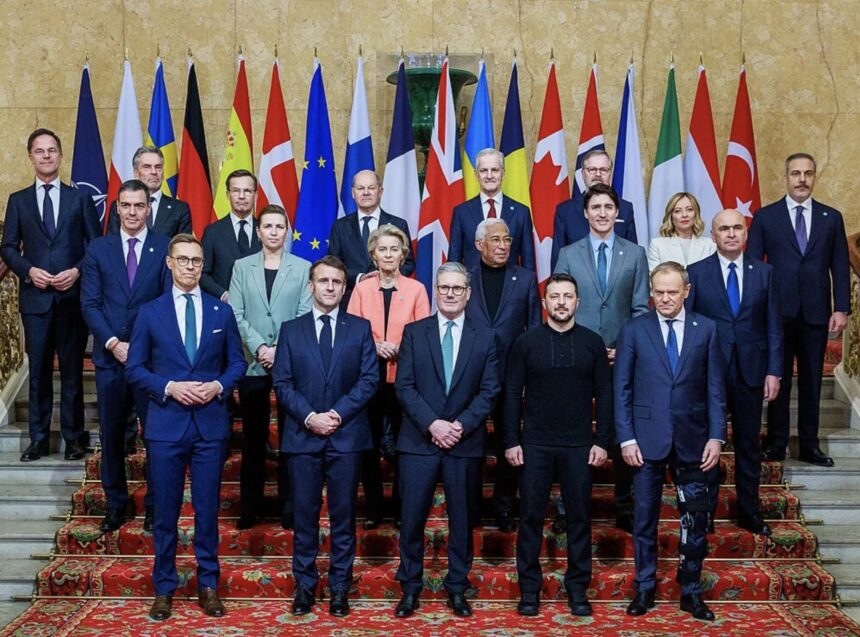
France, Germany and Britain don’t trust Washington to negotiate on their behalf, so they’re quietly building their own seat at the table. Wary that President Trump could strike a deal with Moscow that leaves Europe out entirely, the three powers are working to lock in a formal European role in any future Russia-Ukraine settlement, according to The New York Times, which cited five European officials. France and Germany are leading the push; Britain, under a new prime minister, is more cautious about testing ties with Washington. The stakes go beyond diplomacy alone: Europe is already funding Ukraine’s war effort and is expected to provide security guarantees after any settlement, meaning it has as much riding on the outcome as Kyiv or Moscow.
Europe’s Real Leverage
Europe’s push isn’t only anxiety. It rests on hard financial leverage. The EU controls roughly €210 billion ($246 billion) of Russia’s frozen sovereign assets, the bulk of it sitting in Belgium’s Euroclear clearing house. That EU total is part of a wider G7-wide pool of about $300 billion in immobilized Russian central bank reserves, according to the Council on Foreign Relations; no settlement can fully unlock without European sign-off.
The politics of that money are already contentious. EU governments moved in December 2025 to freeze the funds indefinitely, largely to reassure a wary Belgium as the bloc considers using the reserves to back a loan of up to €165 billion for Ukraine’s 2026-2027 military and civilian budget needs. Russia’s central bank has already sued Euroclear in Moscow courts over the freeze, and Hungary and Slovakia, both friendlier to Moscow than most EU members, have periodically threatened to block the sanctions renewals that keep the freeze in place, since EU sanctions require unanimous member-state approval. The EU has adopted 21 sanctions packages against Russia since the invasion; each renewal is a fresh opportunity for a single capital to complicate Europe’s leverage.
Any durable peace will also hinge on EU sanctions relief and access to European reconstruction financing for Ukraine’s rebuilding. Together, these give Brussels and its member states substantial influence over how a peace is actually enforced, regardless of what Washington and Moscow agree bilaterally: Moscow cannot simply have its reserves released by a US-brokered handshake if European regulators don’t sign off.
A Fraying Front
Not every European capital trusts the Franco-German-led format meant to represent them. Officials told the Times that smaller states near Russia and Ukraine, particularly the Baltic countries and Hungary, are wary that Germany and France will not fully represent their interests in any negotiation, a concern sharpened by the fact that Baltic officials have openly treated any direct outreach to Moscow as playing into Russia’s hands rather than advancing Europe’s position.
That friction became public in June. Ukrainian President Volodymyr Zelensky met the leaders of Britain, France and Germany in London on June 7 to discuss Europe’s role in future talks and lay out principles for any agreement. Four days later, the three countries’ ambassadors held an unusual meeting in Moscow with Russian deputy foreign minister Mikhail Galuzin, who handles the Ukraine file. Galuzin used the meeting to accuse the three powers of pushing Ukraine to keep fighting Russia rather than seeking peace.
Around the same time, the EU tried its own opening: Zelensky asked European Council President António Costa to raise Ukraine directly with Moscow, and Costa’s chief of staff, Pedro Lourtie, spoke with Russian officials including Yuri Ushakov, the main Kremlin contact for US envoy Steve Witkoff. Costa argued Europe could not simply rely on others to interpret Russian signals and needed to deliver its own messages directly, though he acknowledged there were no credible signs Moscow wanted serious negotiations at that point. The outreach split opinion inside Europe itself: France and Germany accused Costa of overstepping his role, Austria and Belgium backed him, and the Baltic states dismissed the approach altogether as playing into Russia’s hands. EU foreign policy chief Kaja Kallas tried to thread the needle, acknowledging the E3’s outreach while insisting it was too early to settle who exactly should represent Europe at the table, so long as core interests like sanctions relief and the asset freeze were protected.
French President Emmanuel Macron has said Europeans will need to be present whenever real negotiations happen, and that Costa would have a role within whatever mandate is eventually defined for him. German Chancellor Friedrich Merz has defended the E3’s leading role on more practical grounds: Britain, France and Germany are Europe’s major military powers and its largest contributors to Ukraine’s defense, which he argues gives their coordination a natural logic. Even Merz, though, has deferred the harder question of who exactly speaks for the EU as a bloc until negotiations are actually underway.
The Clock Is Ticking
Behind the diplomacy sits a harder deadline: the war itself. Western officials and analysts told the Times they expect fighting to grow more destructive as Russia presses a winter offensive against Ukrainian lines and civilian infrastructure, just as Kyiv’s air defenses run short.
Some expect Putin to order a modest mobilization, but only after Russia’s parliamentary elections in mid-September. This sequencing suggests the Kremlin wants to avoid the domestic disruption of a draft during a politically sensitive vote. Others fear a cornered Putin could escalate against NATO states to test alliance solidarity.
Putin insists Russia must gain full control of Donbas before he’ll consider talks. Officials say that if Russian forces cannot take it by autumn 2027, negotiations become more likely, meaning Europe’s push for a seat at the table may be a rehearsal for a summit that is still more than a year away.
Not everyone in Europe is convinced the rehearsal matters. German lawmaker and security expert Norbert Röttgen has argued that with Putin showing no genuine interest in talks, Europe risks indulging in wishful thinking, though he maintains Europe will eventually need a seat regardless, since Washington no longer treats European security as a vital American interest, and Putin benefits from exactly this kind of transatlantic drift. Mark Leonard of the European Council on Foreign Relations has gone further, arguing that Europe’s failure to maintain direct channels to Moscow since the 2022 invasion amounts to a serious dereliction of duty given how much is at stake.
Former German diplomat Hans-Dieter Lucas, who helped negotiate the 2015 Iran nuclear deal, put it starkly: Europe has real cards to play, but it has to play them smartly. Without close coordination with Washington, he warned, “the Russians drive wedges between us” — and in a war this long, a wedge is all it takes to lose a seat that was never guaranteed in the first place.