Azerbaijan is seeking U.S. assistance with advanced landmine-clearing technology, arguing that faster detection and removal of mines has become the biggest obstacle to rebuilding territories under its control after decades of conflict with Armenia. Azerbaijani Ambassador to the United States Khazar Ibrahim told Axios that Baku hopes Washington can help accelerate mapping, detection and clearance efforts in one of the world’s most heavily mine-contaminated countries. The appeal comes as Washington, Yerevan and Baku marked the first anniversary of the White House Peace Summit, where President Ilham Aliyev and Prime Minister Nikol Pashinyan signed a joint declaration committing to end the decades-long conflict, although a comprehensive peace treaty has yet to be signed and ratified.
The contamination is the legacy of decades of conflict, including extensive defensive minefields laid along the former Line of Contact and unexploded ordnance left behind as territory changed hands during successive wars. Armenian authorities have transferred hundreds of minefield maps to Azerbaijan, but ANAMA says many have proved incomplete or insufficiently accurate, limiting their operational value and slowing clearance efforts across territory now administered by Baku.
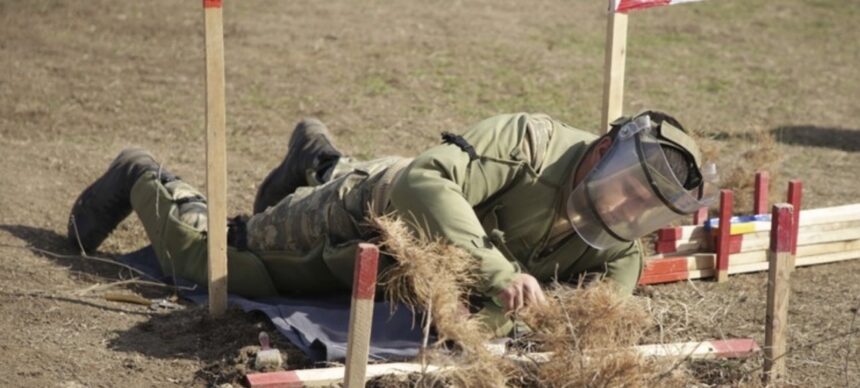
The Azerbaijan National Agency for Mine Action (ANAMA), the state body responsible for clearance, has significantly expanded its operations in recent years while introducing increasingly mechanized methods of removing explosive hazards. Official estimates place more than one million landmines and an unknown quantity of unexploded ordnance across roughly 12% of Azerbaijan’s territory, making it one of the world’s most heavily contaminated countries relative to its size. Large areas nevertheless remain hazardous, slowing housing projects, transport infrastructure, agricultural rehabilitation and broader economic recovery.
Ibrahim told Axios that Azerbaijan is looking for advanced U.S. demining technologies and techniques capable of accelerating clearance while reducing risks to personnel. Potential capabilities include improved remote sensing, geospatial analysis, unmanned systems and more efficient mechanical clearance technologies, although neither Baku nor Washington has detailed what specific assistance could ultimately be provided. The request also reflects Azerbaijan’s broader effort to deepen cooperation with the United States in technology, defense and other strategic sectors.
The request carries significance beyond humanitarian mine action. Clearance is a prerequisite for Azerbaijan’s “Great Return” programme, which aims to resettle internally displaced people in Karabakh and surrounding districts after decades of displacement. It is also essential for restoring transport links, rebuilding energy and communications infrastructure and advancing economic development across former conflict zones. Contaminated land continues to delay Baku’s efforts to establish full administrative and economic control over territories returned to Azerbaijani authority following the 2020 war.
U.S.-Azerbaijan cooperation on demining predates the current request and forms part of a broader bilateral relationship that has expanded over the past year. The U.S.-based Marshall Legacy Institute has donated 93 mine-detection dogs to ANAMA since 2005, making mine action one of the longest-running areas of practical cooperation between the two countries. That relationship was further strengthened in February when Vice President JD Vance traveled to Baku and signed a Charter on Strategic Partnership with President Aliyev covering energy, digital connectivity, defense dialogue and maritime security, although the agreement does not specifically commit Washington to providing demining technology.
Whether the United States ultimately agrees to supply advanced mine-clearing capabilities remains unclear. Azerbaijan’s appeal nevertheless illustrates how the South Caucasus is entering a new phase in which the success of the peace process will depend not only on diplomacy but also on the painstaking work of removing the physical legacy of decades of war. Clearing contaminated land has become a prerequisite for reconstruction, the return of displaced civilians and the restoration of normal economic life.