Two wars, fought thousands of kilometers apart, are converging on the same insight: the United States only has so many Patriot interceptors, and its adversaries have started counting them. From the deserts of Jordan to the skies over Kyiv, Iran and Russia are running versions of the same campaign – pairing cheap, disposable drones with expensive, hard-to-stop ballistic missiles, forcing American and Ukrainian defenders to burn through their most valuable interceptors just to stay even. Neither country is hiding the logic. Both have studied the other’s battlefield, and both now know that a stockpile built for a Cold War threat has a bottom, and that bottom is closer than Washington would like to admit.
Iran’s Layered Assault in the Gulf
Iranian forces have spent recent months refining a strike formula built to drain American air defenses rather than simply overwhelm them outright, according to reporting carried by Yahoo News, citing The New York Times. During five days of bombardment against U.S. positions in Jordan last month, Iranian units combined ballistic missiles, cruise weapons and drone swarms specifically to force costly interceptor launches rather than relying on raw volume alone.
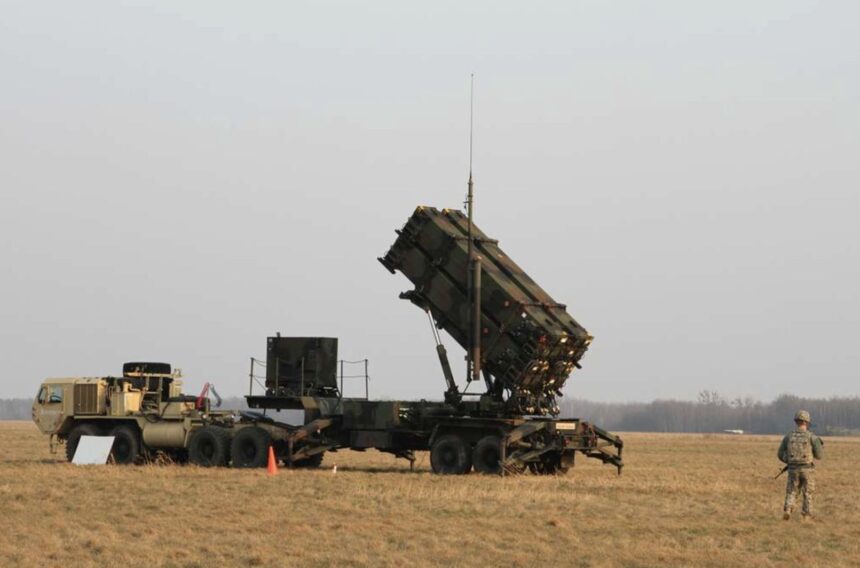
The tactic drew blood on July 17, when a strike breached defenses at Muwaffaq Salti Air Base, killing three U.S. service members and wounding more than 100. Secretary of State Marco Rubio acknowledged the gap directly: “We shot down almost all the missiles. One leaked through.” U.S. forces fired roughly 50 Patriot interceptors – at about $4 million each – in a single day during the July escalation, and have expended more than 1,500 over the course of the conflict.
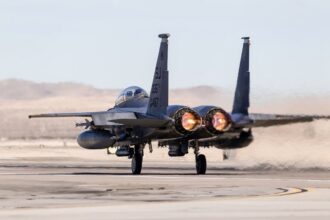
The pattern was visible earlier too. In April, a U.S. military official told the Times that Iran had used a drone swarm to feed real-time coordinates to ground crews before downing an F-15E Strike Eagle with a Chinese-made, shoulder-fired MANPADS — the first U.S. combat aircraft shot down by enemy fire in over two decades, according to Critical Threats. Both crew members ejected safely.
Familiar Playbook in Ukraine
Roughly 2,500 kilometers north, Russia is running a strikingly similar campaign against a strikingly similar shortage. Ukraine’s military intelligence agency said this month that Moscow has been reprioritizing ballistic and cruise missile production since April specifically to exploit Kyiv’s dwindling Patriot stocks, according to Critical Threats, which tracks Russian ballistic missile launches more than tripling between April and July.
The imbalance shows up starkly in interception data. In July, Ukraine shot down 87% of the drones and cruise missiles Russia fired at it – but only 15% of ballistic missiles, because its supply of PAC-3 interceptors, the only weapon that reliably kills an incoming Iskander-M in its terminal dive, ran dry around July 1, according to Modern Diplomacy. Russian barrages killed 17 people in Kyiv on Aug. 5 after the capital’s air defenses failed to intercept a single incoming missile, NPR reported.
Zelensky has said Ukraine holds only about 1% of the interceptors it needs. On July 28, he met with Lockheed Martin representatives to discuss license-building a Ukrainian version of the PAC-3 itself, according to Defense One – a sign Kyiv no longer expects the shortfall to be solved through donations alone.
The Economics of Exhaustion
What links both fronts is not just scarcity but a lopsided cost equation. High-tier interceptors like the PAC-3 MSE and THAAD are built to stop the most dangerous threats – ballistic missiles – and cost millions of dollars per round. Cheaper saturation tools, from Shahed-style drones to decoy rockets, exist precisely to force defenders into firing those expensive interceptors at low-cost threats, thinning the high-tier magazine before the real strike arrives.
American industry delivered roughly 620 PAC-3 MSE interceptors in 2025 – a record – but that still falls far short of wartime expenditure that has exceeded 1,500 rounds in the Iran conflict alone, according to Defense Security Asia. CSIS analysts Mark Cancian and Chris Park estimated the U.S. Patriot inventory has fallen from roughly 2,330 interceptors before the Iran war to between 759 and 827, YourNews reported.
The mismatch is structural, not incidental. More than 18 countries operate Patriot systems and draw on the same production lines, according to Defense Security Asia, meaning a surge in demand from any one theater tightens supply for all the others at once. Unlike a drone or short-range rocket, a PAC-3 MSE cannot be built to order overnight – its guidance electronics, seeker head and rocket motor depend on a supply chain that takes months to scale, even under expanded contracts.
One Stockpile, Three Fronts
That allocation problem is no longer theoretical. To sustain operations against Iran, the Pentagon has shifted interceptor stocks out of positions prepositioned for the Indo-Pacific, leaving other combatant commands operating with thinner margins than military planners consider ideal, particularly as Washington seeks to deter China around Taiwan, according to CBS News. Around the same time, the Defense Department reportedly paused some interceptor deliveries to Ukraine, citing concerns about U.S. supplies, TWZ reported via Yahoo News.
The Pentagon continues to reject the framing publicly. “Claims of U.S. munition shortages are false,” chief spokesman Sean Parnell said in a statement reported by Snopes, adding that such coverage emboldens adversaries. But the underlying numbers are now public enough that the denial and the arithmetic sit side by side uneasily.
Modern Diplomacy captured the dynamic with an energy-market analogy worth borrowing: this is “Missile OPEC” – a world in which Taiwan, Ukraine and Saudi Arabia all draw simultaneously on a single global interceptor stockpile the Pentagon’s own accounting puts at under 800 rounds. Three fronts, one week, the same missile running short in each. That is not a coincidence of timing – it is what happens when a Cold War-era weapon becomes the ceiling on a three-front strategy, and both separate adversaries, an ocean apart, have both figured out exactly where that ceiling is.