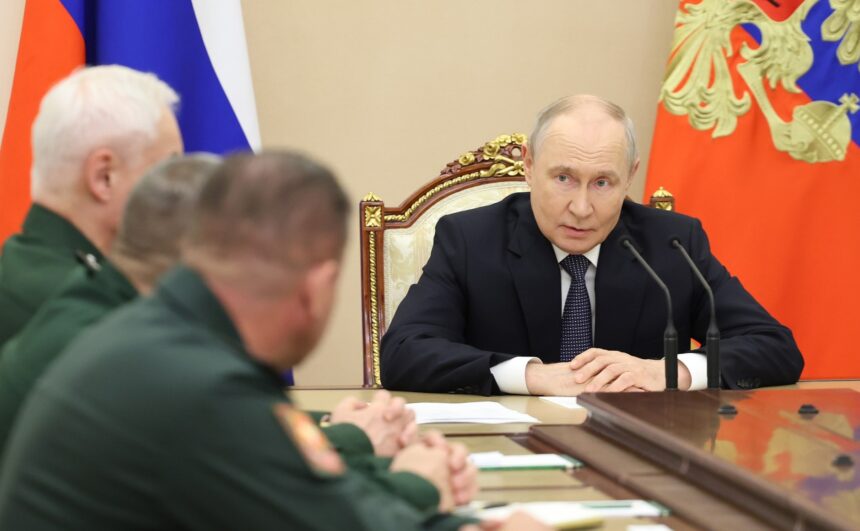
Russian President Vladimir Putin has appointed Denis Lyamin to command Russia’s new Unmanned Systems Forces and reassigned the senior officers running the war in Ukraine, a reshuffle that points less to confidence than to adaptation after years of failed quick-victory assumptions. Lyamin was previously chief of staff of the Centre grouping, the formation Putin himself described as central to Moscow’s drive to capture the rest of Donetsk region. Putin called the changes a “refinement” of the military structure, now in the fifth year of a war Russia entered in 2022 expecting to win in weeks.
The Reshuffle
Centre commander Valery Solodchuk has been moved to oversee all military logistics, while Andrei Ivanayev, previously commanding the Eastern grouping, replaces him. In bureaucratic language this is a promotion and rotation; in strategic terms it pulls a front-line Donetsk commander into the rear-support apparatus that must feed, arm and sustain the campaign. Putin is placing battlefield survivors over the systems Russia now needs most: drones, supply lines, and the stalled push on Donetsk.
The drone appointment matters most. Drones now shape assaults, reconnaissance, artillery correction, deep strikes and naval operations in this war. Reuters noted both sides use them along the full 1,200-kilometre front, at sea, and against rear-area targets like energy infrastructure and warehouses. Russia is catching up rather than innovating: Ukraine built its own Unmanned Systems Forces first and announced a separate long-range strike command last month. Moscow’s move is an admission that the drone war has become permanent enough to need its own hierarchy.
The Command Pattern
None of the men being promoted are outsiders brought in to fix the system – the same war that exposed its early failures formed them. This should be stated carefully: public records do not tie Lyamin or Ivanayev to specific war crimes, and Solodchuk’s public profile is that of a long-serving Ukraine-war commander, not an officer formally designated for a named atrocity. They are battlefield adaptors on the current record, not established atrocity cases.
The wider pattern is nonetheless clear. Earlier this year Putin placed Colonel General Alexander Chayko atop Russia’s Aerospace Forces. Chayko is unconnected to this week’s drone appointment, but the EU sanctioned him in March as the most senior Russian officer on the ground in Ukraine at the invasion’s outset and lead commander when Russian troops entered Bucha. Battlefield failure gets managed through reassignment in Putin’s system; association with the war’s gravest crimes does not reliably block senior command. Chayko has since become a target himself: an explosion at a Moscow restaurant on August 1, during what Russian sources described as his 55th-birthday celebration, killed at least three people and injured more than twenty, and a source told the Kyiv Independent he was the intended target; Russian authorities have not confirmed whether Chayko himself was harmed.
Putin was explicit that the Centre grouping remains central to seizing all of Donetsk, still a core Russian war aim. The stakes of that pressure were visible hours before this reshuffle was announced: a Russian missile and drone barrage on Kyiv killed 17 people and wounded 44 overnight, with Ukrainian air defences failing to intercept a single one of the 24 ballistic missiles fired. That combination – grinding front-line pressure alongside long-range strikes on civilian and logistics targets – is the war this reshuffle is built to sustain, not end. Putin is punishing failure in the only way his system allows: not by abandoning the war, but by reorganising it.